
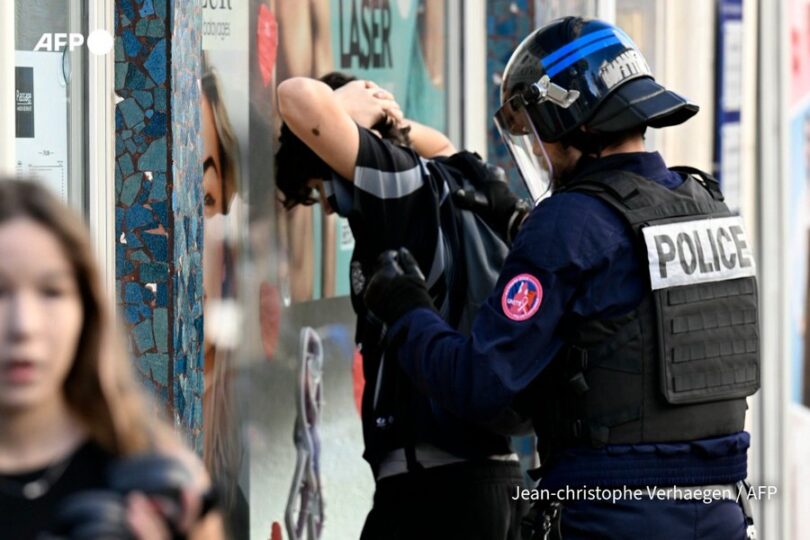
A 15-year-old student lost a hand on Monday as protests by French high school students over classroom conditions escalated into clashes with police, leaving more than 200 students injured. The protests, which began in late September, have spread across France as students at high schools, known as lycees, demand improved……
A 15-year-old student lost a hand on Monday as protests by French high school students over classroom conditions escalated into clashes with police, leaving more than 200 students injured.
The protests, which began in late September, have spread across France as students at high schools, known as lycees, demand improved learning conditions.
More than 500 of the country’s 3,700 lycees were fully or partially closed on Monday as demonstrations intensified.
Larger protests, dubbed “Act III” by a secondary school students’ union, are expected on Tuesday, with calls circulating on social media for a “black week” of demonstrations.
The 15-year-old lost his hand in the northern town of Lens when he picked up a sting-ball grenade fired by riot police and it exploded, according to a police union source.
The teenager, hospitalised in Lille, is “out of danger”, said Francois-Xavier Lauch, the prefect for the northern Pas-de-Calais region.
Another protester, aged 16, who suffered serious head injuries at a protest in the central city of Tours last week has lost the use of one eye, prosecutors said.
READ ALSO: About 500 Schools to Close Amid Student Protests In France
The government says 215 students and 715 police officers have been injured since the protest movement began, while 10 investigations have been opened by the police watchdog.
The protests have seen students block the entrances to hundreds of schools around the country, complaining of teacher absences, overloaded timetables, dilapidated classrooms and buildings ill-adapted to rising temperatures, among other grievances.
“It’s clear the education system isn’t working,” Alma, a pupil at the Lycee Charlemagne in central Paris, told AFP.
The unrest ignited just months before the 2027 election that will determine the successor to centrist President Emmanuel Macron.
The government has sought to address the grievances, while accusing hard-left activists of having hijacked the protest movement.
“They think that just because they’re letting us express ourselves on a platform, on the internet, we’ll stop blocking access and being angry, but this anger has been here for years,” said Simon, a pupil also at the Lycee Charlemagne.
The French Human Rights League (LDH) on Monday accused security forces of using disproportionate methods against protesters, many of whom are legally minors.
– 24 schools damaged –
In central Paris, dozens of teenage students demonstrated outside a school while passing cars honked their horns. Some classmates made their way inside to attend lessons.
Some protesters outside the Gustave Eiffel high school set off fireworks in the direction of police, who responded with tear gas, but overall the situation remained calm, AFP reporters said.
The movement started on September 17 at a high school in the Paris suburb of Creteil, in support of teachers striking over a lack of staff and resources.
It gained momentum and spread across France, at times spiralling into vandalism, including the destruction of bus shelters, the burning of school entrances and clashes between protesters and security forces.
Since the start of the movement, 24 schools have been burned or ransacked, according to the education minister.
More than 5,000 people, 87 percent of them minors, have been arrested.
– ‘Parental responsibility’ –
Prime Minister Sebastien Lecornu on Sunday urged local authorities to prioritise filling gaps left by long-term teacher absences and unfilled posts.
He called a meeting for Tuesday with regional presidents to discuss overhauling the country’s often-dilapidated school buildings.
The government is also pushing legislation to make those responsible for damaging public property pay for repairs themselves, instead of drawing on public funds.
Government spokeswoman Maud Bregeon defended the bill.
“When you have 14-, 15-, 16-year-olds who, at 9 am, are burning bus shelters or — perhaps even more seriously — the high school where they study, that raises the question of parental responsibility,” she told the Europe1/CNews broadcaster.
AFP