
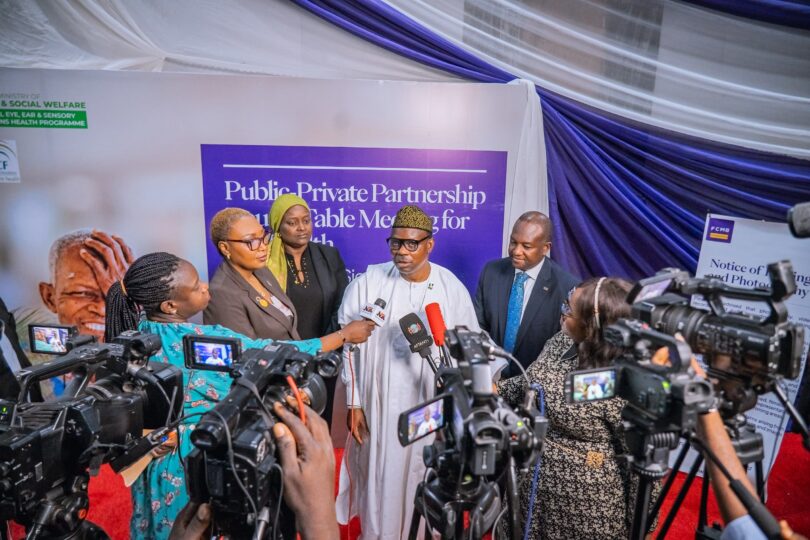
The Federal Government has called for stronger private-sector investment in eye health to reduce preventable blindness, improve productivity and strengthen Nigeria’s human capital….
The Federal Government has called for stronger private-sector investment in eye health to reduce preventable blindness, improve productivity and strengthen Nigeria’s human capital.
The Minister of State for Health and Social Welfare, Dr Iziaq Adekunle Salako, made the call at a Public-Private Sector Roundtable on Eye Health in Abuja, themed, “GIFT of Sight: Mobilising Partnerships and Sustainable Funding towards Transforming Eye Care in Nigeria.”


Salako said eye health should no longer be treated solely as a health-sector issue, stressing that good vision is fundamental to education, workplace productivity, economic growth and national development.
He said about 24 million Nigerians live with vision loss, much of it linked to preventable or treatable conditions such as cataracts, glaucoma and uncorrected refractive errors.
The minister urged businesses in banking, manufacturing, telecommunications, energy and other sectors to view investment in eye health as both a social responsibility and a strategic economic decision.
He called for innovative financing mechanisms, including blended finance, social impact funds, co-financing arrangements and concessional loans, to expand eye-care infrastructure and access to quality services.
Salako also urged companies to channel their Corporate Social Responsibility investments into structured programmes such as school eye-health initiatives, rural surgical outreaches and permanent community-based eye-care centres.
He encouraged telecommunications companies to leverage digital infrastructure to expand tele-ophthalmology, remote screening and mobile diagnostic services.
The minister further challenged Nigerian manufacturers to invest in the local production of spectacle frames, lenses, ophthalmic medicines and other essential eye-care consumables.
According to him, stronger domestic production would reduce dependence on imports, make eye-care commodities more affordable and accessible, create jobs and strengthen local supply chains.
Salako highlighted progress under the Federal Government’s JigiBola 2.0 initiative, saying the programme had delivered more than two million free eye screenings and 1.5 million free spectacles in just over a year.
He said more than 2,200 Primary Health Care workers had also been trained, while over 800 PHC centres had been activated to provide primary eye-care services across 16 states.
The minister said the next phase would extend services to more than one million Nigerians in an additional 10 states, while the Renewed Hope Health Connect initiative is targeting 25,000 free cataract surgeries by 2027.
Salako commended existing private-sector interventions, particularly the partnership between First City Monument Bank and the Tulsi Chanrai Foundation, which he said had reached more than 400,000 Nigerians.
He urged other corporate organisations to replicate such initiatives, given the scale of Nigeria’s eye-health needs.
“A nation cannot march into economic prosperity if it is walking blind,” Salako said.
He reaffirmed the Federal Government’s commitment, under President Bola Ahmed Tinubu’s Renewed Hope Agenda and the Health Sector Renewal Investment Initiative, to creating an enabling environment for sustainable public-private partnerships in eye health.
The minister also urged development partners and civil society organisations to provide catalytic support, technical expertise and innovation while helping Nigeria move from donor-dependent interventions towards a locally financed and sustainable eye-health system.
In her opening remarks, the Managing Director and Chief Executive Officer of FCMB, Mrs Yemisi Edun, represented by Dr Diron Olojo, said eye health was not merely a medical concern but a critical component of education, productivity, economic inclusion and human dignity.
Edun highlighted FCMB’s partnership with the Tulsi Chanrai Foundation through the Priceless Gift of Sight Initiative, launched in 2009, which had provided free eye-care services to more than 400,000 Nigerians by July 2024.
She said the initiative demonstrated the value of sustained partnerships in delivering long-term health impact.
Edun urged stakeholders at the roundtable to agree on practical priorities, including identifying communities and services with the greatest unmet needs, developing sustainable financing plans with clearly defined responsibilities, and establishing delivery timelines and measurable indicators.
The National Coordinator, National Eye, Ear and Sensory Function Health Programme, Dr Oteri Okolo, said the meeting was an opportunity to confront the wider social and economic value of vision.
Okolo said eye health had historically been treated as a secondary priority, despite its importance to learning, work, social interaction and human development.
She said the National Eye, Ear and Sensory Functions Health Programme had been integrated into the broader national health architecture, guided by the National Eye Health Policy and Strategic Plan and the Integrated People-Centred Eye Care strategy.
“Our strategic focus has been guided by the National Eye Health Policy and Strategic Plan, with Integrated People-Centred Eye Care as our strategy, ensuring that eye care is not an isolated specialty, but an essential component of Universal Health Coverage,” Okolo said.
In a goodwill message represented by the Country Director of Sightsavers and Coordinator, Eye Health Non-Governmental Development Organisation Coalition, Prof Joy Shuaibu, the coalition commended the National Eye, Ear and Sensory Function Health Programme for engaging stakeholders across the sector.
It called for actionable solutions, innovative financing and scalable partnerships to accelerate progress towards universal access to eye-health services.
The Head of Vision Care for Development Foundation, supported by Sterling Oil, Mimansa Shulala, said restoring sight was not only about health but also about restoring opportunity, dignity, productivity and hope to underserved communities.
She said the foundation, with support from SIPCON and Tulsi Chanrai Foundation, had screened more than 17,000 people in underserved communities over the past two and a half years, identifying more than 3,000 people requiring intervention.
According to her, the foundation had facilitated more than 1,500 cataract and pterygium surgeries, with more than 1,000 surgeries conducted in partnership with the Tulsi Chanrai Foundation at its Calabar facility.
Shulala said the objective was to strengthen government systems, build local capacity and create a model that could be sustained and scaled.
“This is the strength of public-private partnership, where government provides leadership and system.
SIPCON and Sterling Oil have provided support and resources, TCF has brought its expertise and technical knowledge, while VCDF has channelled the programme to the community. When these strengths come together, we will move beyond individual interventions to build sustainable solutions for communities,” she said.
The roundtable brought together government officials, healthcare providers, private-sector organisations, foundations and other stakeholders to strengthen collaboration towards a more accessible, equitable and sustainable eye-care system in Nigeria.