BY SPECIAL CORRESPONDENT
Sen. Neda Imasuen (Edo South) has described the Lagos-Calabar Coastal Highway as a strategic infrastructure project that will unlock Nigeria’s Blue Economy corridor and create economic opportunities for coastal communities.
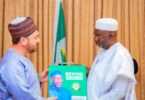
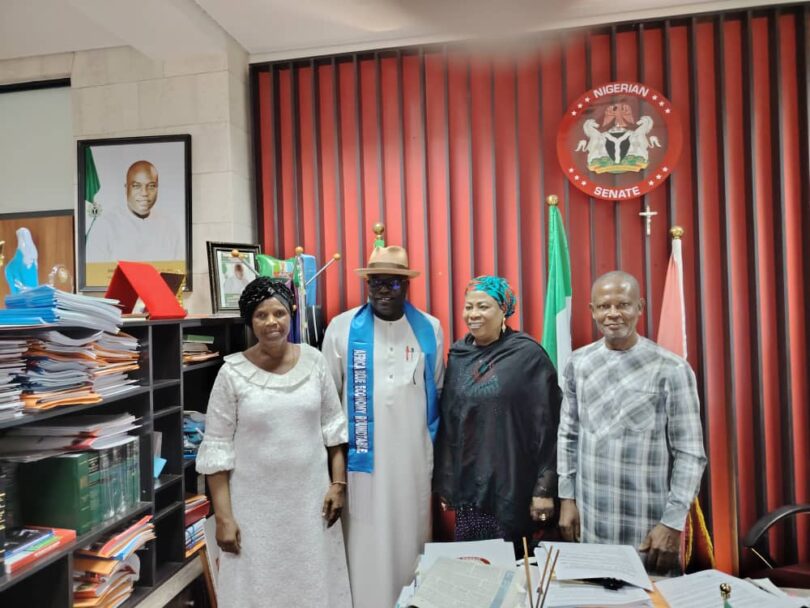
Imasuen, Chairman of the Senate Committee on Ethics, Privileges and Public Petitions, said this on Wednesday in Abuja when the Founder and Convener of the Africa Blue Economy Roundtable (ABER), Dr Piriye Kiyaramo, led a delegation on a courtesy visit to his office at the National Assembly.
He commended ABER’s advocacy for a community-owned Blue Economy and pledged to study its proposal for the establishment of a Nigeria Senate Blue Economy Caucus (NSBEC).
Presenting the proposal, Kiyaramo said Nigeria, despite its 853-kilometre coastline, more than three million artisanal fisherfolk and an estimated 70 billion dollars in annual Blue Economy potential, lacked a dedicated parliamentary platform to drive legislation and oversight of the sector.
He said the absence of such a mechanism had weakened coordination, budgetary provisions and legislative interventions needed to harness the country’s marine resources.
“We lose 2.3 billion dollars annually to illegal, unreported and unregulated (IUU) fishing. We lose mangroves and young lives at sea. Without law, there is no Blue Economy; there is only blue anarchy,” he said.
Kiyaramo said the proposed caucus was modelled on the East African Legislative Assembly (EALA), which provides a regional legislative framework for managing Lake Victoria across seven countries.
“If EALA can govern Lake Victoria, the Nigerian Senate can govern the Gulf of Guinea front,” he said.
He explained that the proposed caucus was anchored on ABER’s vision of a connected, competitive and community-owned Blue Economy that ensured no fishing community was left behind.
According to him, the caucus would advocate the domestication of the African Union Blue Economy Strategy, the Lomé Charter, ILO Convention C188 and the FAO Port State Measures Agreement.
It would also pursue legislation to enforce a five-nautical-mile exclusive zone for artisanal fishing and advocate allocating at least 10 per cent of marine revenue to infrastructure for fishing communities.
Kiyaramo further proposed that South-South states be encouraged to establish Ministries of Marine and Blue Economy, citing Bayelsa as a model.
On its proposed composition, he recommended a 23-member caucus comprising two senators each from the six South-South states and three coastal South-West states.
The proposed membership would also include three non-littoral experts and two ex-officio representatives from the Federal Ministry of Marine and Blue Economy and ABER.
He proposed Imasuen as Chairman and Patron, with a minimum of 35 per cent representation for women.
The caucus would operate through four standing subcommittees covering fisheries, aquaculture and blue food security; blue tourism, marine transport and coastal infrastructure; blue justice, human rights and gender; and blue carbon, mangroves and climate resilience.
The blue justice subcommittee would work with the International Human Rights Protection Service (IHRPS) Forum’s West Africa Envoy to monitor violations, provide legal assistance and promote women’s ownership of cold-chain facilities.
It would also pursue the enforcement of Free, Prior and Informed Consent (FPIC), while the blue carbon subcommittee would seek to ensure that 70 per cent of benefits accrued to coastal communities.
Kiyaramo said the caucus would also initiate three proposed legislative instruments: the National Blue Economy Act, the Artisanal Fisheries Protection and Five-Nautical-Mile Enforcement Act, and the Blue Carbon and Mangrove Protection Act.
He said the proposed body would collaborate with EALA, the ECOWAS Parliament and the Directorate of Technical Cooperation in Africa (DTCA).
On its proposed take-off, Kiyaramo outlined a 90-day action plan, including inauguration by the Senate President and engagement with the South-South Governors Forum.
Other activities would include a public hearing on the Blue Justice Gap, unveiling of 100 bankable Blue Economy deals and a Senate motion on the ratification of ILO Convention C188 and enforcement of the five-nautical-mile artisanal fishing zone.
“The caucus will harmonise blue laws, redirect IUU losses to community jobs and position Nigeria to lead the ECOWAS Blue Parliamentary Network,” he said.
He added that Nigeria’s maritime resources should be preserved and developed for future generations rather than viewed merely as sources of extraction.
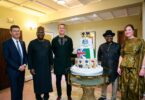
The high point of the visit was the decoration of Imasuen as Patron of ABER by H.E. Dr Mrs Ezeadili Appolonia Obiageri.
Hajiya Medina Dauda Nadabo, ABER Director of Communication and Public Affairs, was also part of the delegation.
ABER is an advocacy platform promoting sustainable development of Africa’s
marine and coastal resources.
Jude Ossai (JP) a veteran journalist is a National Diploma holder in Mass Communication from Ogwashi-Uku Polytechnic Ogwashi-Uku, Delta State. He also studied at Enugu State University of Science and Technology (ESUT) Enugu and Imo State University, Owerri for his first and second degrees in Mass Communication, respectively.
He writes extensively on politics, crime, corruption, climate change, healthcare, human rights, social justice, among others.
He began his journalism career in The Republic Newspaper, Lagos in 1987 as a Special Correspondent in Benin City, Edo State.
In 1990, he was posted from Lagos to old Anambra State as a State Correspondent in Enugu.
In 1994, he joined the African Newspapers of Nigeria (ANN) Plc, Ibadan, Oyo State, Publisher of Nigerian Tribune Newspapers where he rose to the rank of Southeast Bureau Chief.
Retiring from the mainstream traditional media in 2019, he began another journey in online newspaper publication.
He was the Overall Best Reporter in 2015, an award bestowed on him by Correspondents’ Chapel of the Nigerian Union of Journalists (NUJ), Enugu State.
He has attended several workshops/seminars organised by multi-nationals, government institutions, local and international media including BBC.
He is also a unionist and had held top positions as Chairman and Vice Chairman of the Nigerian Union of Journalists of Enugu Correspondents’ Chapel and State Council of NUJ, respectively. He was also a one-time Enugu State Secretary of Sports Writers’ Association of Nigeria (SWAN).