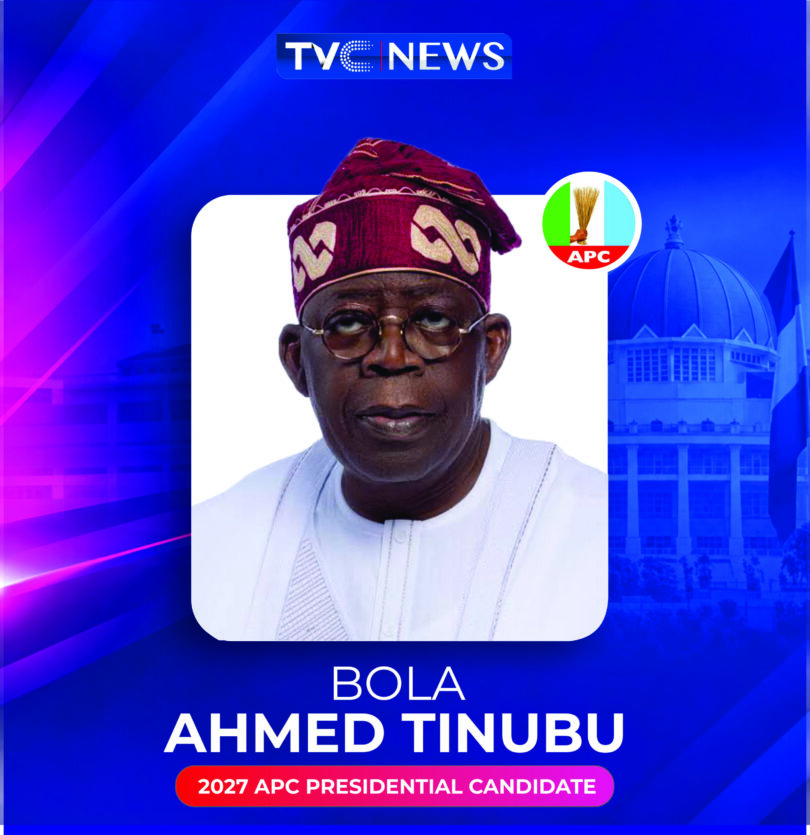
Asiwaju Bola Ahmed Adekunle Tinubu goes into Nigeria’s 2027 presidential election as the candidate of the ruling All Progressives Congress (APC), seeking to extend his tenure as president after more than three decades at the centre of Nigeria’s political life….
Asiwaju Bola Ahmed Adekunle Tinubu goes into Nigeria’s 2027 presidential election as the candidate of the ruling All Progressives Congress (APC), seeking to extend his tenure as president after more than three decades at the centre of Nigeria’s political life.
A professional accountant, former corporate executive, senator, two-term governor of Lagos State and one of the architects of the APC, Tinubu has built a political career around coalition-building, economic management, political organisation and the cultivation of a formidable network of political allies.
Now, as an incumbent president seeking re-election, his political legacy is being tested against the record of his first term and his promise to take his reform programme further.
From accounting to politics
Born in Lagos in 1952, Tinubu began his professional life away from politics.
He travelled to the United States in 1975, where he studied accounting and management at Chicago State University. He worked several jobs while studying before graduating with a Bachelor of Science degree in Business Administration in 1979.
After university, he worked with American accounting and consultancy firms, including Arthur Andersen, Deloitte and GTE Services Corporation. He later worked with Mobil in the United States and returned to Nigeria, where he joined Mobil Producing Nigeria and rose to become a senior executive and treasurer.
The experience would later inform a political career in which taxation, public finance, revenue generation and fiscal restructuring became recurring themes.
But Tinubu eventually left the corporate world for politics.
The making of a politician
Tinubu’s political career took off during the transition to the Third Republic.
He joined the Social Democratic Party in 1991 and was elected senator for Lagos West in 1992. At the National Assembly, he chaired the Senate Committee on Banking, Finance, Appropriation and Currency.
The annulment of the June 12, 1993 presidential election marked another decisive turning point.
Tinubu became involved in the National Democratic Coalition, NADECO, which campaigned for the restoration of democratic rule and recognition of the election widely believed to have been won by MKO Abiola.
Following the military takeover and the emergence of General Sani Abacha’s regime, Tinubu faced arrests, harassment and threats and eventually went into exile in 1994.
He continued his pro-democracy activities from abroad and returned to Nigeria in 1998 after Abacha’s death, as the country moved towards a return to civilian rule.
Eight years that defined Lagos Tinubu
In 1999, Tinubu won election as governor of Lagos State on the platform of the Alliance for Democracy.
Four years later, he secured a second term, becoming the only AD governor in the South-West to survive the PDP’s sweeping victories in the region.
His eight years in Lagos remain the cornerstone of the political argument made by his supporters.
Tinubu inherited a rapidly expanding megacity and pursued road construction, urban development, public-sector reform and stronger internally generated revenue. His administration also pushed for the creation of additional Local Council Development Areas, a decision that brought him into a prolonged confrontation with the Federal Government under President Olusegun Obasanjo.
The dispute over the councils eventually reached the Supreme Court, which ordered the release of funds withheld from Lagos State.
For Tinubu, however, Lagos was about more than infrastructure. It became a laboratory for the political and economic philosophy that would later inform his presidential campaign.
He advocated greater fiscal autonomy for states and stronger internally generated revenue, while seeking to position Lagos as a major commercial, financial and cultural centre.
His administration also established a political succession structure that outlived his tenure.
When he left office in 2007, Babatunde Fashola succeeded him. Fashola was followed by Akinwunmi Ambode and later Babajide Sanwo-Olu, keeping Lagos under the political influence of the Tinubu-led APC structure.
It was this ability to build and sustain political structures that earned Tinubu the description of Lagos’ political “godfather” among supporters and opponents alike.
From opposition leader to APC architect
Tinubu’s influence expanded beyond Lagos after he left office.
In the years following the 2007 elections, he became one of the principal figures working to unite Nigeria’s fragmented opposition parties against the PDP, which had dominated federal politics since 1999.
The effort eventually produced the All Progressives Congress in 2013 through the merger of several opposition political parties and factions.
Tinubu’s political calculations were central to the coalition.
In 2015, the APC achieved what had previously appeared unlikely: Muhammadu Buhari defeated incumbent President Goodluck Jonathan, bringing the PDP’s 16-year hold on the presidency to an end.
Tinubu had supported Buhari and remained one of the influential figures within the APC during the Buhari years.
He also supported Buhari’s re-election in 2019.
But the next phase of his political career would be his own presidential ambition.
The journey to Aso Rock
Tinubu emerged as the APC’s presidential candidate for the 2023 election after a fiercely contested party primary.
His campaign presented him as an experienced political organiser and administrator capable of applying his Lagos experience to the management of the federation.
He defeated Atiku Abubakar of the PDP and Peter Obi of the Labour Party in the February 2023 presidential election and was sworn in as Nigeria’s 16th President on May 29, 2023.
His victory completed a political journey that had begun more than three decades earlier in the Senate.
But the presidency also brought Tinubu face-to-face with an economy under severe pressure.
A presidency defined by reform
From the beginning of his administration, Tinubu chose an economic path that involved major policy changes.
One of his first and most consequential decisions was the removal of the petrol subsidy, a policy he argued had become too costly for government to sustain.
His administration also reformed the foreign-exchange regime, pursued changes in the monetary and fiscal architecture and introduced measures aimed at increasing government revenue and attracting investment.
The reforms have generated both support and opposition.
Supporters argue that Tinubu confronted structural problems that successive administrations had avoided and that the reforms are laying the foundation for a more productive and investment-friendly economy.
Critics point to the immediate cost to households and businesses, including higher transport and living expenses, and argue that the benefits of the reforms have not yet been felt evenly across the country.
That tension is at the heart of the 2027 presidential contest.
Tax reform and the $1 trillion ambition
Tax and fiscal reform has become another major component of Tinubu’s economic programme.
His administration has pursued legislation aimed at restructuring Nigeria’s tax system and improving tax administration, with the stated objective of creating a more efficient system while making the business environment more competitive.
The President has also set an ambitious target of building a $1 trillion Nigerian economy by 2030.
For Tinubu, the objective is not simply to increase the size of the economy but to create a more sustainable fiscal base capable of financing infrastructure, social programmes and development without excessive dependence on oil revenue.
The economic agenda has consequently become a major pillar of his argument for continuity in 2027.
A political strategist in the presidential contest
Tinubu’s political reputation has always rested on more than his ability to win elections.
He is widely regarded as a political strategist with a strong instinct for identifying and developing political talent. His influence in Lagos and his role in bringing opposition forces together to create the APC remain central to that reputation.
His supporters describe him as a risk-taker and strategist who has repeatedly made political calculations that changed the direction of Nigerian politics.
His critics, however, have questioned the extent of his political influence and accused him of exercising excessive control over political structures, particularly in Lagos.
Those competing descriptions — strategist and political godfather on one side, overly dominant political operator on the other — have followed Tinubu into the presidency.
Controversies and scrutiny
Like many of Nigeria’s most powerful political figures, Tinubu’s career has been accompanied by controversy.
Questions have been raised over aspects of his personal history, wealth, business interests, political influence and financial dealings.
His political opponents have repeatedly used those controversies to challenge his credibility, while Tinubu and his supporters have defended his record and rejected allegations of wrongdoing.
Some allegations resulted in investigations or legal proceedings, while others remain part of the political debate surrounding his career.
For 2027, those controversies matter because Tinubu is not entering the election as an outsider seeking an opportunity to govern. He is an incumbent asking Nigerians to assess both his past record and his performance in office.
The Tinubu-Shettima ticket


 The APC is returning to the electorate with the same presidential combination that won the 2023 election.
Tinubu is seeking another term with Vice President Kashim Shettima as his running mate.
The decision gives the APC a continuity argument: the same leadership team that began the Renewed Hope Agenda in 2023 is asking voters for another mandate to consolidate its reforms.
For Tinubu, the 2027 election is therefore likely to be framed around whether Nigerians believe the sacrifices associated with his reforms will eventually produce stronger economic growth, greater investment, improved public finances and better living conditions.
The 2027 test
The 2027 presidential election represents another defining moment in Tinubu’s long political career.
He has already occupied some of the most influential positions in Nigeria’s political history — senator, two-term Lagos governor, opposition leader, APC national leader and now president.
His political journey has also crossed some of the country’s most significant transitions: the struggle against military rule, the return to democracy, the rise of the PDP, the formation of the APC and the first successful transfer of power from one major party to another through an opposition victory in 2015.
Now, Tinubu is seeking to write another chapter.
The APC’s case for his re-election rests largely on continuity: that the economic reforms begun in his first term require time to mature and that the administration should be allowed to complete its transformation agenda.
The opposition is expected to make the election a referendum on the cost of those reforms, the state of security, governance and the living conditions of Nigerians.
For Tinubu, therefore, 2027 is not simply another election.
It is a vote on the political legacy he has spent more than three decades building — and on whether Nigerians believe the “Renewed Hope” agenda deserves another four years to reach its promised destination.