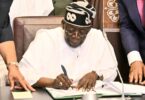
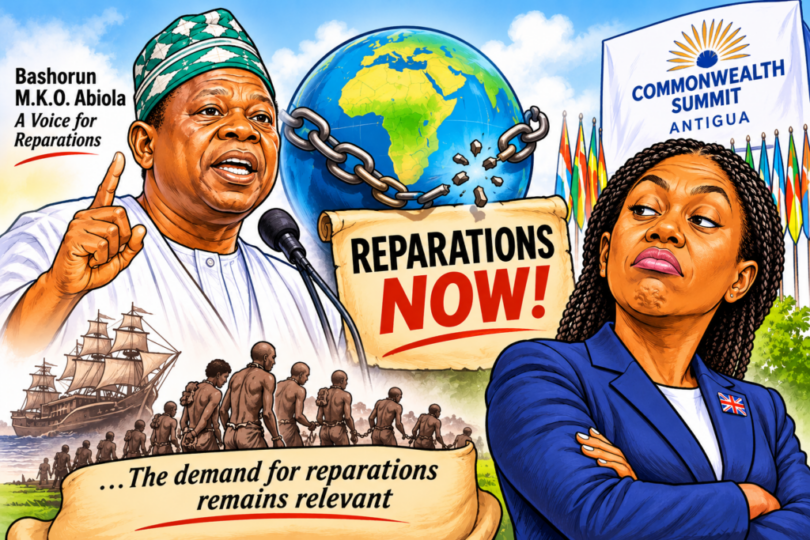
The campaign for reparations, courageously championed by the far-sighted Bashorun M.K.O. Abiola, remains as relevant as ever. The revelations and conversations his initiative triggered decades ago are still at the forefront of global discourse, reaffirming the foresight of the great Nigerian nationalist and democracy icon.
It is regrettable that Nigeria’s President was not present at the Commonwealth Summit in Antigua, particularly at a time when the question of reparations for the victims and descendants of the transatlantic slave trade featured prominently on the agenda. His absence notwithstanding, the discussions at the summit reinforced the wisdom of Abiola’s historic advocacy for compensation for the devastation wrought by slavery. May his patriotic and Pan-African soul continue to rest in peace.
Let us not attempt to put a deceptive gloss on history: the slave trade was hideous, barbaric and profoundly destructive. It disrupted the social, economic and political ecosystems of African societies, with consequences that continue to reverberate across the continent and its diaspora. No amount of historical revisionism can erase this reality, much less undo the damage.
The British monarch, to be fair, does not wield the executive authority of the British Government and therefore sought to steer a middle course in addressing the matter. Importantly, there was no attempt to obscure or minimise the brutality of the slave trade. However, the monarch could not commit the British Government to financial reparations for the descendants of its victims. To borrow from the traditional language of British governance, he is not the “First Lord of the Treasury”, a designation reserved for the Prime Minister.
The current British Prime Minister has demonstrated some alignment with calls for reparative justice. However, given the country’s challenging fiscal circumstances, he must tread carefully and navigate the competing demands confronting the British economy.
The most disappointing intervention, however, came from the Leader of the Opposition in the United Kingdom, Mrs Kemi Badenoch. It is particularly unfortunate that, despite her Nigerian heritage as the daughter of the late Dr Femi Adegoke, a respected progressive and medical doctor, she has chosen to distance herself so emphatically from her Nigerian roots. In this regard, Nigeria may well be spared the embarrassment of claiming her political positions as representative of its interests. Her appearance on the British television channel, Sky News, was particularly reprehensible.
Badenoch’s intervention appeared to emerge straight from the pages of Frantz Fanon’s groundbreaking 1952 work, Black Skin, White Masks. Fanon, who originated from Martinique in the Caribbean, explored the psychological consequences of colonialism, particularly the internalisation of the coloniser’s values and the resulting alienation from one’s identity.
Badenoch’s position raises uncomfortable questions about identity, self-acceptance and the lingering psychological consequences of colonialism. Her apparent repudiation of her African heritage evokes the kind of identity crisis Fanon examined, in which the desire for social acceptance, economic survival and validation within a dominant culture can produce a painful estrangement from one’s origins.
Watching someone of African descent appear so dismissive of the historical experiences of her ancestors is both heartbreaking and troubling. Rather than simply condemn such attitudes, we should also recognise the psychological complexities of colonial conditioning. Unfortunately, thousands, if not millions, of people across the world remain caught in similar struggles over identity, belonging and self-acceptance.
The demand for reparations must therefore continue. It is a legitimate historical and moral demand, not an attempt to rewrite history or impose an arbitrary burden on present generations. There is also an important precedent worth recalling. A few years ago, the British Government reached an out-of-court settlement with Kenyan victims of colonial-era torture, resulting in the payment of £19 million in compensation to thousands of Mau Mau veterans and their families. These were freedom fighters whose resistance helped pave the way for Kenya’s independence. That settlement demonstrated that historical injustices can be acknowledged and addressed through meaningful reparative action. It should serve as a useful precedent for broader conversations on reparations.
Opportunists such as Kemi Badenoch should also be reminded that, until as recently as 2015, successive British governments were still repaying loans raised to compensate slave owners and merchants for the loss of their so-called property and commercial interests following the abolition of slavery. In other words, the British state continued to honour financial obligations arising from the abolition of slavery long after the victims of the slave trade and their descendants had been denied comparable consideration.
As the British themselves would say, “What is sauce for the goose is sauce for the gander.”
The demand for reparations, which should also encompass the pursuit of a more equitable international trade and economic framework, must be sustained within the Commonwealth of Nations. Historical justice cannot be separated from the continuing economic inequalities that shape relations between former colonial powers and their former territories.
It is particularly encouraging that our own distinguished compatriot, Dr Ngozi Okonjo-Iweala, was present at the Commonwealth Summit. Her international experience and expertise in global economic governance should be brought to bear on the conversation. The reparations debate must move beyond historical acknowledgement to practical proposals for economic justice, equitable trade and sustainable development.
May the soul of Bashorun M.K.O. Abiola, alongside those of all nationalists who faithfully served humanity and have since departed, continue to rest in perfect peace.