
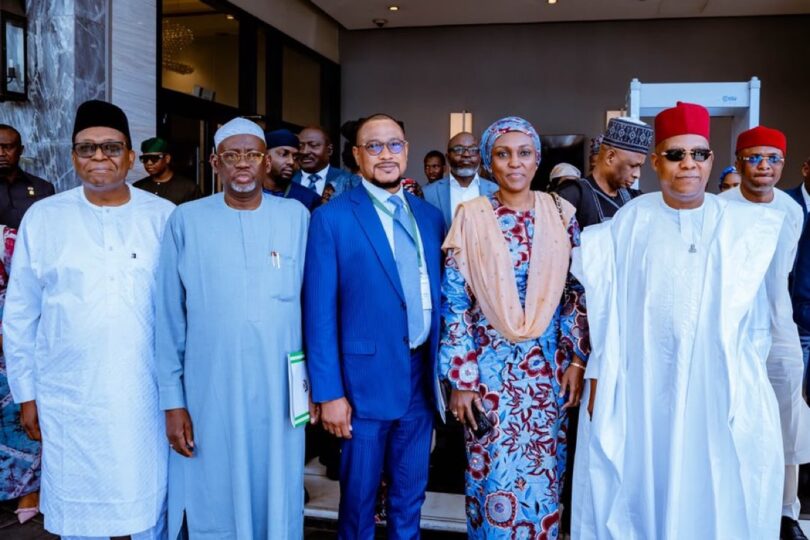
The Federal Government and state governments have pledged to strengthen grassroots implementation of the Nutrition 774 Initiative, drawing lessons from Ethiopia’s efforts to tackle malnutrition and child stunting. The commitment was made during the Nigeria–Ethiopia Nutrition Leadership Exchange in Addis Ababa, where Nigerian governors and ministers called for coordinated action……
The Federal Government and state governments have pledged to strengthen grassroots implementation of the Nutrition 774 Initiative, drawing lessons from Ethiopia’s efforts to tackle malnutrition and child stunting.
The commitment was made during the Nigeria–Ethiopia Nutrition Leadership Exchange in Addis Ababa, where Nigerian governors and ministers called for coordinated action across health, education, agriculture, water, sanitation and social protection to improve nutrition outcomes.
In a statement issued on Friday, October 9, the Senior Special Assistant to the President on Media and Communications, Office of the Vice President, Stanley Nkwocha, said the discussions focused on translating Nigeria’s nutrition policies into measurable improvements in communities and households.
The Coordinating Minister of Health and Social Welfare, Prof. Muhammad Ali Pate, said nutrition was central to human capital development and required collaboration across government and society.
“Nutrition is key to human capital development, and it requires sectors to work together in a whole-of-government and whole-of-society approach,” Pate said.
He said Nigeria had recorded progress through national interventions and community-based programmes but needed to strengthen implementation.
“We have to now go back and deepen the progress, accelerate,” he added.
Pate disclosed that Nigeria and Ethiopia would develop a roadmap based on lessons from the exchange, expressing optimism that sustained efforts could improve nutrition outcomes over the next four to five years.
“There are reasons to be optimistic that if we continue in this direction over the next four to five years, Nigeria will achieve remarkable success in dealing with key issues affecting the people of Nigeria, particularly the children who are the future of our country,” he said.
Osun State Governor Ademola Adeleke said nutrition interventions should prioritise children under five and pregnant women, noting that Nigeria could build on the progress already recorded.
“Especially for the young ones under five and, of course, pregnant women, it is very, very important,” Adeleke said.
“We have some success, but we can improve on it. That is why I am here, to learn from our counterparts in Ethiopia,” he added.
Abia State Governor Alex Otti urged Nigeria to learn from countries that had made progress in addressing nutrition challenges rather than attempt to develop solutions from scratch.
“There’s nothing wrong with saying that we have not done as well. And there’s also nothing wrong in learning from those who have done it, so that you don’t go reinventing the wheel,” Otti said.
He stressed that nutrition required interventions beyond food production and availability, citing healthcare, education, climate change, agriculture and poverty reduction as interconnected factors.
“Today, we have learned that it’s not just about food security. It’s also about health. It’s about education. It’s about climate change. It’s about agriculture. So, a whole lot of things are intertwined,” he said.
Otti also highlighted Abia’s investments in education, including the recruitment of 9,469 teachers, the development of 20 smart schools and the rehabilitation of more than 200 primary and secondary schools.
He said the state committed about 20 per cent of its annual budget to education.
Zamfara State Governor Dauda Lawal said insecurity had worsened nutrition challenges in the state, which previously produced enough food to feed its population.
“In the past, when you spoke about nutrition, we didn’t even have anything like that in the state because we produced enough to feed our people. However, because of those challenges now, it has become difficult,” Lawal said.
He, however, said the state must not allow insecurity to define its response to the problem.
“Should we be defined by the insecurity? The question is no. What else can we do?” he asked, emphasising the need to align with federal programmes while adapting interventions to local conditions.
Jigawa State Governor Umar Namadi said Ethiopia’s experience under the Seqota Declaration offered lessons for Nigeria’s Nutrition 774 Initiative, particularly in extending programmes to local governments, communities and households.
“The one thing that is very important with 774 is the fact that it will have to go down from the national level to each local government, each ward, each community and each household,” Namadi said.
He said Jigawa had complemented federal interventions with local programmes, including the Masaki initiative and a “Tom Brown” nutrition programme that had trained about 600 women to produce nutritious food for children.
The Minister of Education, Dr. Maruf Tunji Alausa, said nutrition interventions must begin during pregnancy and continue through the critical early stages of a child’s development.
“If we miss that period, the 2,000 days, we’ve set those children up for failure in life,” Alausa said.
He said the Nutrition 774 agenda was designed to extend interventions from the Federal Government to states, local governments and communities.
“We have an expansive 774 nutrition agenda that drives our nutrition agenda from the federal to the subnational government, state, local government and the community,” he added.
The Minister of Water Resources and Sanitation, Prof. Joseph Utsev, also stressed the link between nutrition, water supply, sanitation and agricultural production.
“When we talk about the workforce, we must first talk about healthy living. A human being must be healthy before he can impact positively in any role given to him,” Utsev said.
He said reliable water supply was essential for drinking, sanitation, irrigation and food production, making it a key component of efforts to improve nutrition across the country.