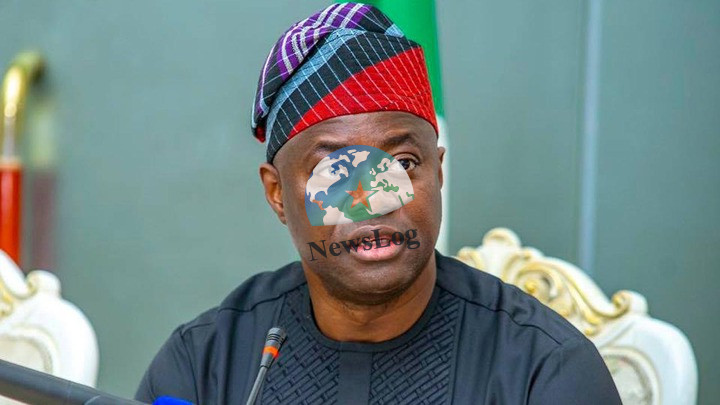
Oyo State Governor, Seyi Makinde, faces a defining choice ahead of 2027 as a deepening crisis in the Peoples Democratic Party (PDP) intensifies following a split ruling by the Supreme Court of Nigeria, which nullified the party’s disputed November 2025 national convention in Ibadan.…....
Last Thursday’s judgment, delivered in a 3–2 decision by a five-member panel led by Justice Mohammed Garba, upheld earlier rulings of lower courts that voided the convention and all structures that emerged from it.
The verdict has not resolved the PDP’s leadership crisis but has instead deepened uncertainty, sharpening the political choices before Makinde at a critical moment.
Recent opposition engagements in Ibadan, combined with the ruling, have placed the governor at the centre of a wider opposition realignment, even as he continues to publicly affirm loyalty to the PDP.
Supreme Court Ruling: Clarity Without Closure
The apex court affirmed that the Ibadan convention was conducted in violation of a subsisting court order, effectively nullifying its outcomes, including leadership claims tied to the exercise.
While the majority held that the convention breached due process, the minority questioned the extent of judicial intervention in internal party affairs, highlighting the contentious nature of the decision.
Crucially, the ruling did not install new leadership but reverted the party to its pre-convention status, leaving multiple factions to interpret the outcome in their favour.
Victory Claims, Lingering Crisis
The immediate aftermath has been marked by competing narratives.
“Today, the Supreme Court has brought an end to the so-called factions of the PDP. There is no more faction in the party. There is only one PDP,” said Nyesom Wike, insisting the ruling has settled the crisis and dismissing rival claims.
But other voices within the party struck a different tone. Figures aligned with the Ibadan convention, including blocs associated with Tanimu Turaki, SAN, argue that the ruling leaves the PDP without clear leadership, deepening uncertainty rather than resolving it.
The PDP Board of Trustees, aligned with structures linked to Kabiru Turaki, accepted the judgment and moved to assert continuity, positioning itself as a stabilising authority while calling for reconciliation.
The conflicting interpretations underscore a familiar pattern: legal clarity without political consensus.
Ibadan Summit Signals Coalition Push
Even before the ruling, Makinde had begun widening his political engagements.
Barely a week earlier, he hosted a high-level gathering of opposition leaders in Ibadan, bringing together figures from multiple parties, including elements linked to the African Democratic Congress (ADC), Labour Party, and the New Nigeria Peoples Party (NNPP).
Former Anambra State Governor Peter Obi, after a closed-door meeting with Makinde, said: “We have come to respectfully consult my dear brother on the coalition for the 2027 election and the overall well-being of Nigeria. It’s about how to build a better Nigeria.”
These engagements reinforce Makinde’s role as a bridge across opposition divides, even as they raise questions about whether he will remain within the PDP or align more fully with coalition forces.
Coalition Cracks Emerge
However, the coalition path is far from settled.
The response underscores divisions within the coalition space and highlights the difficulty of forging a unified front among parties still grappling with internal disputes.
For Makinde, the calculation is delicate: aligning too quickly with a fragile alliance carries risk, while staying put ties him to a PDP still struggling to define its leadership after the court ruling.