BANGKOK (AP) — Former Myanmar leader Aung San Suu Kyi has been moved from prison to house arrest and her sentence has been reduced as part of a prisoner amnesty for a Buddhist holiday.
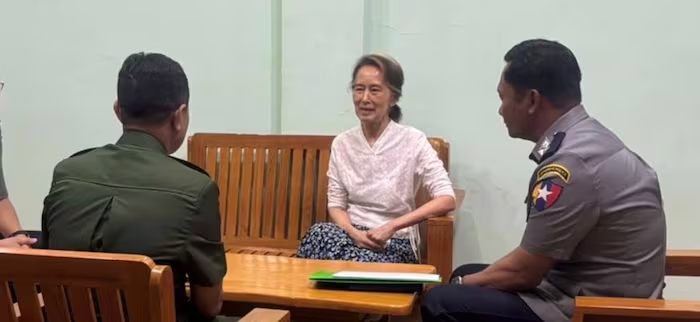
Accompanying the announcement was a photo of the 80-year-old leader dressed in a traditional white blouse and skirt and sitting on a wooden bench behind a low table facing two unidentified men, one in a police uniform and the other in military uniform. Myanmar’s military information office and state television disclosed the move and shared the photo of her Thursday night, but when and where the photo was taken was not clear.
Suu Kyi was detained Feb. 1, 2021, when the army seized power from her elected government. She has not been seen publicly since then, and the last official photo of her was from a court appearance on May 24, 2021.
Earlier Thursday, authorities had announced Suu Kyi’s sentence was being reduced as part of a prisoner amnesty marking a Buddhist holiday, the Full Moon Day of Kason honoring Buddha’s birthday. The amnesty covered 1,519 prisoners and cut the sentences for those still in prison by one-sixth.
It’s the second recent prisoner amnesty to apply to her
Prisoner amnesties are common in Myanmar for religious holidays and other important events, and the amnesty announced Thursday was the second in recent weeks to apply to Suu Kyi. Nearly two weeks earlier, a separate amnesty freed ousted President Win Myint, a longtime Suu Kyi loyalist who was arrested the same day as her.
The amnesties came after Senior Gen. Min Aung Hlaing was sworn into office as president April 10 following an election that critics say was orchestrated to maintain the military’s tight grip on power.
In his inauguration speech, he said his government would grant amnesties to promote social reconciliation, justice and peace. Actions including the amnesties and Suu Kyi’s transfer are widely seen as an effort to burnish his image.
The message announcing her transfer says she was moved from the main prison in Myanmar’s capital Naypyitaw to house arrest, with the action “made to celebrate Buddha Day, to show humanitarian concern, and to demonstrate the state’s benevolence and goodwill.”
It does not specify her exact location but says that by law “she will now serve the remainder of her sentence at a specific home instead of in prison.”
Her prison sentence was seen as an attempt to discredit her
Suu Kyi was originally sentenced to 33 years in prison in late 2022 for several offenses that her supporters and rights groups described as attempts to legitimize the army takeover that removed her from office, as well as to prevent her return to politics.
Thursday’s amnesty would bring her sentence down to 18 years, with more than 13 years left to serve, according to the calculation.
U.N. Secretary-General António Guterres considered Suu Kyi’s transfer “a meaningful step toward conditions conducive to a credible political process,” U.N. spokesman Stéphane Dujarric said.
Guterres also called for all political prisoners to be released as a fundamental step toward a political process and solution that “must be based on an immediate cessation of violence and a genuine commitment to inclusive dialogue,” his spokesperson said.
The human rights advocacy group Burma Campaign UK said the announcements were part of a strategy to project reform while maintaining power.
“Moving Aung San Suu Kyi isn’t about change or reform, it’s about public relations designed to preserve military rule,” Burma Campaign UK’s director Mark Farmaner said. “No-one should be fooled.”
Information about Suu Kyi is tightly controlled
Suu Kyi’s legal team has not been allowed to meet her in person since December 2022. Reports of declining health, including low blood pressure, dizziness and heart problems in 2024 and 2025 could not be verified.
Kim Aris, her younger son living in London, and Myanmar democracy activists launched an online campaign named “Proof of Life” to demand evidence she is alive and well, following the last mass amnesty on April 17.
The 2021 army takeover triggered massive public resistance that was brutally suppressed, triggering a bloody civil war that has killed thousands of people.
According to the Assistance Association for Political Prisoners, a rights monitoring organization, 22,047 people had been detained for political reasons since the army takeover.
Suu Kyi, the daughter of Myanmar’s martyred independence hero Gen. Aung San, spent almost 15 years as a political prisoner under house arrest between 1989 and 2010.
Her stand against military rule in Myanmar turned her into a symbol of nonviolent struggle for democracy, and won her the 1991 Nobel Peace Prize.
___
Associated Press writer Edith M. Lederer at the United Nations contributed to this report.
Copyright 2026 HeraldSun. FOLLOW US FOR MORE.