
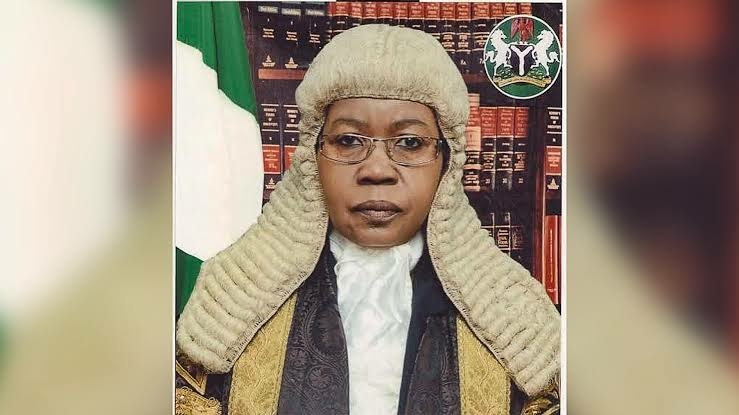
A retiring Justice of the Supreme Court, Justice Uwani Musa Abba-Aji, has lamented that a United States travel ban imposed on her and six other members of the apex court over their controversial judgment that installed Hope Uzodimma as Imo State Governor in 2020 remains in force.
Justice Abba-Aji disclosed this on Friday during a valedictory session held in her honour ahead of her mandatory retirement from the Supreme Court on November 7, 2026.
The retiring jurist, who described the judgment that triggered the sanctions as widely misinterpreted, said the travel restrictions remained one of the difficult experiences she encountered during her years on the bench.
She said, “My time on the Supreme Court bench was filled with challenges, some of which have served as additional opportunities to stand firm on the side of justice, regardless of the consequences.
“One of such challenging judgments was widely misinterpreted and led to a travel ban to the United States of America being imposed on all members of the panel, a ban which still holds today.”
Although Justice Abba-Aji did not specifically identify the judgment, the disclosure is understood to relate to the Supreme Court’s January 14, 2020, decision which removed Emeka Ihedioha of the Peoples Democratic Party from office and declared the All Progressives Congress candidate, Hope Uzodimma, the duly elected governor of Imo State.
The seven-member panel, which included the current Chief Justice of Nigeria, Justice Kudirat Kekere-Ekun, and Justice Abba-Aji, had overturned the concurrent decisions of the Imo State Governorship Election Petition Tribunal and the Court of Appeal, both of which had affirmed Ihedioha’s election.
In the lead judgment delivered by the then Chief Justice of Nigeria, Justice Tanko Muhammad, the apex court ordered the Independent National Electoral Commission to withdraw the Certificate of Return earlier issued to Ihedioha and issue a fresh one to Uzodimma.
The decision was based on the inclusion of results from 388 polling units, amounting to 213,295 votes, which were tendered before the election tribunal by a police officer who testified as PW-54 but were reportedly disowned by INEC.
The addition of the votes changed the outcome of the election, placing Uzodimma ahead of Ihedioha, who had initially been declared the winner.
The judgment generated widespread controversy, with critics questioning the basis for the inclusion of the disputed results and the implications of the decision for Nigeria’s electoral jurisprudence.
Ihedioha subsequently returned to the Supreme Court seeking a review of the judgment, arguing that it had occasioned a miscarriage of justice. However, the apex court dismissed his application.
One of the seven justices, Justice Centus Nweze, delivered a dissenting judgment in which he called for Ihedioha’s reinstatement, describing the decision that removed him as a nullity.
Justice Nweze also warned that the ruling would have lasting implications for the country’s electoral jurisprudence.
“This decision of the Supreme Court will continue to haunt our electoral jurisprudence for a long time to come,” he said.
At Friday’s valedictory session, Justice Abba-Aji maintained that the consequences of the controversial judgment were among the challenges she faced in the course of her judicial service, adding that such inconveniences were a price worth paying for the preservation of justice.
“Such inconveniences were a small price to pay to preserve the chastity of justice,” she added.
Meanwhile, the Chief Justice of Nigeria, Justice Kekere-Ekun, praised the retiring jurist for her contributions to the Nigerian judiciary, describing her career as an example of dedication, professional growth and service.
She recalled that Justice Abba-Aji began her judicial career in Borno State in 1973 as a Clerical Assistant and subsequently served as Assistant Registrar, Acting Registrar and Higher Registrar.
According to her, Abba-Aji was elevated to the Court of Appeal on September 22, 2004, serving in different divisions, including Benin, Abuja, Ekiti, Owerri and Kaduna, before her appointment to the Supreme Court on January 8, 2019.
The CJN also highlighted her contributions to the advancement of women in the judiciary, particularly through her leadership roles in the Federation of Muslim Women Associations of Nigeria and as President of the National Association of Women Judges Nigeria.
She said Abba-Aji’s career had helped create opportunities for women in the legal profession, particularly at a time when female representation on the bench was less common.
“For many of us, particularly the women who have entered the Nigerian Judiciary in more recent years, Hon. Justice Abba-Aji’s career is part of the story of how the place of women in our Judiciary has evolved,” Kekere-Ekun said.