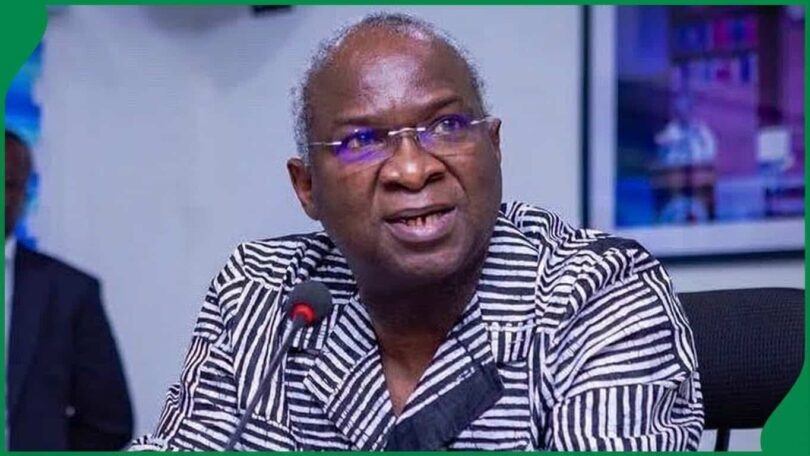
Former Lagos State governor Babatunde Fashola has disclosed that former President Olusegun Obasanjo repeatedly rejected requests for federal assistance to tackle ocean encroachment in Lagos.
He explained that President Bola Tinubu, then governor of Lagos State, initiated the intervention that led to the Eko Atlantic project.
Fashola, who served as Tinubu’s Chief of Staff before succeeding him as Lagos State governor in 2007, said he personally drafted several letters to Obasanjo seeking intervention against the Atlantic Ocean’s encroachment.
Herald Sun reports that the former governor disclosed this during an interview on Arise News on Friday.
The interview comes weeks after Tinubu took a swipe at Peter Obi, the presidential candidate of the Nigeria Democratic Congress, accusing him of running away from the state’s erosion challenges while contrasting his record with his claim to have tamed the Atlantic Ocean in Lagos.
Reacting during the interview, Fashola said Tinubu deserved the credit for pursuing the project, which he said began before his own tenure as governor.
“Let me set the record straight.
“When the President says he tamed the Atlantic, he tamed it. Nobody should take the credit,” Fashola said.
The former Minister of Power, Works and Housing said he was directly involved in the correspondence between the Lagos State Government and the Obasanjo administration while Tinubu was governor.
“I was the Chief of Staff. I drafted those letters on his instructions to President Obasanjo,” Fashola said.
He recalled that the requests were repeatedly rejected, but Tinubu kept pursuing federal intervention.
“There were several letters to Obasanjo. Obasanjo would reply, ‘No.’ He would say, ‘Write another one.’ I would draft it,” the former power minister said.
Fashola added that he still had copies of the correspondence in his personal records.
He said Tinubu’s persistence eventually led Lagos to explore another solution through a partnership with South Energyx Nigeria Limited, which resulted in the Eko Atlantic development.
The former governor recalled that the project attracted considerable scepticism at its inception, including questions about the company involved and the feasibility of reclaiming land from the Atlantic Ocean.
However, Fashola pointed to the developments in the area as evidence of the project’s transformation, citing the return of businesses and the emergence of new infrastructure.
“All the waterfront properties are there. Banks are back. Restaurants are back. Hotels are back. There’s a road. A big shopping mall has opened there,” Fashola said.
“That is what infrastructure does: a new town,” he added.
Fashola said that when he became governor, his responsibility was to protect and continue the vision he had helped implement as Tinubu’s Chief of Staff, rather than claim ownership of the project.
“The idea was his,” the former governor said.
“And it’s not being hyperbolic. And it’s not being bombastic. I was in the room. And I still have those letters,” he added.