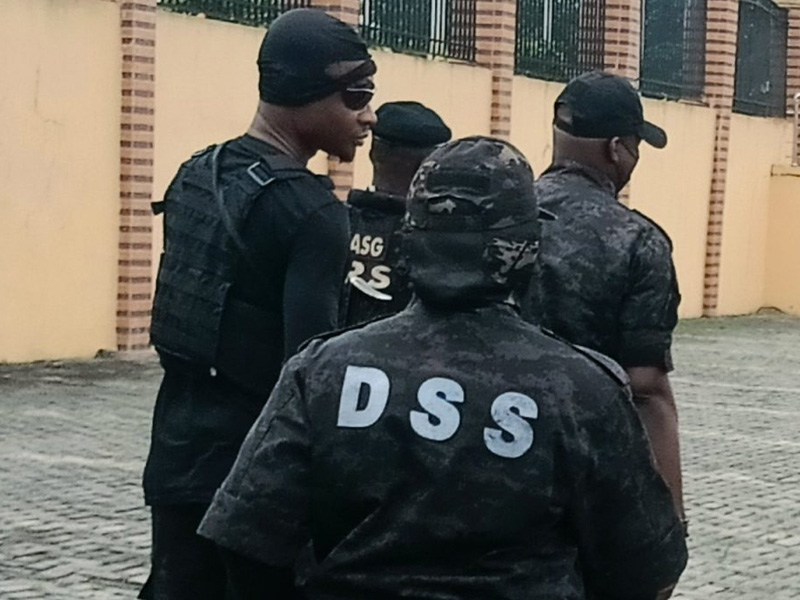
A Department of State Services (DSS) investigator has told the Federal High Court in Abuja how four suspected members of the Indigenous People of Biafra (IPOB) allegedly abducted and murdered the agency’s operative, Ekpenyong Owoh, in February 2022….
A Department of State Services (DSS) investigator has told the Federal High Court in Abuja how four suspected members of the Indigenous People of Biafra (IPOB) allegedly abducted and murdered the agency’s operative, Ekpenyong Owoh, in February 2022.
The witness, identified by the code name AAA for security reasons, gave the account on Wednesday while testifying as the first prosecution witness before Justice Joyce Abdulmalik in the ongoing trial of the four defendants.
The defendants are Michael Okafor, also known as Onyechimeleze; Chinedu Chukwudozie, alias Kante; Chibunna Olisa; and Chigozie Olisa, also known as Ability.
They were arraigned on September 28 on a six-count charge bordering on terrorism and kidnapping. They pleaded not guilty.
The prosecution alleged that the defendants conspired to commit acts of terrorism, abducted Owoh while he was travelling from Port Harcourt, Rivers State, to Awka, Anambra State, and subsequently killed him.
They were also accused of belonging to the proscribed IPOB and its armed wing, the Eastern Security Network (ESN), as well as unlawfully possessing firearms, including an AK-47 rifle and a pump-action gun.
How DSS traced missing operative
Led in evidence by prosecution counsel, Munirat Oladunjoye, the witness said he had worked with the DSS for about 17 years and investigated Owoh’s disappearance alongside other operatives.
He told the court that the investigation began in February 2022 after the officer’s wife reported that her husband had gone missing while travelling from Port Harcourt to Awka.
“Sometime in February 2022, the wife of our personnel made a complaint to us in Anambra Command that her husband, who was travelling en route from Port Harcourt to Awka in Anambra State, was missing.
“We sprang into action and we found that he made his last call in Osomogu, Ihiala Local Government Area of Anambra State,” he said.
The witness added that Owoh’s Toyota Pontiac vehicle was also traced to the same local government area.
According to him, the DSS subsequently worked with the military to conduct surveillance in the area because it was believed to be a stronghold of IPOB and ESN.
He said the investigation gained fresh momentum in 2026 when the agency discovered that someone was using the late operative’s telephone number.
The DSS tracked the phone’s International Mobile Equipment Identity (IMEI) and arrested a 36-year-old mother of two, Chinyere Okabe, on June 20, 2026.
The witness said further investigation led to the identification and arrest of the four defendants.
Okafor was arrested on September 14, while the other three were apprehended on September 20.
He said Okabe was later granted administrative bail after investigators established that she had no knowledge of the operative’s abduction.
How operative was allegedly killed
Recounting the circumstances surrounding Owoh’s disappearance, AAA said the operative called his wife on February 23, 2022, informing her that he would be coming home to see his newborn baby.
However, he was allegedly intercepted by the defendants, who became suspicious after noticing a pistol holster on him.
“When they intercepted him, they saw a pistol holster on him which made them suspect he was a security personnel,” the witness said.
He identified Okafor as a sub-commander in an ESN camp operating under an individual known as Innocent Obieke, popularly called Double Lion.
According to the witness, the defendants took Owoh to their camp after contacting Double Lion, who allegedly directed them to bring the operative to him.
He further alleged that Chibunna Olisa drove Owoh’s vehicle to the camp, where the officer was held before Double Lion instructed Okafor to kill him.
“And he was shot several times and buried in a shallow grave,” AAA told the court.
The witness also alleged that Okafor subsequently converted Owoh’s vehicle to personal use and gave the deceased’s telephone to his girlfriend, Chinyere, as a gift.
He said Double Lion was later killed by a rival ESN group.
Court verifies alleged ESN marks
During his testimony, AAA alleged that the four defendants had distinctive ESN marks on their chests, which he described as a sign of protection within the group.
“They all have ESN mark which is 14, 14 mark on their bodies. The mark is located in their chest area,” he said.
Following the allegation, Justice Abdulmalik directed the defendants to come forward and remove their clothes one after another to enable the court to verify the marks.
The witness and defence lawyers, K.C. Ekwe and G.U. Oputa, subsequently confirmed the presence of the marks.
The witness told the court that members of the group received the markings as a form of protection.
He also disclosed that Okafor travelled to Côte d’Ivoire and later India but was deported around 2024 following his alleged involvement in criminal activities.
After returning to Nigeria, Okafor reportedly kept a low profile and worked as a bricklayer in Azia, Ihiala Local Government Area, before his arrest.
Defence challenges confessional statements
The proceedings later took a different turn when the prosecution sought to tender the defendants’ statements in evidence.
Although the witness maintained that the statements were voluntarily obtained in a relaxed, air-conditioned environment and in the presence of a legal aid counsel, the defence objected.
Ekwe, representing the first and second defendants, and Oputa, who appeared for the third and fourth defendants, argued that the statements were obtained under duress and were not voluntary.
Justice Abdulmalik consequently ordered a trial-within-trial to determine the voluntariness and admissibility of the statements.
The prosecution then called AAA as its first witness in the separate proceedings.
The DSS investigator maintained that the defendants were not tortured and said they underwent medical examinations upon arrival at the command.
He explained that the suspects were asked whether they had lawyers but, after they reportedly answered in the negative, a lawyer from the Legal Aid Council was provided for them.
According to him, cautionary words were administered before the statements were recorded, while audio-visual recordings were also made.
He said the defendants admitted membership of the ESN in their statements, with Okafor allegedly admitting that he was a sub-commander, the second-in-command at the camp.
The witness further claimed that Okafor admitted that ESN members had engaged military personnel in an encounter on the day Owoh was abducted.
The statements were admitted as exhibits after the defence lawyers did not object to their admission at that stage.
The prosecution subsequently applied for the audio-visual recordings to be played in open court.
During playback, the interviewer was heard explaining to each defendant that the recording was being made in accordance with the law and in the presence of a lawyer from the Legal Aid Council.
The defendants were also informed of their right to remain silent and that anything they said could be used against them in court. They reportedly indicated their willingness to make statements.
The recordings were admitted by the court and marked as Exhibit TWT-5 Series.
Justice Abdulmalik adjourned the case until November 16 for the continuation of the trial-within-trial and cross-examination of the DSS witness.
The judge warned that the defence lawyers risked losing their right to cross-examine the witness if they failed to appear on the next adjourned date.