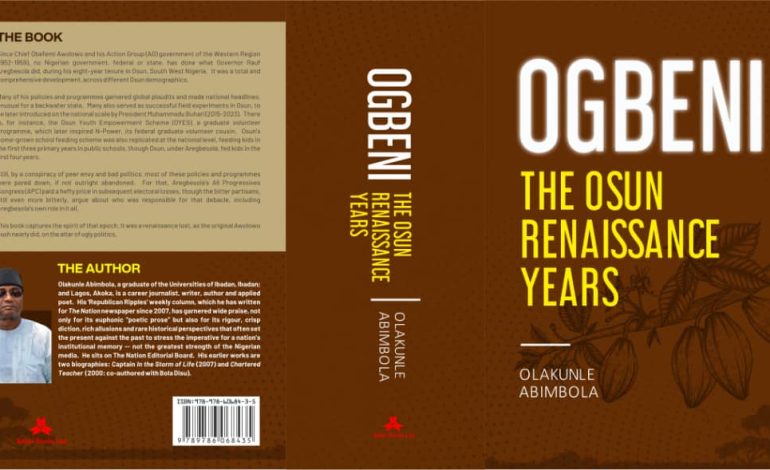
REJOINDER: You Called It Romance, We Call It Renaissance – A Direct Response To Adekunle Yusuf’s “Beyond The Romance Of Renaissance: The Unfinished Story Of Aregbesola’s Osun Years”
“History is not written by paid writers. It is written by those who lived it.”
Dear Adekunle Yusuf,
I read your piece, and considered it necessary to respond to you directly because journalism demands fairness, balanced opinion and fidelity to facts.
Let me be clear. This whole debate did not start on twitter or in a beer parlour. It started from a book presented before Nigerians with facts, figures, witnesses and history as you also acknowledged.
You must understand that historical fact is different from individual perception. Perception can be bought, twisted or coloured by present political loyalty, emotional sentiment or lack of conscience. Fact remains fact, no matter how many times paid writers and opinion twisters try to rewrite it.
You called Aregbesola’s story seductive, a political legend, a romance of renaissance. That is not analysis, that is dismissal. Aregbesola did not become a legend by storytelling. He became a legend by hard work and strong spirit of service. He met Osun in decay with dilapidated schools, impassable roads, hopeless youths, a society where crime was gradually overtaking communal peace and he left it transformed. What you call romance, the people of Osun call it reality.
You asked: was Osun genuinely reborn or did he run faster than his economic legs could carry him? Yes, Adekunle, Osun WAS genuinely reborn. Rebirth is not measured only by bank balance, it is measured by human transformation. Aregbesola came with a vision — the Six-Point Integral Action Plan. Every programme flowed from that vision. It was well crafted and aimed at not only physical development but to also transform lives. The positive result is still manifesting across various sectors of human engagement in Osun till today.
You reduced O’YES to an experiment. Adekunle, O’YES was life itself. 20,000 youths were taken off the streets at once, given stipends, training, dignity and hope. Many of them today are teachers, entrepreneurs, artisans, security personnel and business owners because O’YES gave them a foundation. Ask their families. For many homes, O’YES was the economic survival foundation. That is not romance, that is transformation of lives. That is renaissance.
You reduced O’Meal to school feeding. This is too narrow, Adekunle. O’Meal fed over 250,000 pupils daily. It kept children in school, reduced dropout, improved nutrition, and created jobs for thousands of women food vendors known as the O’Meal caterers. Many women built houses, trained their children and started businesses from O’Meal money. Broadening your understanding of the whole concept, you will discover that the chain benefit of O’Meal transcends school feeding alone.When you dismiss it, you dismiss the mothers of Osun.
Typically of a paid writer, you conveniently ignored O’Reap. A programme that empowered farmers, gave them inputs and linked agriculture to food security. It was part of the same vision: no Osun person should go hungry in a land blessed with fertile soil. That programme put food on tables and money in farmers’ pockets. The farmers in Osun cannot dismiss the period in their own records.
You called Opon Imo and the mega schools wasteful and also narrowed the education reform of Osun under Aregbesola to the side that suits your own narrative. Adekunle, Opon Imo was the first of its kind in Africa; a tablet loaded with textbooks, past questions and learning aids for every SS3 student. Opon Imo built students. And the schools? Not to even talk of their architectural grandeur, they (elementary, middle and high mega schools with modern facilities that rivalled private schools) changed the psychology of Osun children as they now learned in classrooms as beautiful as private schools. Parents proudly withdrew their children from private schools to public schools. Aregbesola didn’t just build schools, he created a learning environment of modern standard.That is foundation. That is transformation. That is renaissance.
You said the roads were overhyped. No, you got it wrong. Over 300km of township roads, 222km of rural roads under RAMP, Osogbo-Gbongan dual carriageway, bridges and urban renewal programme. If you will be honest in assessment, you will flash back to Osogbo landscape before Aregbesola, during and after his tenure. Also, villages that had never seen tarred road for decades saw it under Aregbesola. You cannot Photoshop a road. You cannot pay a road to disappear.
On debt and half salary, this is where fairness demands balance from you. Yes, there was a national economic recession, federal allocation collapsed and Osun, like 27 other states, struggled. Aregbesola did not steal salaries. He, together with the leadership of the Osun organized labour JOINTLY AGREED on a modulated salary arrangement and paid as much as the state could carry. Every serious journalist knows that the crisis was national, not Osun-made. He chose to preserve jobs rather than sack workers. That is leadership, not wickedness. To reduce eight years of visionary governance to “half salary” is intellectual dishonesty and a deliberate twisting of history.
Yes, the real test began when promises confronted realities. Thank you for admitting that the Six-Point Integral Action Plan of Aregbesola is Awolowo’s welfare philosophy which sees development as social obligation and not political favour. Aregbesola did not see governance as a favour. He saw it as duty.
On borrowing, understand that every school project, road, OYES, urban renewal was an investment, not a waste. A government that borrows to build is not reckless. Aregbesola borrowed to build. I challenge you to carry out the current cost of executing those projects now and make your findings public. You will discover the benefits behind the vision behind borrowing to build.
Your analysis collapsed completely on the fate of the formidable political movement and renaissance built around one personality. You deliberately refused to tell the truth about who destroyed the movement. Aregbesola left laudable gestures that were working. It was Oyetola’s bad intention, vindictiveness and lack of vision that ended them. He killed O’YES, killed O’Meal, abandoned O’Reap, abandoned the school maintenance system. He did not build on the foundation, he demolished it to erase his predecessor’s name and abandoned the spirit of continuity.
But his destructive tendencies did not stop at Aregbesola’s legacies alone. He also destroyed the Osun APC. Through exclusion, imposition, arrogance and winner-takes-all politics, Oyetola divided the party, drove away its loyal leaders, grassroots mobilizers and stakeholders, and turned a once united winning machine into a fragmented, demoralised and distrusted party. That is the reason why the party lost two gubernatorial elections consecutively (2022 and 2026). A party that was once the pride of the South-West was reduced to a party that could not win its own state, even with federal power.
The manifestation of this destruction was shameful and historic: President Bola Tinubu openly took away the leadership of his campaign in Osun from Oyetola and handed it over to Governor Ademola Adeleke. Think about it, Adekunle. A sitting President, leader of the APC, could no longer trust his own party leader in Osun to lead his campaign. He had to hand it to a governor of another party because Oyetola had destroyed the APC in Osun beyond repairs. That single act is the final verdict on Oyetola’s leadership.
And it was not even his enemies who said it. It was Baba Bisi Akande himself, the father of the party who openly confessed that the Osun APC was rudderless and without direction and that the party had been without an established leader since their defeat. He said, “We were rudderless until Adeleke accepted to lead our campaign for Tinubu’s re-election.”
Adekunle, when Baba Akande himself says the party Oyetola led became rudderless, what else is there to argue? History has recorded who built, who destroyed, and who was eventually rejected even by his own national leader. _Eni to ba ba ilu je, ilu naa yoo ba a je._ He who destroys his town, his town will destroy him.
You conclude that the true monument is not ceremonies or grandeur but quality of life and strength of institution that outlive it. I agree with you. Aregbesola’s institutions outlive him. The schools still stand, roads still speak, OYES beneficiaries still testify and O’Meal mothers still remember. Aregbesola’s legacies have stood the test of time and passed. No governor after him has surpassed his achievements — not in education, not in youth empowerment, not in school feeding, not in infrastructure, not in vision. Paid writers can write, opinion twisters can twist but the fact still remains and the people of Osun still know. You cannot rewrite what the people have lived.
Augustus Caesar once said: ” I found Rome a city of bricks and left it a city of marble.” Aregbesola met Osun as a state of decay and left it as a state of developmental attractions. He met Osogbo as a city of mud and left it as a city, befitting standard of a state capital.
That is renaissance. That is rebirth. That is transformation.
Aregbesola remains the benchmark by which every governor of Osun will be judged.