The Federal Government has moved to strengthen collaboration between Nigeria’s civil and military aviation authorities following the Nigerian Air Force (NAF) aircraft crash at Igbokoda, Ondo State…
The Federal Government has moved to strengthen collaboration between Nigeria’s civil and military aviation authorities following the Nigerian Air Force (NAF) aircraft crash at Igbokoda, Ondo State.
Minister of Aviation and Aerospace Development, Festus Keyamo, SAN, and the Chief of Air Staff, Air Marshal Sunday Kelvin Aneke, agreed to deepen cooperation in aviation safety, airworthiness, certification, training and capacity building.
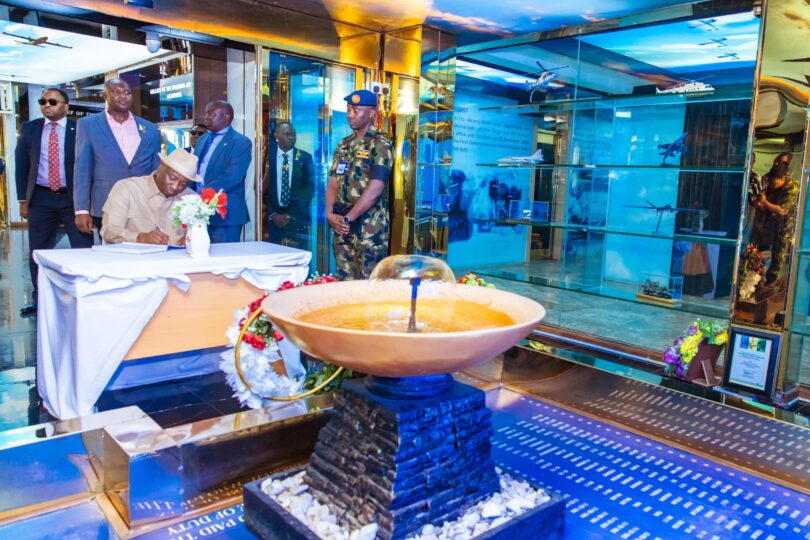
The agreement was reached on Wednesday when Keyamo paid a condolence visit to the Chief of Air Staff following the tragic incident involving a NAF ATR-42 aircraft in Igbokoda.


After signing the condolence register, the minister held a private meeting with Aneke before both leaders addressed journalists on plans to strengthen ties between the civil and military aviation sectors.
Keyamo described the crash as a national tragedy and commended the sacrifices of Nigerian Air Force personnel.
“We value the Air Force. We value the efforts of the gallant men and women of the Air Force and what they do for the country,” he said.
The minister said the incident had reinforced the need to close the gap between civil and military aviation, noting that accidents in either sector affect Nigerians regardless of whether the aircraft involved is military or civilian.
“It is one country, one people. When disaster happens, it affects everybody. There were civilians in that air crash and when there’s an air crash in the civil aviation too, there can be military personnel. And so, it is important that we cooperate in the area of safety,” Keyamo said.
He noted that the NAF already relies on civil aviation infrastructure, particularly air traffic control, but said the relationship should be expanded into a structured partnership covering other areas of aviation safety.
According to him, he had contacted the Director-General of the Nigerian Civil Aviation Authority (NCAA) and facilitated direct communication between the NCAA leadership and the Chief of Air Staff.
“We have decided that we will cooperate in terms of capacity building,” he said.
Keyamo said a joint committee involving the NCAA and NAF would be established to coordinate collaboration on airworthiness, certification, training and other safety-related matters, while respecting the statutory responsibilities of both institutions.
He also offered NAF personnel access to relevant training programmes undertaken by civil aviation authorities.
“There is no reason why we cannot take some names from the Air Force. We have a lot of training we go for, so there is no reason why we cannot,” the minister said.
Keyamo also acknowledged the specialised expertise within the Air Force that could benefit the civil aviation sector, describing the proposed cooperation as a two-way exchange of knowledge and experience.
“This is a kind of cross-pollination and symbiotic relationship we have decided to build for the safety of the lives of Nigerians,” he said.
Responding, Air Marshal Aneke thanked the minister for the condolence visit and his support for the Nigerian Air Force.
He said the initiative reflected the strong relationship between the civil and military aviation sectors and disclosed that discussions had already begun on a framework for greater technical cooperation.
Under the proposed arrangement, civil aviation personnel would contribute to the Air Force’s safety environment, particularly in airworthiness and certification, while NAF personnel would provide specialised expertise to the civil aviation sector where necessary.
“We have both agreed that we need to move the aviation industry, whether military or civil, to a higher level,” Aneke said.
The Chief of Air Staff welcomed the offer of training opportunities for Air Force personnel, saying the initiative would improve capacity and strengthen aviation safety.
He stressed that both institutions ultimately have the same responsibility to protect Nigerian lives.
“We are serving the same government; we are protecting the same Nigerians. So we are just a blend of each other,” he said.
The proposed partnership is expected to enhance information sharing, technical cooperation, professional training and safety coordination between Nigeria’s civil and military aviation authorities.