The Federal Government says it is targeting a least a 30 per cent reduction in Nigeria’s cancer burden by 2030 through improved prevention, early diagnosis, data management and standardised treatment….
The Federal Government says it is targeting a least a 30 per cent reduction in Nigeria’s cancer burden by 2030 through improved prevention, early diagnosis, data management and standardised treatment.
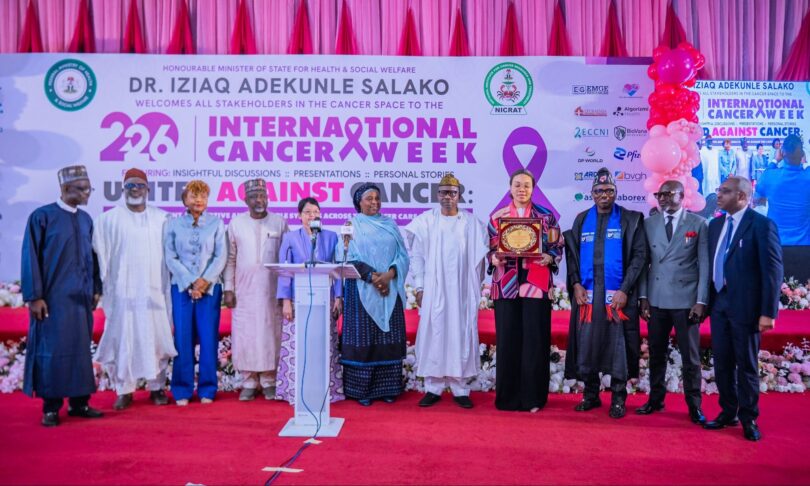
Minister of State for Health and Social Welfare, Dr Iziaq Salako, disclosed this on Wednesday while declaring open the 2026 International Cancer Week in Abuja.

The event, organised by the National Institute for Cancer Research and Treatment (NICRAT), is themed: “United Against Cancer: Building Resilient, Innovative and Equitable Systems Across the Cancer Care Continuum.”
Salako said the Federal Ministry of Health and Social Welfare, through the National Cancer Control Programme and NICRAT, was implementing the costed National Cancer Control Plan (NCCP) 2026–2030 under the Nigeria Health Sector Renewal Investment Initiative.
He listed key interventions under the plan to include the development and commissioning of cancer centres of excellence, the procurement of 35 linear accelerators over the next three years, expanded diagnostic services and Immunohistochemistry services under the Nigeria Cancer Access Partnership Programme.
On prevention, the minister said eight NICRAT Preventive Oncology Clinics across the six geopolitical zones, alongside nationwide awareness campaigns, were expanding access to early detection.
He added that more than 18 million girls aged nine to 14 had received HPV vaccination, while the National Taskforce on Cervical Cancer Elimination was coordinating efforts towards achieving the World Health Organisation’s 2030 cervical cancer elimination target.
Salako also highlighted the role of innovation and research, saying digital health, artificial intelligence, telemedicine, molecular diagnostics, precision medicine and cancer registries were being deployed to improve clinical decision-making and patient outcomes.
He said financial protection remained critical, noting that the National Cancer Health Fund and other mechanisms for addressing catastrophic health expenditure were aimed at ensuring that financial hardship did not prevent patients from completing treatment.
The minister said Nigeria’s participation at the World Cancer Congress 2026 in Hong Kong had further strengthened the country’s cancer-control efforts.
A 46-member Nigerian delegation led by the Permanent Secretary, Daju Kachollom S., mni, presented the NCCP 2026–2030 at the congress as a model for translating cancer policy into implementation.
Nigeria also recorded two major achievements at the congress, with Dr Zainab Shinkafi-Bagudu becoming the first African President of the Union for International Cancer Control (UICC), while Engraced Life Foundation won the 2026 World Cancer Day Campaign Award.
Salako said the government’s objective was to ensure that access to cancer treatment was not determined by a person’s financial circumstances or location.
“Cancer control is a shared responsibility. Our goal is clear: no Nigerian should be denied lifesaving cancer care because of poverty, geography or social circumstance.”
He urged Nigerians to take advantage of available prevention, screening and early-detection services.
The minister also called on government agencies, development partners, academia, professional bodies, the private sector, civil society organisations and patient groups to translate the outcomes of International Cancer Week into measurable action.