
By Bimbola Oyesola
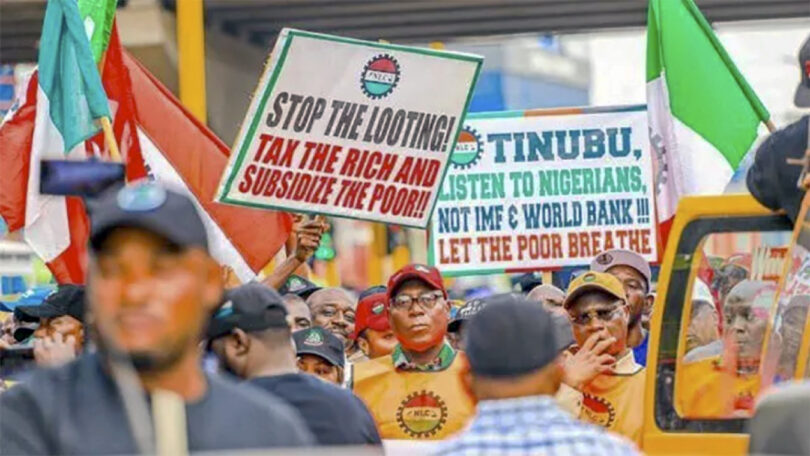
As Nigeria joins the rest of the world to mark International Workers’ Day today, a troubling reality confronts millions of workers: the promise of decent work is steadily slipping out of reach. Across sectors, from agriculture to banking, insecurity, rising poverty and weakening labour protections are converging to erode not just jobs, but the dignity of work itself.

For an average Nigerian workers like Ade Oladimeji (not real name) who is in his early 40s, married, with four children, there is nothing special to celebrate. He works full-time in a mid-sized private company in Lagos Nigeria, and would traditionally be considered a “decent” worker with salary of ₦150,000 a month, at least he earns more than the country’s minimum wage of ₦70,000.
On paper, he is employed. In reality, he is stretched thin.
With six mouths to feed, and extended family on his neck, at the end of the month, his salary comes in and disappears almost immediately. Rent, school fees, food prices that keep rising, generator fuel, security dues for his street and community because safety is not guaranteed. Contributions to extended family. Medical bills. Transport.

At work, expectations are high. Targets must be met. There’s talk of restructuring, automation, even AI. Job security is no longer guaranteed. He knows colleagues who were “let go” quietly. So he works harder, stays longer, answers emails late into the night—because losing this job is not an option.
But even with the job, the numbers don’t add up.
What should have been savings becomes survival. There is no real safety net. No reliable public services to cushion him. The government provides electricity on paper, but he pays for power. Provides security, but he pays for that too. Provides healthcare, yet he pays privately. Education exists, but he cannot risk his children’s future on it.
And so Ade lives in a constant balancing act; employed, but economically strained.
He is not unemployed: But he is not secure.
And certainly, he is not experiencing what the International Labour Organization (ILO) defines as decent work, a job that delivers fair income, security, social protection, and dignity.
Ade did not always live like this.
A few years ago, he worked in a regional branch of his company in the Northern part of Nigeria. Life was modest but stable. His family lived close to his workplace, his children attended school regularly, and his wife ran a small provision shop that supplemented their income.
Then insecurity escalated. At first, it was rumours! Attacks in nearby communities, stories of kidnappings on highways. Then it became real. Colleagues began to relocate quietly. One staff member was kidnapped on his way home. Another resigned abruptly after threats to his family.
Eventually, the branch scaled down operations. Movement became restricted. Customers stopped coming. Staff safety could no longer be guaranteed.
Ade had a choice: stay and risk everything, or leave and start over. He left. But relocation did not come with stability, it came with survival.
He moved his family to the southern part of the country, nearer to his roots, he believed, but without a guaranteed position. His previous role no longer existed in the same form. The company offered him a contract role, lower pay, no benefits, no long-term security.
His wife lost her shop overnight. Starting again required capital they didn’t have.
Now, instead of a structured job, Ade juggles multiple income streams. He works part-time, does consultancy when he can, and sometimes takes on roles far below his skill level just to make ends meet. At one point, he even considered ride-hailing services, not because he wanted to, but because he needed immediate cash flow.
This is the quiet transition from formal employment to vulnerable work.
His children’s education is disrupted. Rent is higher in the city. Competition for jobs is intense. And without stable income, the family begins to slip, slowly but steadily into poverty.
This is not just Ade’s story.
Across parts of Nigeria, insecurity has forced farmers off their land, cutting off livelihoods and food supply. Displaced teachers, health workers, and small business owners. Shut down local economies, pushing workers into informal, low-paying, and often unsafe jobs.
Increased internal migration, creating pressure on urban centres and reducing job quality.
Even those who remain employed often experience a downgrade, from stable, pensionable jobs to contract, casual or gig work with little protection.
The International Labour Organization defines decent work as productive employment that delivers fair income, security in the workplace, social protection, and dignity.
In Ade’s case, and for millions like him, insecurity has stripped away each of those pillars: Income becomes unstable:
Security is no longer guaranteed.
Protection disappears with informal or contract work: Dignity is eroded when survival replaces choice: What makes this particularly devastating is the cycle it creates.
Insecurity leads to job loss or displacement.
Displacement leads to underemployment or informal work and underemployment deepens poverty. Poverty, in turn, feeds further instability.
So the issue is no longer just about jobs, it is about the quality of work and the conditions under which people are forced to survive.
Labour perception
At a pre-May Day lecture in Abuja on Wednesday, organised labour leaders delivered a stark warning, Nigeria’s labour market is increasingly defined not by opportunity, but by survival. The President of the Nigeria Labour Congress (NLC), Joe Ajaero, captured the urgency: insecurity and poverty have become fundamental barriers to decent work, trapping millions in conditions where employment no longer guarantees a livelihood. For many, he argued, the issue is no longer about getting a job, but about what that job can sustain.
Background to May Day
The roots of May Day could be traced back to the Haymarket Affair in Chicago, where workers protested for an eight-hour workday—an event that became a global symbol of the struggle for fair labour conditions. Today, that struggle has evolved into what the International Labour Organization defines as “decent work”—productive employment that delivers fair income, security in the workplace, social protection, and rights at work.
By that standard, Nigeria faces a deepening crisis.
Data from the National Bureau of Statistics paints a grim picture. As of the second quarter of 2024, about 93 percent of employment in Nigeria is informal, with self-employment accounting for 85.6 percent of jobs. This means the vast majority of Nigerian workers operate outside formal protections, no pensions, no health insurance, no job security.
For Ajaero, this is the core of the problem. “If there is poverty, if there is insecurity, you don’t even have a job, talk less of having a decent job,” he said, stressing that employment without protection cannot be considered decent.
Across Nigeria, insecurity has become an economic disruptor. Farmers abandon fields due to fear of attacks. Traders avoid long-distance travel. Small businesses operate under constant threat. According to labour leaders, this has directly reduced productivity and deepened poverty.
“If we remove insecurity today, there will be food everywhere,” Ajaero noted. “People will go back to their farms.”
This is not theoretical. In many agrarian communities, displacement has led to reduced food output, higher food prices and job losses across the agricultural value chain—one of Nigeria’s largest employers.
The poverty Trap: When work doesn’t pay
Even for those employed, rising poverty has redefined the meaning of wages. The President of the Trade Union Congress (TUC), Festus Osifo, warned that the average worker’s salary can no longer sustain basic living.
This reality is echoed by TUC Deputy President Oluwole Olusoji, who described a system where workers are forced to self-provide essential services—security, electricity, healthcare, education and transport—costs that should ordinarily be covered by public infrastructure.
In practical terms, a Nigerian worker earning a monthly salary is also paying for private security, alternative power supply, private schooling, healthcare and transportation. What should be disposable income becomes survival expenditure.
As Olusoji put it bluntly: Nigerians are “not getting a fair deal.”
Another major threat to decent work is the rise of casualisation; short-term, contract-based employment that offers little or no job security. Across industries, particularly banking, telecommunications and emerging fintech sectors, employers increasingly rely on contract staff.
While this model offers flexibility for businesses, it leaves workers vulnerable, excluded from union protections, career progression and long-term benefits.
Labour leaders warn that this trend is being reinforced by loopholes in Nigeria’s Labour Act, particularly provisions around “volunteerism,” which allow employers to discourage union membership.
Beyond insecurity and poverty, technology is reshaping the labour market. The rise of artificial intelligence (AI) and automation is already altering job structures across sectors.
Olusoji acknowledges the dual nature of this shift: while AI poses a threat to certain roles, it also creates new opportunities. The challenge, however, is preparedness.
“Who are the people that will be at risk? Likely those who have not adapted,” he noted.
Without large-scale re-skilling and training, many workers risk being left behind in a rapidly evolving economy.
Governance as a ‘hidden tax’ on workers
Perhaps the most striking argument came from Dr. Toyin Olawunmi, Acting Head of International Relations, Chrisland University, Abeokuta, a scholar of international relations and strategic studies who described poor governance as a “hidden tax” on Nigerian workers.
When public services fail, citizens are forced to fill the gap effectively paying twice: once through taxes, and again through private spending.
“A minimum wage without minimum governance will not secure the worker,” he said.
This underscores a critical point: improving wages alone cannot deliver decent work without parallel improvements in public infrastructure, security and service delivery.
Labour’s warning—and a Call to action
With economic hardship intensifying, the TUC has warned of possible nationwide protests if conditions do not improve. The message is clear: decent work is not negotiable.
For labour leaders, the way forward requires a multi-dimensional approach:
Strengthening security to revive economic activity; formalising the informal sector to expand worker protections; reviewing outdated labour laws; investing in public services to reduce the cost burden on workers and promoting skills development to prepare for technological change.
At its core, the crisis of decent work in Nigeria is not just about jobs, it is about dignity, fairness and survival.
As workers participate and march at different places across the federation in celebration of May Day today, the question remains whether Nigeria can realign its policies and priorities to meet the global standard of decent work or if millions of workers will continue to work without the basic guarantees that make work meaningful.