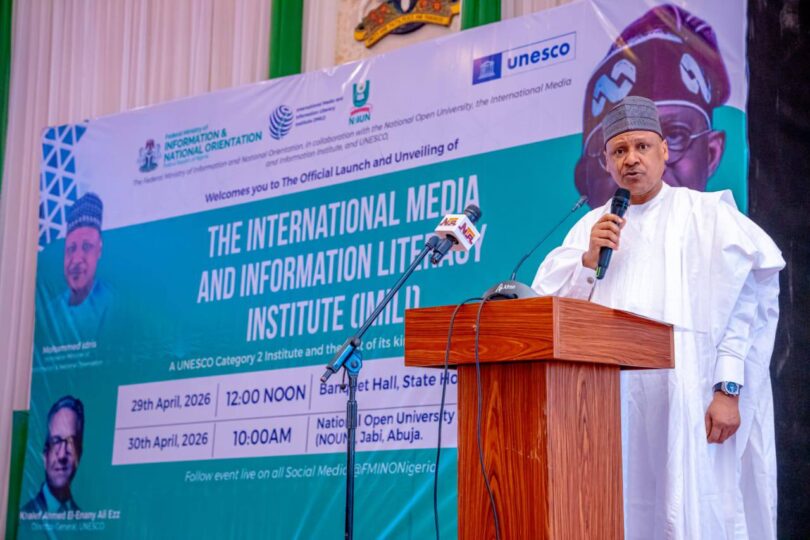
The Minister of Information and National Orientation, Alhaji Mohammed Idris, has described the launch of the International Media and Information Literacy Institute (IMILI) as an institute of global relevance, established to tackle misinformation, disinformation in Nigeria.
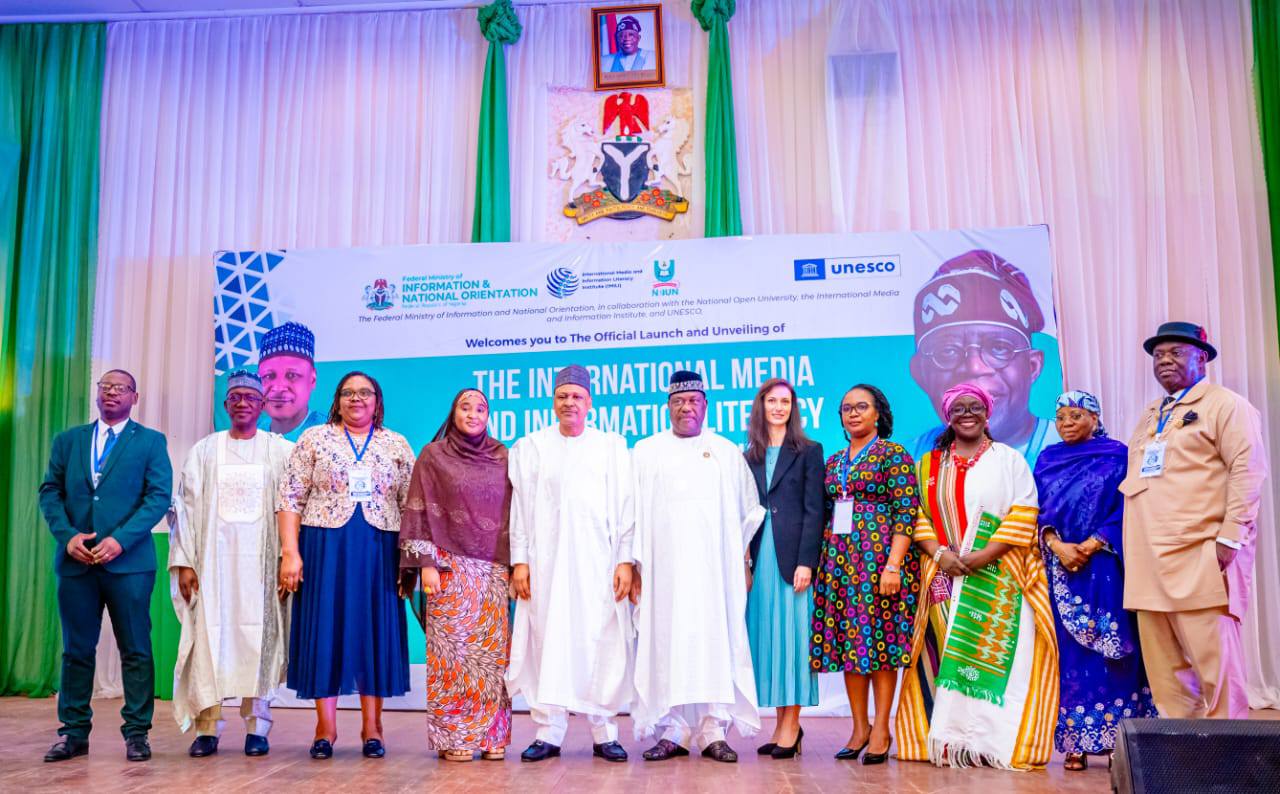
Idris said this at the official launch of IMILI, the world’s first United Nations Educational, Scientific and Cultural Organisation (UNESCO) Category 2 Institute dedicated to Media and Information Literacy, on Wednesday in Abuja.
“Today is a moment of pride not just for Nigeria, but for Africa and the global community.
“On our soil now stands an institute of global relevance, positioned to confront one of the most pressing challenges of our time – misinformation and disinformation.
“This achievement reflects a deliberate and rigorous process. It was earned through sustained effort, commitment, and competition, and it speaks to Nigeria’s readiness to lead in this critical area.”
According to him, Nigeria stands at the intersection of technology, knowledge, and democracy.
“By hosting the world’s first UNESCO Category 2 Institute dedicated to Media and Information Literacy, we are affirming our leadership in promoting informed citizenship, strengthening democratic discourse, and advancing global efforts to safeguard information integrity.
“We are honoured by the trust you have placed in Nigeria to host this one-of-a-kind institute.
“Your confidence reaffirms our country’s growing stature as a leader in driving global knowledge exchange and capacity-building initiatives in Africa and beyond.
“For the record, this is also the first UNESCO Category 2 Institute in Nigeria’s Information and Communication sector, thus underscoring our determination, as an administration, to change the communication landscape better than we met it,” he said.
The minister said the establishment of IMILI was both a national milestone and a global necessity.
“In today’s information-driven world, the ability to distinguish fact from falsehood is essential. Media and Information Literacy equips citizens with the skills to access, evaluate, and share information responsibly.
“The vision of IMILI, a media and information-literate world, aligns with our national aspiration for an informed, resilient, and inclusive society.
“Through IMILI, we aim to build knowledge systems that empower citizens, young and old, to engage critically with the digital environment, participate meaningfully in democracy and nation building, and uphold truth in public discourse,” he added.
The minister said as a UNESCO Category 2 Institute, the institute would serve as a hub for research, policy dialogue, capacity building and international collaboration across sectors.
According to him, the administration of President Bola Tinubu has sufficiently provided foundational support for the take-off of IMILI.
He said the country was establishing a sustainable governance framework that met all UNESCO standards.
“IMILI will operate independently, professionally, and transparently, guided by international best practices and accountable to its mission to advance freedom of expression, access to information, and media integrity,” the minister said.
Speaking after assessing the institute’s facilities at the National Open University of Nigeria, Abuja, Ms. Mariya Gabriel, Assistant Director-General, Communication and Information, UNESCO, said she was impressed with the facilities put in place.
Gabriel said, “My impression is first that the key milestone was achieved. We have a very strong foundation to unlock the full potential of Nigeria, leading in the media information literacy.
“What I already have seen, that here collaborative research, multi-stakeholder approach and working with all the entire ecosystem of the information integrity is something that has a very solid foundation.
“So, now what we need is to stay very pragmatic, to offer training to educators, to work with civil servants, teachers, media and to see how in a very concrete case we can offer solutions,” she said.
Nigeria’s Permanent Representative to UNESCO, Dr Hajo Sani, said with the launch of the institute, Nigeria had demonstrated to the world its capacity to advance media and information literacy.
Sani recalled that Nigeria started the concept in 2022, expressing happiness over the reality on the ground.
“Practically coming to this centre, we have seen that really the structure is on the ground and it’s just for the take-off now.
“We are very happy that we are showing the world that Nigeria has the ability, has the capability to push forward the media and information literacy.
“At higher level and international level, it’s not just for Nigeria, Africa, it’s for the global, being the first global institute to be established, and we are happy Nigeria is hosting it,” she said.
Also speaking, Director of IMILI, Dr Sharon Omotosho, expressed the institute’s readiness to address the situation around misinformation, disinformation, hate speech, and all the challenges of artificial intelligence and the digital platforms.
“We are grateful that Nigeria has taken the first step, of lighting a candle in the midst of the darkness, so we are not worried about the situation.
“But we are willing to address the situation around misinformation, disinformation, hate speech, and all the challenges that come with the use of artificial intelligence and the digital platforms.
“So the International Media and Information Literacy Institute is set to ensure that it provides all the services like training, advocacy support, research, policy support, and others as may be required across sectors,” she said. (NAN)