
4 min readApr 30, 2026 09:40 PM IST
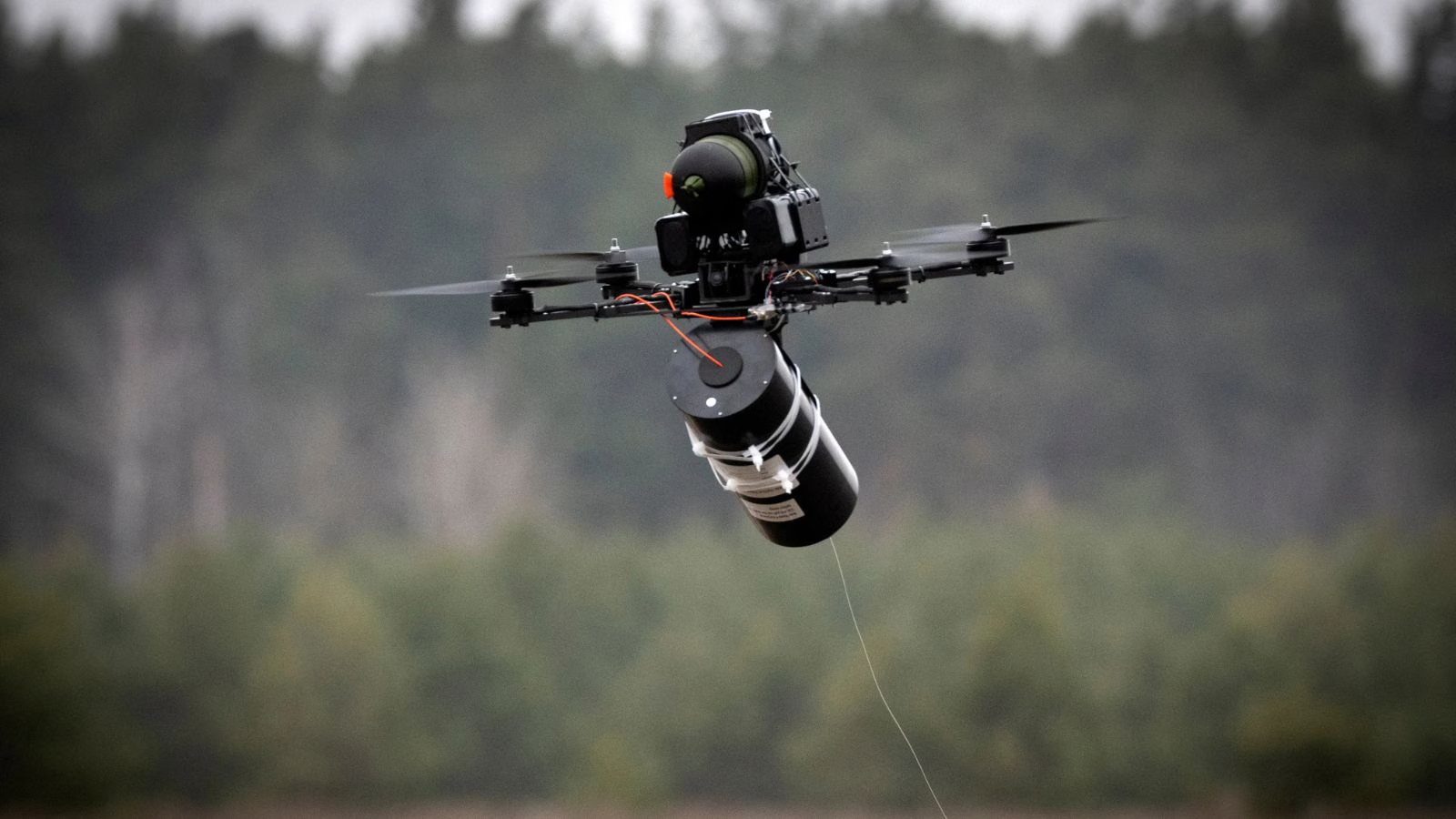
Small drones, controlled by fiber optic cables the width of a dental floss, are being deployed by Lebanese militant group Hezbollah in its war against northern Iran. This weapon has previously been widely used by Ukraine in its war against Russia, the Associated Press reported.
The fibre optic cables used in the drones are thin and almost invisible, making them immune to electronic jamming. While they are susceptible to tangling due to wind or other drones, drone expert Robert Tollast of the Royal United Services Institute told AP that “if you know what you’re doing, it’s absolutely deadly.”
According to Tollast, the drones fly low and are fast and small, making detection and interception extremely difficult. Experts also note that since they are small and fast, they are hard to track and detect. Israel needs to find a way to intercept them, which is extremely difficult, or snip the nearly invisible cables.
Former Israeli air defence commander Ran Kochav admitted Israel is currently failing to counter them: “They fly very low and very fast, and they are very small, it’s very difficult to detect them, and even after they’re detected, they are really hard to track.” He also acknowledged that Israel focused too heavily on missile and rocket defence, neglecting drone threats — a lesson that should have been drawn from the Ukraine war.
Ukrainian technology
Moscow and Kyiv have been in a constant battle of technology in the four-year war. Fiber-optic drones were developed in the Ukraine conflict to bypass the electronic jamming of Russian Shahed drones.
Tollast said that Russia and Ukraine have been using many different types of drones “at a phenomenal scale.”
The scale is such that entire fields in Ukraine have been covered in the cables. Cables have been recorded extending up to 50 km. Their use is so widespread in Ukraine that front-line towns are draped in shiny, fishing-line-like cables resembling giant spiderwebs.
Attacks and casualties
Story continues below this ad
Hezbollah has been airing videos of attacks with the new drones against Israeli troops in southern Lebanon on social media platforms and Al-Manar TV. Notable points in the video series have been an attack that killed one Israeli soldier and wounded six, and another, on Tuesday, when an attack killed an Israeli civilian.
In the attack where the Israeli soldier was killed, Hezbollah issued a video taken by a drone till it exploded. In the same location, a second drone was fired as a military helicopter landed to evacuate the injured. The drone, however, narrowly missed the mark.
Israel has a fleet of drones that carry out attacks and ensure surveillance to target Hezbollah militants. Hezbollah announced the use of the drones on March 2 during a round of fighting.
A close call in Kiryat Shmona
Zevik Glidai, a 78-year-old math teacher and ambulance volunteer living 1.5 miles from the Lebanese border, found one such drone crashed in his backyard on April 13, surrounded by coils of white fiber-optic thread, AP reported. Nearly 2 kg of explosives failed to detonate. “We are very worried about these drones because there’s no way to shoot it down, because we can’t detect it,” he said, adding that bomb squad responders told him, “You have a lot of luck.”
Story continues below this ad
“They picked up all of the pieces that they could pick up, and they left me a few optical fibers as a keepsake,” he added.
Stay updated with the latest – Click here to follow us on Instagram
© Heraldsun