Ceasefires are usually treated as the negative space of war: the moment when fire stops, diplomats return and the strategic temperature begins to fall. That reading is dangerously incomplete. In the present Iran-US-Israel confrontation, the ceasefire is not merely an interruption of violence. It is becoming a coercive architecture in its own right: a system that suspends open combat while keeping pressure, surveillance, blockade logic and nuclear bargaining simultaneously alive. The more radical conclusion is this: a ceasefire can intensify the logic of war precisely because it removes the battlefield without removing the coercion.
The question, then, is no longer whether Tehran, Washington and Tel Aviv are moving toward peace or war in the old binary sense. The sharper question is whether a ceasefire under pressure can remain stable when one side experiences it not as de-escalation, but as controlled attrition.
A pause that leaves Iran under maritime pressure in the Strait of Hormuz, under nuclear-verification pressure from the IAEA, under diplomatic pressure to accept a compressed framework, and under regional pressure through Lebanon and Iraq, is not a neutral diplomatic interval. It is an attempt to convert military shock into political extraction.
The technical term for this is coercive de-escalation. It is not the same thing as peace-making. Peace-making reduces the opponent’s perception of existential pressure. Coercive de-escalation does the opposite: it lowers the immediate kinetic tempo while preserving the adversary’s sense that time is working against it. The ceasefire then becomes a strategic vice. It compresses Tehran’s decision-making horizon, narrows its bargaining bandwidth and forces it to calculate whether waiting is safer than acting.
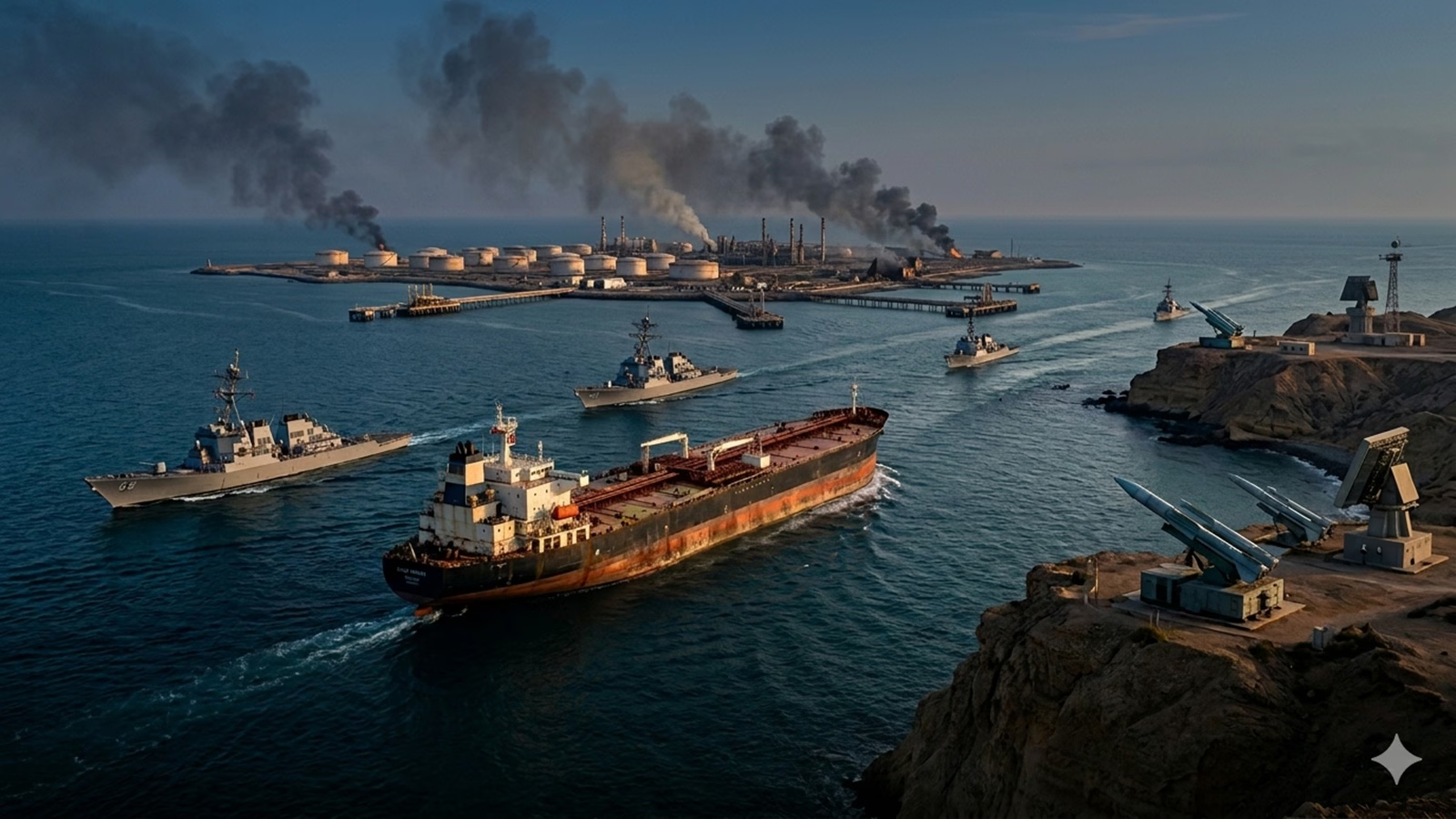
Hormuz is the most visible part of this architecture. The issue is not only whether ships pass or do not pass. The issue is who defines the rules of passage, who prices risk, who converts insurance into strategy, and who can make transit politically conditional.
Maritime advisories and AP reporting on military orders show that the waterway has become a live theatre of deterrence management. Once a maritime corridor is securitised at this level, “open” and “closed” become misleading categories. The real condition is controlled permeability: traffic may move, but under a regime of fear, permission, threat and political signalling.
For Iran, this matters because Hormuz is not simply a geographic chokepoint. It is one of the few instruments through which Tehran can globalise the cost of pressure. If the ceasefire gradually neutralises that instrument—by normalising inspections, sanctions exposure, naval escort structures or blockade-adjacent enforcement—then Iran’s leverage is not frozen; it is being slowly dismantled. In that environment, pre-emption begins to look less like irrational escalation and more like an attempt to prevent the permanent conversion of a temporary ceasefire into a new coercive order.
READ: Iran warns US of ‘prolonged, painful blows’ amid reports of potential strike plans
The nuclear file sharpens the same dilemma. The unresolved status of highly enriched uranium, the sequencing of sanctions relief and the scope of verification are not technical details at the edge of diplomacy. They are the core of the bargaining system. The IAEA Director General’s statement and reporting on narrowing differences after Pakistani mediation reveal the central asymmetry: Washington and its allies want verifiable irreversibility, while Tehran needs reversible leverage. A deal that removes the nuclear card before changing the coercive environment would not be read in Tehran as compromise. It would be read as unilateral demobilisation.
This is where the logic of limited pre-emption becomes analytically intelligible. The point is not to predict or endorse a specific act. The point is to understand a strategic grammar. When a state concludes that diplomacy is being used to lock in its degradation, it may seek a calibrated shock to reopen bargaining space. Such a move would not necessarily be designed to start a full war. It could be designed to disrupt the opponent’s assumption that escalation dominance has already been secured. In deterrence terms, Tehran would be trying to restore uncertainty to a system that the US and Israel are trying to make administratively manageable.
This is why the most important sentence in the current crisis may be this: waiting is not always de-escalatory. In many Western readings, patience is treated as restraint. But for a state under layered coercion, patience can also mean allowing the adversary to consolidate the next phase of pressure.
If the ceasefire becomes the time in which Washington strengthens maritime rules, Israel refreshes military options, negotiators harden nuclear terms and regional fronts are disciplined against Iran, then time itself becomes hostile terrain.
The Pakistan-mediated track illustrates the ambiguity. The fact that talks survived through last-ditch mediation does not mean balance has returned. It may mean only that both sides still need a diplomatic shell around coercive manoeuvre. Reporting on a possible rushed framework deal suggests movement, but not settlement. In fact, a framework that moves faster than the underlying balance can be more destabilising than no framework at all. It creates deadlines, reputational traps and incentives to act before the window closes.
Lebanon and Iraq widen the geometry. Pressure on Iraq’s dollar flows and the linkage between the Lebanon ceasefire track and Iranian influence over Hezbollah turn the regional arena into a network of connected pressure nodes. This is precisely the kind of environment in which limited action by one actor can be misread as theatre-wide intent. The danger is not only escalation by decision. It is escalation by architecture: too many coercive levers operating at the same time, each producing signals that the others distort.
There is also a deeper political layer. Iran is often misread as a brittle administrative state: a regime with borders, ministries and command centres, but without the thicker historical grammar that allows political pain to be translated into collective endurance. This is a categoric error. Pressure does not enter an empty strategic field. It enters a political culture that often converts coercion into resistance, and resistance into legitimacy. The West may imagine pressure as a solvent. Tehran may experience it as proof of the need for counter-pressure.
The radical implication is that Washington and Tel Aviv may be manufacturing the very pre-emption logic they seek to deter. By treating ceasefire as a holding pen for Iranian concessions, they risk convincing Tehran that restraint has become a depreciating asset. The more the ceasefire is used to accumulate pressure, the less valuable compliance becomes. At that point, the incentive structure flips: not acting may appear more dangerous than acting, because inaction allows the opponent to define the post-war order without paying a new price.
READ: Iran’s supreme leader says Gulf future ‘without US,’ new Hormuz rules to boost stability, economy
The White House can present the ceasefire as evidence that coercion worked; indeed, its own public framing casts military pressure and diplomatic pause as complementary instruments. But that is precisely the problem. If the other side sees the same arrangement as surrender dressed in procedural language, the pause does not stabilise the system. It radicalises the calculation. The more Washington insists that force created diplomacy, the more Tehran may conclude that only counter-force can create a different diplomacy.
This does not mean Iranian pre-emption would be wise, lawful or strategically successful. It could misfire, trigger escalation and deepen the very encirclement it seeks to resist. But analytical seriousness requires separating judgment from explanation. A move can be dangerous and still rational inside a particular threat model. The task is not to moralise the calculation away, but to ask why the calculation becomes available at all.
The answer is that the ceasefire is carrying too much coercive weight. It is expected to stop war, discipline Hormuz, contain Lebanon, pressure Iraq, regulate the nuclear file, preserve US credibility, satisfy Israeli security demands and compel Iranian flexibility. No ceasefire can bear that many strategic functions without becoming militarised. The more functions it absorbs, the more it stops being a bridge to peace and becomes a platform for the next contest.
A genuine de-escalation architecture would require something very different: visible reduction of maritime coercion, credible limits on Israeli re-attack options, a nuclear sequence that does not demand Iranian demobilisation before sanctions relief, and a regional track that treats Lebanon and Iraq as political arenas rather than mere pressure extensions. Without these elements, the ceasefire remains reversible by design.
The uncomfortable conclusion is that the most dangerous moment may not be the collapse of talks, but their continuation under asymmetric pressure. Talks can pacify, but they can also trap. If Tehran reads the current process as a trap, limited pre-emption becomes not the opposite of diplomacy, but its violent punctuation mark.
The line between ceasefire and renewed strikes is therefore not a line between reason and madness. It is a line between two competing theories of time: Washington and Tel Aviv trying to use time to institutionalise pressure, and Tehran trying to prevent time from becoming a weapon against it.
That is the strategic paradox now facing the region. The ceasefire was meant to pause escalation. Yet if it continues to operate as an offensive system by other means, it may produce exactly the behaviour it was supposed to prevent. The first shot in the next phase, if it comes, may not be born from a rejection of diplomacy. It may be born from the belief that diplomacy has been converted into a cage.
OPINION: Talks without balance: Why Tehran and Trump remain locked in escalation
The views expressed in this article belong to the author and do not necessarily reflect the editorial policy of Middle East Monitor.