
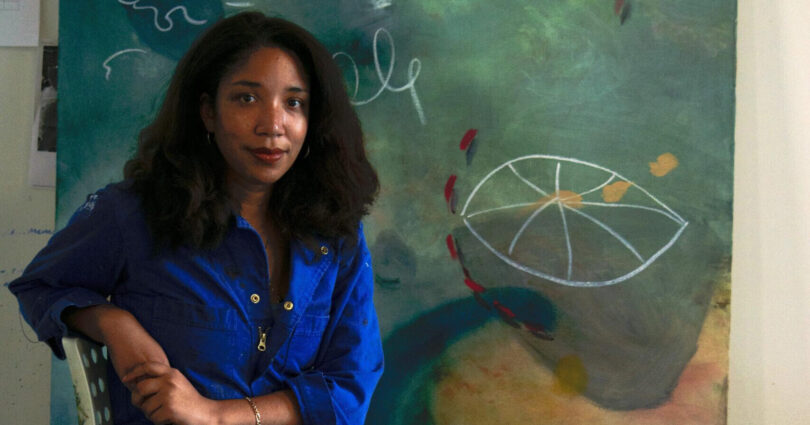
Within Debra Cartwright’s practice, oil paintings, watercolors, and illustrations create a terrain to confront and contemplate the history of medical injustice and its wake. Her elegant works engage viewers in a formalistic beauty while revealing narratives of Black women in America affected by the legacy of current disparity in health care.
She explains, “I’d love to share stories and have people look a little bit harder at areas of the world that are just an article or just a blip or just something you read in a textbook a long time ago. To sit with it for a little bit longer.”
Cartwright’s first drawings and doll sculptures were created from medical supplies as a young child waiting in her mother’s gynecology office. As she grew beyond this office into her adult life, Cartwright became exposed to the entirety of the medical world. Her encounters with these spaces created a disconnect from the community-oriented office she had grown up in.
Cartwright describes, “my friends were having medical complications or going through pregnancy, talking with them and doing research with them and realizing the disparity in health between Black women and everyone else.” This disconnect and inequity is at the core of Cartwright’s practice, prompting research surrounding the history of gynecology, abortion, and midwifery in America that fuels her work.
Through writing, reading, illustrations, and watercolor collages, Cartwright’s work explores these histories. In her oil paintings, Cartwright draws from Saidiya Hartman’s “The Belly of The World: A Note on Black Women’s Labors.” Hartman relates racial capitalism’s plundering of Black women’s bodies to the exploitation and commodification of land. This connection informs Cartwright’s work, creating what she describes as an “amalgamation of the inside, the outside of the body, and the landscape together”, visually manifesting their intertwinement.
In her large-scale canvases human forms emerge from an abstracted landscape, referencing these exploitative relationships and relating them to the extractive practice of gynecology. Specifically influenced by painters from the Hudson River School, Cartwright uses the classical conversation of oil painting to raise critical issues affecting Black women’s health care today.
In a recent series, Cartwright researched experiments on enslaved women conducted by the man widely regarded as the father of gynecology, Dr. Sims. While he conducted horrific experimentations on many more women, only three are named in his documentation: Anarcha, Lucy, and Betsy.
Cartwight draws from these women’s experiences to create narratives that transcend the only documentation that exists of their lives in secondary sources. She notes, “I would do these illustrations of them in community, them getting free, the interior and exterior of their lives.” Drawing inspiration from Saidya Hartman’s practice of critical fabulation, Cartwright restores the agency and interiority the archive denies these women.
As Cartwright’s work reflects their lives, she describes “placing myself in community with these women,” bringing past and present together to explore how their experiences connect with her own.” In her practice Cartwright is finding ways to, as she describes,“lay my own story on top of the story that is embedded within it.” This pursuit is realized in her repurposing of scraps of legs, limbs, and bodies from Essence Magazine, where she worked for a decade before learning traditional oil painting. As her practice evolves, layering these connected experiences, Cartwright is continuing to involve her personal history in her work; she describes “diving more into my own play, as a child in that office and thinking about how I can rectify that with … the horror.”
As an artist-in-residence at Silver Art and a painting professor at Rutgers University, Cartwright is continuing to create work that inscribes the pertinence of health disparities and memorializes those affected by it, whilst interweaving her own personhood in new ways.
Propelling her own work, she questions, “What is the best way to say what I am trying to say? is it painting? If it’s not painting, what is it?”. This tension is moving Cartwright’s practice toward installation and community projects, using painting as one component in a larger display to recontextualize and powerfully represent the history of medical injustice against Black women.
Courtesy: Silver Art