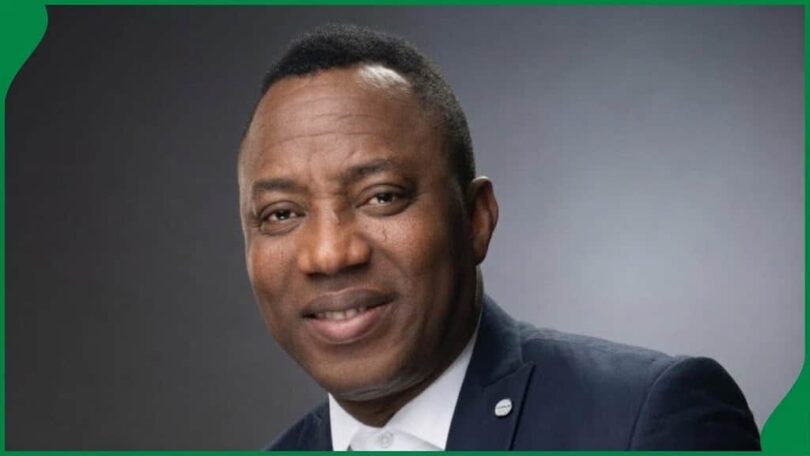
The Department of State Services (DSS) has asked the Federal High Court in Abuja to stop Omoyele Sowore from presenting more witnesses in his ongoing cyberbullying trial.
The security agency told the court that the African Action Congress (AAC) presidential candidate had taken more adjournments than allowed by law, insisting that the trial should no longer be delayed.
DSS counsel, Akinlolu Kehinde, SAN, made the request on Tuesday before Justice Mohammed Umar, shortly before the court adjourned, Herald Sun reports.
Kehinde informed the judge that the agency had filed an application seeking an order to close Sowore’s defence, adding that the defendant’s legal team had already received a copy.
The senior lawyer argued that Sowore had exceeded the five adjournments allowed under the Administration of Criminal Justice Act (ACJA) by nine.
He urged the court to consider the application, insisting that there must be an end to the repeated delays.
“Before we finally draw the curtain to the proceedings, I want to bring to your lordship’s notice the application we filed and served on the defendant.
“The application is that there must be an end to all these. The defendant has since exceeded the number of adjournments as required by law,” he said.
In the application filed on November 23, the DSS asked the court to make two orders.
The first is an order closing Sowore’s defence, while the second is for both parties to file and exchange their final written addresses within a period to be fixed by the court before setting a date for their adoption.
Giving reasons for the request, Kehinde said Sowore was re-arraigned on a two-count charge on January 19, 2026, and pleaded not guilty before the trial began.
He explained that the DSS called its witness and closed its case in March 2026.
The lawyer added that the court dismissed Sowore’s no-case submission on May 8, 2026, after which he was asked to open his defence.
According to Kehinde, Sowore had requested or secured adjournments on at least 14 occasions, including eight times after he was called upon to defend himself.
He argued that this was above the five adjournments permitted under Section 396(4) of the ACJA 2015.
The DSS counsel further told the court that since Sowore opened his defence on July 6, 2026, only two defence witnesses had testified.
He also accused the activist of filing several applications and court processes that had slowed down the trial, including a subpoena issued against the DSS lead counsel.
Kehinde said the court had warned Sowore several times against further delays.
He maintained that the constitutional right to fair hearing did not give a defendant the freedom to seek unlimited adjournments after being given enough time to present his case.
The lawyer referred to Section 36 of the 1999 Constitution, arguing that the law guarantees a fair hearing within a reasonable time.
He also cited the ACJA, which requires criminal trials to proceed from day to day or within the limits set for adjournments.
Kehinde urged the court to grant the application in the interest of justice.
However, Sowore’s lawyer, Reuben Adakole, opposed the timing of the request, saying the court needed to first rule on other pending applications filed by the defence.
Adakole acknowledged receiving the DSS application but argued that it was too early for the court to consider it.
He said the defence was waiting for the court to decide on its objection to the subpoena involving the Chairman of the Independent National Electoral Commission (INEC), Prof. Joash Amupitan.