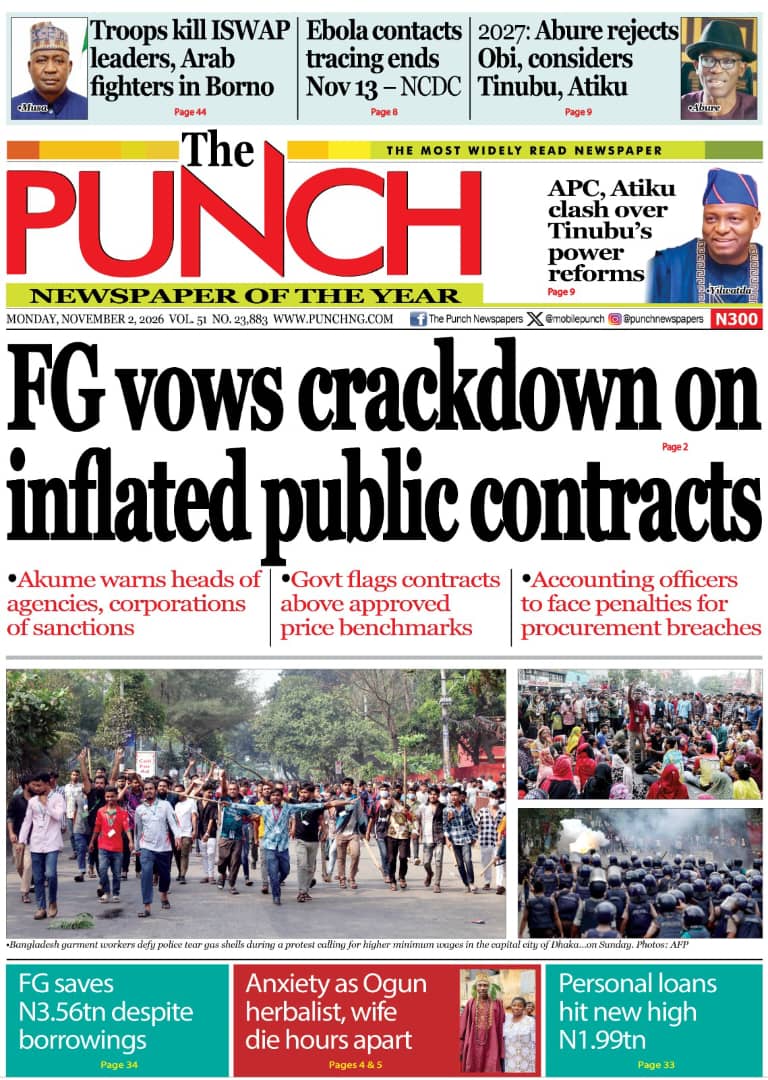
Newspapers reported on issues ranging from the preparation for the 2027 Elections, the issue of the recent loan approval by the National Assembly for the Federal Government to public infrastructure contracts….
Newspapers reported on issues ranging from the preparation for the 2027 Elections, the issue of the recent loan approval by the National Assembly for the Federal Government to public infrastructure contracts.
Sports and entertainment also got prominent mentions as well as developments in the Economy.
1. The Punch leads with a report on the move by the Federal Government to put a stop to the practice of inflating contracts and save public funds among other stories.
The Federal Government has vowed to crack down on inflated public contracts and procurement violations, warning heads of government-owned agencies, corporations, councils, authorities and commissions that they risk sanctions for breaching procurement regulations.
The government raised the alarm over contract awards that exceed approved price benchmarks, restricted competition through exclusive arrangements for contractors and undermine regulatory oversight.
The Secretary to the Government of the Federation, George Akume, issued the warning in a circular directing accounting officers of Federal Government-owned enterprises and other public institutions to comply strictly with the Public Procurement Act, 2007, or face penalties.
The circular, obtained by our correspondent in Abuja, was addressed to ministers, permanent secretaries, heads of government agencies and parastatals, among other senior public officials. Read More In The Punch
2.The Nigerian Tribune in its front page lead reports on the issues surrounding the exclusion of some candidates for the 2027 General Elections by the Independent National Electoral Commission.
The Independent National Electoral Commission (INEC) has come under criticism, following the omission of some political parties’ candidates from its final list for the 2027 general election, with pro-democracy advocates and constitutional lawyers questioning the commission’s powers to exclude candidates.
Constitutional lawyers have questioned whether INEC possesses the authority to independently disqualify candidates from participating in elections.
A constitutional lawyer, Monday Mawah, said neither the Constitution nor the Electoral Act empowered the commission to selectively remove candidates from an election list.
Speaking during a television programme, Mawah said the recent Supreme Court judgment and provisions of the Electoral Act concerning the submission of political parties’ membership registers should not be interpreted as granting INEC the power to disqualify individual candidates.
He explained that where a political party failed to comply with the statutory requirement for submitting its membership register within the stipulated timeframe, the consequence could be a restriction on the party’s ability to field candidates rather than the selective exclusion of individuals. Read more in The Nigerian Tribune


3. The Nation in one of its front page lead focuses on the move by some groups calling for the announcement of election results by media organisations.
The growing call by some political actors for media organisations to engage in the announcement of winners of elections has been described as an invitation to anarchy.
Speakers at a forum in Abuja, which included media executives and representatives of civil society organisations(CSOs), said it was in order for media houses and others to participate in collating election results, but not assume the role of announcing winners.
The forum, tagged: “Dialogue session with media executives on the compliance with the national peace accord,” was organised by the National Peace Committee (NPC) with support from the European Union (EU), the International Press Centre (IPC), the Kukah Centre, among others. Read more in The Nation
4. Guardian in its front page lead reports on the cost of living crisis and debt burden faced by Nigerians with digital loans rates now nearing almost 50%.
Nigeria’s worsening cost-of-living crisis is pushing millions of households into a debt trap, even as digital lenders aggressively factor rising default rates into the cost of their loans. Digital loan disbursements rose to $1.63 billion last year.
Unlike a few years ago, when they began operations, digital lenders now charge nearly 20 per cent interest on one-month loans as they struggle to offset a growing number of defaulters.
While borrowers who default for extended periods may end up paying several times what they borrowed, non-borrowing users of digital-first banks also face constant pressure as lenders seek to expand their customer base.
Checks by The Guardian show that OPay, which claimed to have accounted for 57.4 per cent of the total value of digital credit disbursed last year, charges low-risk borrowers 18.9 per cent monthly interest through its EaseMoni lending platform. Compounded monthly at that rate, the interest would translate into an effective annual rate of about 698 per cent, excluding fees and other charges. Read More in The Guardian
5. The Daily Trust in one of its front page stories reports on the recent revelation of over 300 containers of critical power equipments left to rot at the nations ports for over 20 years.
Recent revelations that more than 300 containers of critical electricity equipment imported by the Federal Government remained stranded at Nigerian ports for years have exposed the administrative bottlenecks and institutional inefficiencies undermining efforts to improve electricity supply across the country, experts have said.
The equipment, some of which have reportedly been trapped in the ports for close to two decades, were procured under various government-funded and development-partner-supported electricity projects, including the National Integrated Power Project (NIPP), Transmission Company of Nigeria (TCN) donor-funded projects and the Presidential Power Initiative (PPI).
Despite their importance to the country’s electricity infrastructure, the equipment have been unable to reach their intended destinations because of unresolved import documentation, disagreements over duty exemptions, mounting shipping demurrage, port charges and bureaucratic delays involving government agencies.
President Bola Tinubu has consequently directed the immediate clearance of the stranded containers, a move that has generated mixed reactions among stakeholders in the power sector. Read more in Daily Trust