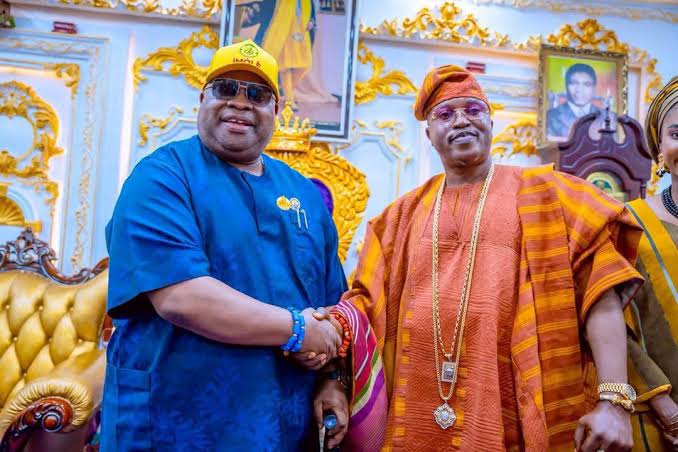
•Says Oluwo’s Freedom of Expression Under Threat
•Wants No Threat Of Removal Over Monarch’s Opinions
The Tawunu Human Rights Initiative has dragged the Osun State Government before the Federal High Court, Osogbo, over alleged interference with the freedom of thought, conscience, religion and expression of the Oluwo of Iwo, Oba Abdulrasheed Akanbi.
The group, which says it is suing in the public interest and on behalf of persons whose fundamental rights are threatened, filed the suit marked FHC/OS/CS/205/2026 through its counsel, Prof. Abdul Rasheed Musa Yusuf.
Joined as respondents are the Osun State Commissioner for Local Government and Chieftaincy Affairs, the Attorney-General of Osun State and the Oluwo himself.
In the originating motion, the group wants the court to declare that the Oluwo has the right “to hold, entertain, maintain and express his personal religious, philosophical, cultural and conscientious opinions concerning traditional religious practices, idol worship, ritual observances and the administration of traditional palaces in Yorubaland” as guaranteed under Sections 38 and 39 of the Constitution.
It also wants a declaration that freedom of expression under Section 39(1) includes the right “to hold opinions, communicate them publicly, disseminate views, advocate reform of cultural and traditional practices and express dissenting opinions on matters of religion, culture, governance and public interest, subject only to lawful and constitutionally permissible restrictions.”
The suit contended that the issuance or procurement of any administrative directive, warning, restraining letter, threat or intimidation purporting to prohibit the Oluwo from expressing his personal opinions, without express statutory authority, amounts to an unlawful interference with his fundamental rights.
The suit urged the court to declare that the Commissioner “has no constitutional or statutory authority to impose an extra-constitutional restriction upon the Third Respondent’s freedom of expression merely because his personal religious or philosophical opinions are considered unpopular, controversial, inconsistent with prevailing traditional practices or offensive to sections of the traditional institution.”
It further seeks a declaration that the existence of a traditional institution, traditional council, customary authority or recognised chieftaincy structure “does not confer upon the Ministry of Local Government and Chieftaincy Affairs any inherent power to censor, suppress or prohibit the constitutionally protected personal opinions of a traditional ruler.”
The group also wants the court to declare that administrative oversight over traditional institutions “must conform to the supremacy of the Constitution and cannot lawfully be employed as a mechanism for suppressing freedom of thought, conscience, religion or expression.”
It also asks the court to declare that any attempt to compel the Oluwo “to abandon, retract or refrain from expressing his sincerely held religious or philosophical convictions solely to conform to an officially preferred interpretation of Yoruba traditional religious practices constitutes an infringement of his constitutionally protected freedom of conscience and expression.”
The applicant is seeking orders of perpetual injunction restraining the Commissioner and the Attorney-General, their agents, officers, servants, privies or any person acting under their authority, from “unlawfully censoring, intimidating, threatening, sanctioning or otherwise interfering with the Third Respondent’s exercise of his constitutionally guaranteed freedom of expression and conscience on matters of religion, traditional practices and cultural reform.”
It also wants an injunction restraining them from employing the machinery, administrative authority or regulatory influence of the Osun State Government or the traditional institution to prevent the Oluwo from expressing his personal opinions, “provided that such expression remains within the boundaries of the law.”
The group further seeks an order directing the Commissioner to “withdraw, rescind or formally disclaim any restraining directive or administrative communication issued against the Third Respondent which purports to prohibit the expression of his personal religious, philosophical or cultural opinions without lawful justification.”
It also seeks an order directing the Commissioner and the Attorney-General to respect, protect and uphold Oluwo’s freedom of expression, conscience and religion in all administrative dealings with him, and to ensure that no adverse administrative action, disciplinary measure, threat of removal, withdrawal of recognition, deprivation of privileges or other punitive consequence is imposed on him merely on account of his constitutionally protected opinions or peaceful advocacy concerning traditional religious practices.
HERALDSUN reports that the state government, in a letter dated November 2026, with reference number CD.17/1/VOL.VIII/377 and signed by Wale Alliyu on behalf of the Permanent Secretary, Ministry of Local Government and Chieftaincy Affairs, cautioned the Oluwo over alleged inflammatory statements capable of igniting religious confrontation and inter-town conflicts.
The letter, a copy of which was received by the monarch’s secretary on November 3, said the monarch’s activities are “raising communal tension, sowing seeds of communal and religious discord and discrediting traditional values.”
The government said the persistence of such crisis-inciting activities had reached a level it could no longer ignore.
“The administration wants to put it on record that within the context of the Nigerian Constitution, every citizen has a right to freedom of religious association,” the government stated.
It added that as a traditional ruler, the Oluwo is bound by the Constitution to respect the rights of his constituents to hold religious beliefs.
“You cannot, and you must not, conduct yourself in any way that can foment religious crisis through serial attacks on people of other faiths,” the letter warned.
The government directed the Oluwo to stop any further attacks on people of other faiths, refrain from further attacks on fellow traditional rulers to forestall inter-town confrontation, and work to preserve the culture and tradition of the people which the stool symbolises.
It also urged him to be guided by norms and regulations as spelt out in the Chieftaincy Laws and resolutions of the State Council of Obas.
The Ministry said it will be monitoring compliance, while the State Council of Obas has equally been directed to watch and act on recent developments within Iwo land.