BY SPECIAL CORRESPONDENT
The second day of the Enugu Photo Festival 2026 unfolded on Tuesday, 17 November, at the Centre for Memories, Enugu, drawing a vibrant cross-section of artists, academics, students, traditional craftspeople, and members of the public into an immersive celebration of heritage and visual storytelling.
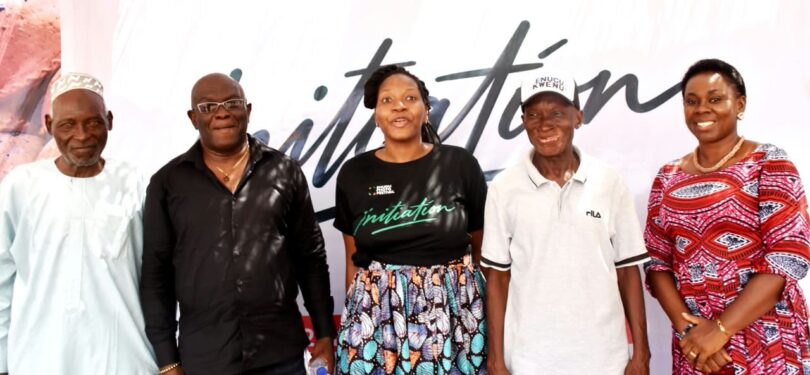
Gathered under this year’s evocative theme, “Initiation,” participants engaged in a dynamic programme of intellectual discourse, live craft demonstrations, cultural performances, and the formal opening of the festival’s flagship exhibition.
Explaining the curatorial vision behind the theme, the festival’s Curator and Artistic Director, Chidera Sam-Eze, noted that “Initiation” was deliberately chosen to move beyond conventional notions of closed spiritual or social rituals. Instead, the festival interrogates that critical threshold before knowledge transforms into practice—examining how artistic skills, cultural memory, and creative mastery are transmitted across generations through deliberate teaching, quiet observation, rigorous apprenticeship, and active community participation.
A major highlight of the morning session was a thought-provoking keynote address delivered by Prof. Chuu Krydz Ikwuemesi, a renowned Professor of Painting and History of African Art at the University of Nigeria, Nsukka (UNN). Drawing deeply from his decades of scholarly and creative engagement with African art, traditional Uli aesthetics, and indigenous visual knowledge systems, Ikwuemesi situated contemporary artistic practice within broader frameworks of cultural survival and continuity. His lecture set a compelling intellectual tone, challenging attendees to examine how indigenous knowledge adapts, mutates, and endures as it passes from one generation to the next.
Building on the keynote’s foundation, the conversation expanded into a dynamic panel titled “Conversations Across Generations and Practice.” The session bridged academic and generational divides by bringing together lecturers alongside postgraduate and undergraduate students from diverse disciplines, including graphics, fashion, art history, and photography. Through candid presentations, speakers offered varied perspectives from different stages of artistic learning, framing initiation as a continuous, lifelong journey that stretches from the classroom and studio into professional and cultural life.
Transitioning from theoretical discourse to tactile reality, the afternoon programme moved into live, practical demonstrations led by both traditional artisans and contemporary practitioners. Master potters from Ishiagu, skilled basket weavers from Ukehe, and fine artists from UNN captivated the audience by demonstrating intricate aspects of their respective crafts. According to Sam-Eze, bringing together such varied practitioners underscores that despite working across different mediums, they all actively sustain the informal yet vital systems through which cultural knowledge is handed down. These live sessions highlighted the intimate relationship between the hand, the raw material, the master, and the learner—reinforcing the festival’s core thesis that true initiation frequently occurs through doing, watching, and participating rather than through formal instruction alone.
Adding rhythmic and oral dimensions to the visual and tactile displays, the programme also featured evocative poetry readings and an energetic cultural performance by the Adanta Cultural Group, weaving movement and indigenous storytelling into the broader dialogue on heritage preservation.
The day’s activities culminated in the formal opening of the Enugu Photo Festival 2026 exhibition—a sprawling visual showcase featuring more than 70 photographs, including distinct bodies of work by eight emerging and established artists selected through the festival’s 2026 Open Call.
Curated to reflect diverse visual voices, the exhibition brings together compelling projects that interrogate cultural practice, spirituality, environmental shifts, identity, collective memory, and the evolving relationship between modern communities and age-old traditions. Standout works include visual narratives documenting vibrant masquerade traditions, indigenous pottery, communal festivals, environmental degradation, sacred spaces, and the quiet, everyday processes through which communities preserve and renegotiate their cultural inheritance.
During a curator-led walkthrough that guided guests through the gallery space and introduced the exhibiting artists, Sam-Eze urged audiences to look beyond the finished images and reflect upon the histories, practices, and communities embedded within the subjects. Emphasizing that photography is deeply intertwined with traditional practices rather than separate from them, she noted that the medium serves as a vital gateway for documentation and engagement—challenging observers to consider their own responsibilities when encountering knowledge that has survived across generations, an experience she described as its own form of initiation.
Ultimately, the second day of the Enugu Photo Festival 2026—presented by FUJIFILM—demonstrated that initiation is rarely a singular ceremony, but a living bond between master and apprentice, lecturer and student, parent and child, and artist and community. As the festival continues across Enugu through 22 November with workshops, historical remembrances, photo walks, films, and performances, audiences are left to ponder a central question: what does it truly mean to enter into knowledge, memory, and artistic practice, and what responsibilities accompany that inheritance?
Jude Ossai (JP) a veteran journalist is a National Diploma holder in Mass Communication from Ogwashi-Uku Polytechnic Ogwashi-Uku, Delta State. He also studied at Enugu State University of Science and Technology (ESUT) Enugu and Imo State University, Owerri for his first and second degrees in Mass Communication, respectively.
He writes extensively on politics, crime, corruption, climate change, healthcare, human rights, social justice, among others.
He began his journalism career in The Republic Newspaper, Lagos in 1987 as a Special Correspondent in Benin City, Edo State.
In 1990, he was posted from Lagos to old Anambra State as a State Correspondent in Enugu.
In 1994, he joined the African Newspapers of Nigeria (ANN) Plc, Ibadan, Oyo State, Publisher of Nigerian Tribune Newspapers where he rose to the rank of Southeast Bureau Chief.
Retiring from the mainstream traditional media in 2019, he began another journey in online newspaper publication.
He was the Overall Best Reporter in 2015, an award bestowed on him by Correspondents’ Chapel of the Nigerian Union of Journalists (NUJ), Enugu State.
He has attended several workshops/seminars organised by multi-nationals, government institutions, local and international media including BBC.
He is also a unionist and had held top positions as Chairman and Vice Chairman of the Nigerian Union of Journalists of Enugu Correspondents’ Chapel and State Council of NUJ, respectively. He was also a one-time Enugu State Secretary of Sports Writers’ Association of Nigeria (SWAN).