The Independent National Electoral Commission (INEC) has announced plans to conduct a nationwide mock accreditation and voting exercise on November 28, 2026, as part of measures to test its technological systems ahead of the 2027 general elections. The INEC Chairman, Prof. Joash Amupitan, disclosed this on Thursday during a dialogue……
The Independent National Electoral Commission (INEC) has announced plans to conduct a nationwide mock accreditation and voting exercise on November 28, 2026, as part of measures to test its technological systems ahead of the 2027 general elections.
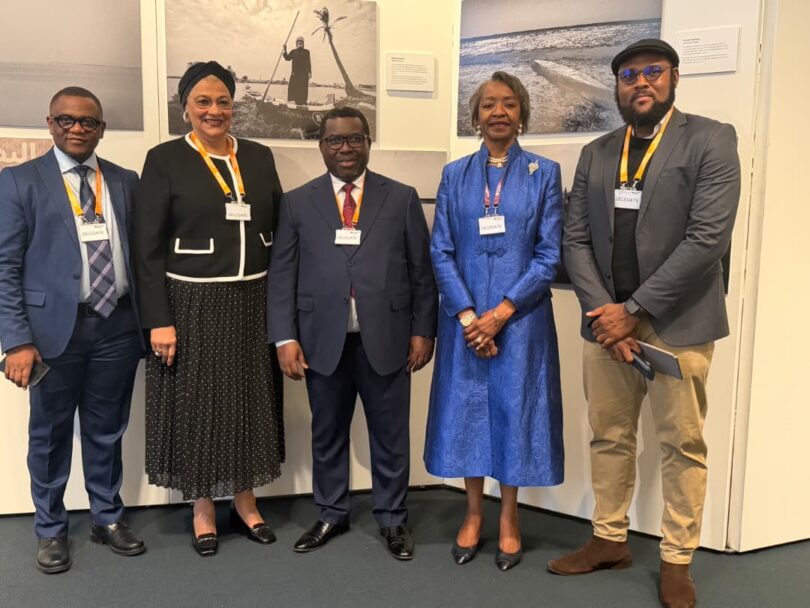
The INEC Chairman, Prof. Joash Amupitan, disclosed this on Thursday during a dialogue at Chatham House in London, where he also assured Nigerians that the Commission had introduced safeguards to prevent inaccurate election results and figures reflecting over-voting from being uploaded to its Result Viewing Portal (IReV).
In a statement signed by the Chief Press Secretary and Media Adviser to the INEC Chairman, Adedayo Oketola, the Commission said Amupitan spoke during a high-level dialogue organised in partnership with the Kimpact Development Initiative (KDI), themed, “Nigeria’s 2027 Elections: Democratic Trajectory and Regional Stability Beyond the Ballot.”
Addressing concerns over the 2023 presidential election, Amupitan acknowledged that the controversies surrounding the exercise had significantly affected public confidence in the electoral body.
Read Also: INEC Says Preparations For 2027 General Elections Progressing, Nine Activities Completed
“First and foremost, let me speak about what happened in 2023, which resulted in a significant trust deficit for INEC—damage so large that the Commission has not yet fully recovered from it,” he said.
However, he said the Commission had used subsequent off-cycle elections to identify operational weaknesses and improve its accreditation, voting and result management processes.
Citing the Anambra and Osun governorship elections, Federal Capital Territory (FCT) Area Council polls, Ekiti governorship election and 16 legislative by-elections, Amupitan urged Nigerians to assess his leadership based on the improvements recorded in recent exercises.

“Why must Nigerians trust me? Nigerians must trust me because, number one, I have conducted off-cycle elections—and observers agree that the recent election in Osun State marked a clear improvement,” he said.
“Every election is a lesson. The 2023 general election was a major lesson for Nigeria, and the Anambra election was another.”
He noted that previous governorship elections in Anambra and Osun had experienced prolonged and inconclusive processes, but said administrative reforms introduced under his leadership enabled results in both states to be declared the day after voting.
On preparations for 2027, the INEC chairman identified insecurity, logistics and result management as the Commission’s three major priorities.
He disclosed that a post-2023 review by the Commission found that the most significant failures in result management occurred at collation centres rather than polling units.
To address the problem, he said INEC had introduced technical safeguards to prevent inaccurate results and figures indicating over-voting from being uploaded to IReV.
“We found that the core problem of election result management and declaration in Nigeria is not even at the polling unit—it is at the collation centres,” he said.
“In 2023, there were instances of inaccurate results or results with over-voting being uploaded onto IReV. We have now devised a technical safeguard: if a result is not accurate at the polling unit, it will not go to IReV at all.”
He added, “The moment a result appears on IReV, citizens can trust what they see. By eliminating inconsistencies at the source, collation will become a transparent formality.”
Amupitan also said INEC had opted to upgrade its existing electoral technology rather than introduce an entirely new system ahead of the polls, citing the limited time available before the elections.
On reported malfunctions of the Bimodal Voter Accreditation System (BVAS) during the 2023 elections, which he linked to extreme heat and storage conditions, he said the Commission was constructing climate-controlled storage facilities across the states.
He added that INEC had procured additional devices and reduced the maximum number of voters assigned to each BVAS machine from 1,250 to 850. Polling units with more than 850 registered voters would therefore be provided with multiple devices.
The chairman said the November 28 mock exercise would simulate the presidential election and test the accreditation and electronic transmission of results.
“On the 28th of this month, we will conduct a mock accreditation and voting exercise across all states of the federation to simulate the presidential election and verify that we have gotten both accreditation and electronic result transmission right,” he said.
On funding, Amupitan confirmed that INEC had received a substantial portion of its 2027 election budget but was awaiting the release of the outstanding balance, including funds for the recruitment and welfare of ad hoc election personnel.
He said the Commission had received assurances that the outstanding funds would be released before the end of November.
The INEC chairman also addressed allegations on social media linking his phone number to a controversial X account, denying that he had ever operated an account on the platform.
He said an independent forensic review had been obtained and the matter referred to the Department of State Services and the Inspector-General of Police for investigation.
Amupitan also dismissed concerns that his previous legal representation in political disputes could affect his neutrality, insisting that he had acted in his professional capacity as a Senior Advocate of Nigeria before his appointment.
“My loyalty is solely to the Constitution of the Federal Republic of Nigeria and the Electoral Act,” he said.
“Every constitutional institution—including the Presidency, the National Assembly, and state governors—owes its primary loyalty to the Constitution and the rule of law.”
On allegations of irregularities in the voter register, including claims of an 85 per cent increase in registrants in a ward in Ebonyi State, he said the Commission had investigated and resolved the complaint in accordance with statutory procedures.
He added that the Electoral Act provided clear timelines for public claims, objections and requests for certified true copies of the register.
The INEC chairman urged young Nigerians to remain actively involved in the democratic process and guard against the spread of false information.
“This country belongs to young Nigerians, and they must not relent in working for the Nigeria they desire,” he said.
“Misinformation remains one of the greatest threats to our democracy. Citizens must verify information before acting or sharing, and give our democracy the chance to succeed.”
The 2027 Presidential and National Assembly elections are scheduled for January 16, 2027, while the governorship and State Houses of Assembly elections will hold on February 6, 2027.