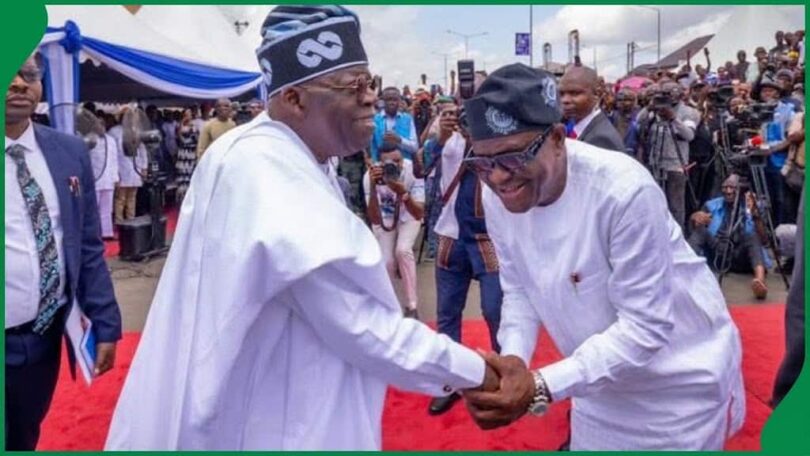
A new book has given an inside account of how President Bola Tinubu built a secret alliance with Nyesom Wike, then Governor of Rivers State, during the 2023 presidential race.
According to the book, written by journalist and founder of TheCable Simon Kolawole, the alliance helped weaken the campaign of the Peoples Democratic Party (PDP) candidate, Atiku Abubakar.
The 296-page book is titled Winning Formula: The Inside Story of Nigeria’s 2023 Presidential Election.
It examines how Tinubu won the election, the internal fights that weakened the PDP, and the voting patterns in presidential elections since 1999.
According to the book, Tinubu, then the All Progressives Congress (APC) candidate, reached out to Wike’s camp in June 2022. This was soon after Atiku chose Ifeanyi Okowa, then Governor of Delta State, as his running mate.
Wike had lost the PDP presidential primary to Atiku and had hoped to be picked as his running mate. He was deeply angered by the choice of Okowa.
Kolawole writes that Tinubu saw a chance to take advantage of the growing crisis in the main opposition party, and moved quickly. He contacted one of Wike’s associates and asked for a meeting to discuss a possible political understanding.
The book says Tinubu wanted Senator Magnus Abe, then an APC chieftain hoping to become governor of Rivers, to attend the meeting.
Wike, however, reportedly had one condition for any deal. The APC must not field a governorship candidate against his preferred successor in Rivers State.
This put Abe in a difficult position, because such a deal would effectively end his own governorship ambition.
Even so, the first meeting between Tinubu and Wike’s representative went ahead in June 2022 at the Lagos House in Abuja.
According to the book, that meeting began a series of secret engagements between the two camps. These went on at the same time as Wike’s increasingly bitter public feud with Atiku.
After the first contact, Wike and his close associates took over the talks themselves. A larger team drawn from both camps was later formed, and it held regular meetings and strategy sessions as the election approached.
Kolawole writes that Wike knew that fighting Atiku alone would limit the damage mostly to Rivers State. To turn his revolt into a national problem for the PDP, he needed powerful allies.
He found them in four other PDP governors: Samuel Ortom of Benue, Ifeanyi Ugwuanyi of Enugu, Okezie Ikpeazu of Abia and Seyi Makinde of Oyo
The five became known as the G-5. The book describes the group as one of the biggest obstacles to Atiku’s ambition.
Two northern PDP governors, Ahmadu Fintiri of Adamawa and Bala Mohammed of Bauchi, were at first linked with the group. They later withdrew, the book suggests, possibly because of sentiment within the party’s northern wing.
Some southern PDP governors stayed loyal to Atiku. They included Udom Emmanuel of Akwa Ibom, Godwin Obaseki of Edo and Douye Diri of Bayelsa.
Emmanuel had also run in the PDP presidential primary. He backed Atiku after losing and briefly hoped to become his running mate.
The book says that while the talks with Tinubu’s camp stayed secret, Wike and his allies kept up a fierce public campaign against Atiku.
The aim was to keep him under pressure, challenge his candidacy on the grounds of power rotation, and reduce his support, especially among voters in the South.
The G-5 argued repeatedly that it would be unfair for another northerner to succeed President Muhammadu Buhari after his eight years in office.
According to Kolawole, the crisis let Tinubu gain from the opposition’s divisions without having to fight the whole battle himself.
While Atiku struggled to contain the revolt in his party, Tinubu already had a direct line to the man leading it.