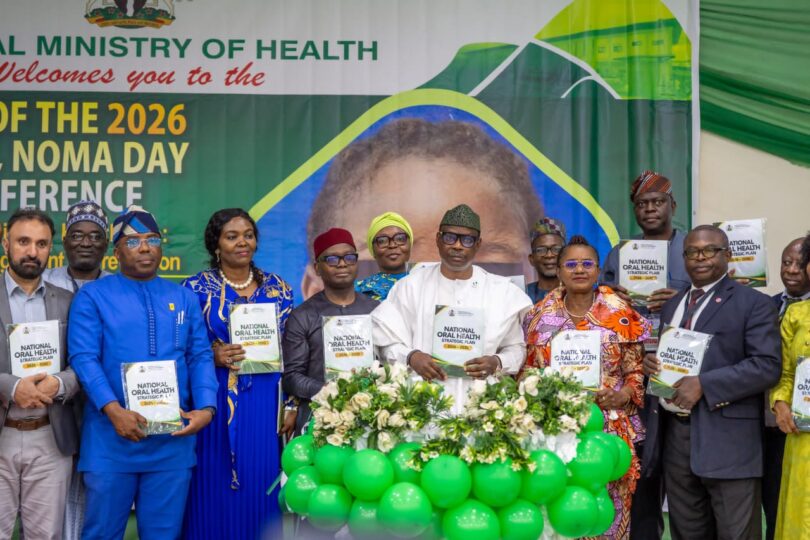
The Federal Government has launched a N70bn National Oral Health Strategic Plan for 2026–2030 to improve access to dental healthcare and eliminate Noma as a public health problem in Nigeria. The Minister of State for Health and Social Welfare, Dr Iziaq Salako, announced this on Monday during the commemoration of……
The Federal Government has launched a N70bn National Oral Health Strategic Plan for 2026–2030 to improve access to dental healthcare and eliminate Noma as a public health problem in Nigeria.
The Minister of State for Health and Social Welfare, Dr Iziaq Salako, announced this on Monday during the commemoration of National Noma Day and National Oral Health Day in Abuja.
Salako said the five-year plan was designed to strengthen preventive oral healthcare, expand access to dental services and integrate oral health into the country’s Primary Healthcare system.
He described Noma as a preventable but devastating disease that causes severe facial disfigurement, disability and death, particularly among malnourished children, expressing concern over its prevalence in the North-West and North-East.
READ ALSO: FG Suspends Broadcast Licence Fee Reviews Indefinitely
The minister noted that the World Health Organisation’s recognition of Noma as a Neglected Tropical Disease in 2023 marked a significant milestone in global efforts to combat the disease.
According to him, the Federal Ministry of Health has integrated Noma surveillance into the Integrated Disease Surveillance and Response system and intensified efforts to improve early detection and referral through Primary Healthcare facilities.
He added that frontline healthcare workers, traditional healers and traditional birth attendants had been trained across 19 states to identify Noma and other oral diseases.
Highlighting the country’s oral healthcare challenges, Salako disclosed that more than 80 per cent of Nigerians had never visited a dentist, while two out of every three children lived with untreated dental caries.
He also put Nigeria’s dentist-to-population ratio at approximately 1:38,000, compared with the World Health Organisation’s recommended ratio of 1:7,500.
To address the gaps, the minister said the government was strengthening the integration of oral health services into Primary Healthcare through the Sector-Wide Approach and Basic Health Care Provision Fund.
He further disclosed that the Federal Executive Council had approved the National Centre for Oral Health Establishment Bill 2026 and transmitted it to the National Assembly for consideration.
According to Salako, the N70bn strategic plan would prioritise preventive services, school-based oral health programmes, access to fluoride toothpaste, sugar-reduction initiatives and the integration of oral healthcare into maternal and child health, nutrition and non-communicable disease programmes.
The plan also provides for the training and equitable distribution of oral health personnel, improved Primary Healthcare infrastructure, stronger referral systems and expanded dental services across all 774 local government areas.
Calling for collective action, the minister urged state and local governments to domesticate the plan and encouraged development partners, including WHO, UNICEF and the FDI World Dental Federation, to sustain their support.
He reaffirmed the government’s commitment to tackling the disease, declaring that “no Nigerian child suffers preventable death or permanent disfigurement from Noma.”
In her welcome address, the Permanent Secretary of the Federal Ministry of Health and Social Welfare, Daju Kachollom S., represented by her Senior Technical Assistant, Dr Dogara Okara, said the ministry remained committed to strengthening oral health services as an essential component of universal health coverage.
She identified capacity building for frontline healthcare workers as a major strategy for improving early detection and treatment.
According to her, community health workers and Primary Healthcare personnel would be equipped with the skills to identify oral diseases, provide health education, promote preventive practices and facilitate timely referrals.
She stressed that “successful implementation of this strategic plan will require sustained collaboration among government institutions, development partners, and professional associations, private sector organizations, as well as academic institutions and communities.”
The Permanent Secretary also commended Médecins Sans Frontières, the Noma Aid Nigeria Initiative, Noma Children’s Hospital, Sokoto, Colgate, professional associations and other development partners for their contributions to the fight against Noma.
Similarly, the Chairman of the Senate Committee on Health, Senator Ipalibo Harry-Banigo, reaffirmed the National Assembly’s commitment to strengthening Primary Healthcare and making oral health an integral part of routine healthcare services.
She identified the Noma Children’s Hospital in Sokoto, the Intercountry Centre in Jos and the ongoing retrofitting of dental centres across federal university teaching hospitals as critical components of Nigeria’s response.
The senator said legislative measures were being pursued to institutionalise routine oral health screenings, early diagnosis of dental infections and specialised training.
She also called for stronger oversight to ensure that appropriated funds translated into tangible healthcare services for affected children and families across the six geopolitical zones.
In his goodwill message, the Country Representative of Médecins Sans Frontières, Dr Aldikhari Ahmed, commended the Federal Government and other stakeholders for integrating Noma into Primary Healthcare guidelines and including the disease in the Surveillance Outbreak Response Management and Analysis System (SORMAS).
He, however, stressed that such initiatives required sustainable funding, functional surveillance systems and effective implementation to achieve meaningful results.
Providing details of MSF’s intervention, Ahmed disclosed that its collaboration with the Federal Ministry of Health and the Sokoto State Ministry of Health at the Noma Children’s Hospital had facilitated more than 1,759 major reconstructive surgeries for 1,174 patients through 35 surgical missions.
He added that 114 surgeries had been performed on 96 patients in 2026 alone, while 28 Nigerian surgeons and 14 anaesthetists had received specialised training through the partnership.
Also speaking, the World Health Organisation Country Representative in Nigeria, Dr Pavel Ursu, represented by Dr Victor, said Noma primarily affected malnourished children between the ages of two and six, particularly those living in impoverished communities.
He stressed that early detection and prompt treatment could prevent the devastating consequences of the disease, calling for improved capacity among frontline health workers, stronger surveillance systems and adequate psychosocial support for survivors and their families.
Meanwhile, Dr Adebimpe Adebiyi paid tribute to the late Mama Ute Winkler-Stumpf, founder of Hilfsaktion Noma, for her contributions to the treatment and rehabilitation of children affected by the disease.
Adebiyi recalled that the organisation worked with the World Health Organisation and Nigerian authorities to establish critical treatment infrastructure, including the Noma Centre in Abuja, where numerous children benefited from free reconstructive surgeries.
She said the late humanitarian’s legacy should inspire stakeholders to move beyond sympathy and isolated clinical interventions towards sustainable healthcare systems focused on prevention, early diagnosis and community awareness.
The Federal Government said sustained investment, community engagement and stronger partnerships would be essential to eliminating Noma and improving oral healthcare delivery across the country.