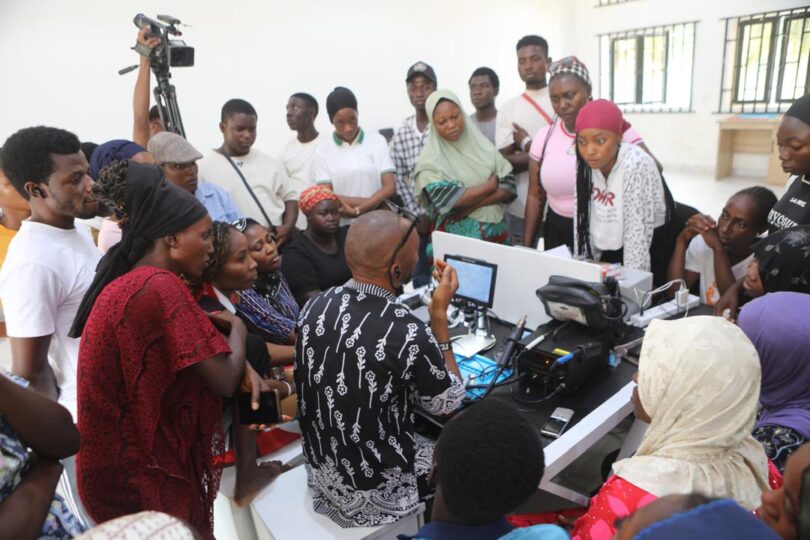
The Federal Government has equipped 38 federal and state technical colleges across Nigeria to provide free technical and vocational training to young people as part of efforts to tackle unemployment, poverty and promote economic self-reliance….
The Federal Government has equipped 38 federal and state technical colleges across Nigeria to provide free technical and vocational training to young people as part of efforts to tackle unemployment, poverty and promote economic self-reliance.
The initiative, supported by the World Bank, provides beneficiaries with free tuition, training materials, monthly stipends and starter packs to enable them to establish businesses after completing their programmes.
National Project Coordinator of the Innovation Development for Effective Acquisition of Skills (IDEAS) Project, Blessing Ehi Ogwu, disclosed this during an inspection of the IDEAS Project Centre at the Federal Science and Technical College (FSTC), Orozo, Abuja.
Ogwu said the government had funded and equipped 20 federal and 18 state technical colleges to expand practical skills acquisition and improve employment opportunities.
“The Federal Government is interested in TVET education. That is why we have about 38 technical colleges that the Federal Government has funded and equipped like this, all to enhance skills,” she said.
She explained that the institutions provide opportunities for both formal and informal skills training, with FSTC Orozo serving as the designated federal technical college for the Federal Capital Territory.
Also speaking, the National Project Monitoring Officer in the Federal Ministry of Education, Olatunji Odewunmi, said Nigeria had more than 1,000 Technical and Vocational Education and Training (TVET) centres, including about 140 skills training centres across the FCT.
He described the IDEAS Project and the government’s TVET initiative as complementary programmes aimed at widening access to vocational education.
Odewunmi said beneficiaries would not pay tuition or training fees, as the government also provides instructional materials and other essential requirements, including accommodation for boarding students.
He added that trainees receive monthly stipends and would be given starter packs upon completing their programmes to enable them to establish businesses.
“Every one of them will get a starter pack even before the end of the training. By the day they graduate, they can go home with it,” he said.
On accountability, Odewunmi said biometric attendance monitoring had been introduced to ensure commitment, warning that trainees who failed to meet the required attendance threshold would lose their stipends and eligibility for starter packs.
He added that monitoring officers regularly visited the centres to assess training activities and ensure proper utilisation of government resources.
The Principal of FSTC Orozo, Stella Uhuegbu, said the college had adopted the revised TVET curriculum, which prescribes a 70 per cent practical and 30 per cent theoretical training structure.
According to her, the college has more than 1,000 regular students, while its six-month short-term skills programme accommodates over 1,000 trainees across five trades.
The training areas include information and communication technology, automobile mechanics, auto-electrical repairs, catering, garment making and GSM repairs.
Uhuegbu said newly constructed and equipped workshops had strengthened the college’s capacity to deliver practical instruction.
“All the workshops you are seeing here were newly built and well equipped. The essence is to ensure that the skills training aspect of the TVET initiative is achieved because, without the workshops and equipment, we cannot effectively impact skills on the trainees,” she said.
Beneficiaries begin earning from acquired skills
Some beneficiaries said the programme had already opened up income-generating opportunities for them, with some securing commercial orders before completing their training.
A catering trainee, Modupe Osundeyi, said she had acquired practical skills in baking and food production, including making buns, egg rolls and doughnuts.
She disclosed that she had approached a school near her residence and secured an opportunity to supply buns and doughnuts.
“The programme has equipped me with practical knowledge and enabled me to earn an income. I went to a school close to my house, explained the skills I had acquired and asked if they could give me a contract. They agreed,” she said.
Another female trainee in automobile mechanics said she had learnt about different engine types, their components, maintenance procedures and basic repairs.
She appealed to the government to provide more equipment and extend the programme to rural communities, while encouraging more women to pursue careers in technical trades traditionally dominated by men.


At the Zenou TVET Centre in Orozo, another beneficiary, Joy Genesis, said she had started earning money from baking barely four to five months after enrolling in the programme.
Genesis said the practical training had equipped her with skills in cake production and decoration, pastries, bread-making and confectionery.
She listed some of the products she could now prepare independently to include meat pies, bread rolls, fruit bread, honey bread, coconut bread, buns, egg rolls, Scotch eggs and shawarma.
“Our work here is hands-on. We did the practicals by ourselves. We did it by ourselves, and we go home and practise,” she said.
Genesis disclosed that she had already received orders for wedding and birthday cakes since acquiring the skills.
“Yes, like me, since I started, I’ve had wedding cakes and birthday cakes. I even had a birthday cake this weekend that just passed,” she added.
The beneficiaries are expected to receive certificates and starter packs upon completing their respective training programmes.