BY ADEBAYO GBEJA
The Federal Government and the Chartered Institute of Project Managers of Nigeria (CIPMN) have called for reforms in project planning, execution and accountability to reduce waste and accelerate industrial development.
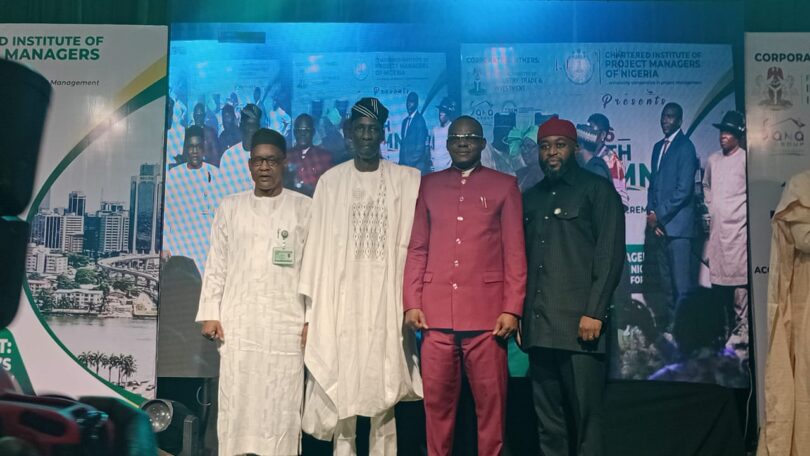
They made the call at the 8th Induction and Conference Ceremony of CIPMN, with the theme: “Project Management: Catalyst for Nigeria’s Industrial Transformation”.
The Minister of State for Industry, Trade and Investment, Sen. John Enoh, in his remarks said Nigeria had lost more than N17 trillion to abandoned projects, highlighting the consequences of poor project management.
Enoh represented by the Permanent Secretary in the ministry, Dr Chris Isokpunwu, noted that weak project implementation continued to undermine infrastructure development, industrial growth and economic prosperity.
He said CIPMN had estimated the value of abandoned projects nationwide at over N17 trillion, while the House of Representatives had also raised concerns over abandoned federal government projects and properties estimated at more than N20 trillion.
He clarified that the figures were drawn from different assessments and periods, but demonstrated the scale of Nigeria’s project implementation challenges.
The minister also cited a 2011 assessment by the Presidential Projects Assessment Committee, which identified 11,886 ongoing federal government capital projects with estimated financial commitments of N7.78 trillion.
He said the consequences of abandoned projects extended beyond financial losses, as they deprived communities of essential infrastructure and services.
“These are not mere statistics. These represent hospitals that never opened, schools that never welcomed students, roads that never connected communities, and power projects that never met a single goal,” he said.
Enoh said Nigeria’s major challenge was not necessarily the absence of policies and development plans, but the difficulty of translating them into tangible results.
“Policies alone do not build economies. Projects do,” he said.
He added that industrialisation strategies must translate into functional factories, infrastructure and measurable outcomes.
He also said effective project execution was critical to achieving President Bola Tinubu’s ambition of building a one-trillion-dollar economy.
According to him, the ministry’s strategic priorities include expanding demand for Nigerian products and services, strengthening domestic industrial capacity, attracting strategic investments and leveraging digital infrastructure.
He said the ministry had adopted a 90-day implementation reporting cycle to strengthen accountability and monitor the progress of its programmes.
The minister urged CIPMN to deepen professional training and certification, while collaborating with government institutions to establish project management structures across ministries, departments and agencies.
In the same vein, the Registrar-General and Chief Executive Officer of CIPMN, Mr Henry Mbadiwe, said effective project management was essential to reducing delays, cost overruns and abandoned projects across the country.
Mbadiwe said project management went beyond construction, engineering and architecture, noting that virtually every sector of the economy required competent professionals to coordinate projects and ensure successful delivery.
He said Nigeria’s persistent project failures were partly attributable to inadequate planning, coordination and risk management rather than a shortage of technical professionals.
The registrar-general recalled that the institute had developed a standardised project management curriculum for Nigerian universities, which had received approval from the National Universities Commission (NUC) for undergraduate programmes.
He also said CIPMN had completed a 17-module licensing framework designed to equip practitioners with the competencies required for professional project management practice.
Mbadiwe further disclosed that the institute had digitised its membership, training, examination and licensing processes to improve accessibility and operational efficiency.
He said CIPMN had grown to more than 2,000 members nationwide within three years of its establishment.
Also speaking, the Registrar of the Chartered Institute of Information and Strategy Management (CIISM), Dr Adelanke Oyintoke, said Nigeria’s development challenges were largely linked to weaknesses in project execution rather than a lack of policies.
Oyintoke said the collaboration between CIISM and CIPMN was aimed at producing competent and ethical professionals capable of translating development plans into successful projects.
He urged newly inducted members to uphold professional integrity and ensure that projects under their supervision were delivered within approved timelines, budgets and quality standards.
The stakeholders called for stronger collaboration among professional bodies, government institutions and the private sector to ensure that investments in infrastructure and industrial devel
opment delivered measurable benefits to Nigerians.
Jude Ossai (JP) a veteran journalist is a National Diploma holder in Mass Communication from Ogwashi-Uku Polytechnic Ogwashi-Uku, Delta State. He also studied at Enugu State University of Science and Technology (ESUT) Enugu and Imo State University, Owerri for his first and second degrees in Mass Communication, respectively.
He writes extensively on politics, crime, corruption, climate change, healthcare, human rights, social justice, among others.
He began his journalism career in The Republic Newspaper, Lagos in 1987 as a Special Correspondent in Benin City, Edo State.
In 1990, he was posted from Lagos to old Anambra State as a State Correspondent in Enugu.
In 1994, he joined the African Newspapers of Nigeria (ANN) Plc, Ibadan, Oyo State, Publisher of Nigerian Tribune Newspapers where he rose to the rank of Southeast Bureau Chief.
Retiring from the mainstream traditional media in 2019, he began another journey in online newspaper publication.
He was the Overall Best Reporter in 2015, an award bestowed on him by Correspondents’ Chapel of the Nigerian Union of Journalists (NUJ), Enugu State.
He has attended several workshops/seminars organised by multi-nationals, government institutions, local and international media including BBC.
He is also a unionist and had held top positions as Chairman and Vice Chairman of the Nigerian Union of Journalists of Enugu Correspondents’ Chapel and State Council of NUJ, respectively. He was also a one-time Enugu State Secretary of Sports Writers’ Association of Nigeria (SWAN).