By Vitus Ozoke, PhD
Abia State Governor Alex Otti has reportedly made a remarkable declaration. He does not intend to spend public resources campaigning for a second term. His reasoning is simple and politically refreshing: he has been governor long enough for the people of Abia State to assess his performance. If they are satisfied, they should re-elect him. If they are dissatisfied, they should elect someone else. He believes his record should speak for itself.
There is something profoundly appealing about that philosophy. It treats public office as a responsibility rather than an entitlement, governance as a continuous process of examination rather than an endless campaign, and voters as citizens who can evaluate performance rather than spectators to be entertained at political rallies.
Of course, there is an important distinction between declining to campaign and declining to misuse public funds for campaigning. A governor seeking re-election remains accountable to the electorate and should be prepared to defend his record. But Otti’s reported position raises a fascinating question about another governor elected in the same political cycle: Peter Ndubuisi Mbah of Enugu State. Why does Alex Otti seem comfortable letting his record speak for itself, while Peter Mbah invests so heavily in securing his political future?
That question becomes particularly intriguing when one considers that Mbah has a substantial infrastructure record of his own. Indeed, one could plausibly argue that Mbah has undertaken more ambitious and more visible physical infrastructure projects than Otti. His administration has invested in roads, schools, transportation and water infrastructure, and other development initiatives. His supporters have considerable material to build a credible case for his re-election.
This is not to suggest that the quality, financing, execution, and sustainability of those projects are beyond scrutiny. They are not. Questions have been raised about the administration’s smart schools, transport terminals, and public-private partnership arrangements. Some criticisms warrant rigorous technical and financial scrutiny. A project does not become an achievement merely because a government commissions it, just as a photograph of a completed structure does not establish its engineering quality, value for money, or long-term viability.
Nevertheless, political analysis must distinguish between what technical scrutiny can demonstrate and what ordinary voters can readily perceive. A newly constructed road is visible. A completed terminal is visible. A new school building is visible. The financing structure, contractual obligations, maintenance liabilities, and opportunity costs behind those projects are far less visible. Mbah therefore enters the 2027 election with something many incumbent governors would envy: a substantial portfolio of visible projects. So why might that not be enough? The answer, I suggest, lies less in what Peter Mbah has built than in the political company he has chosen to keep.
On October 14, 2025, Governor Mbah announced his defection from the People’s Democratic Party (PDP), the party that elected him, to the All Progressives Congress (APC), Bola Ahmed Tinubu’s party. He described the decision as a strategic realignment intended to advance Enugu State’s development through closer cooperation with the federal government.
That explanation may have made sense in the calculus of political power. It may even have appealed to those who believe that proximity to Abuja guarantees greater access to federal resources. But electoral politics is not conducted exclusively in the boardrooms of political strategists. It is conducted in the hearts, memories, experiences, pains, and grievances of ordinary citizens. In that arena, Mbah may have committed the most consequential political miscalculation of his governorship. He appears to have underestimated the depth of anti-APC sentiment among substantial segments of the Igbo electorate.
For many voters in the Southeast, the APC is not merely another political party. It carries the accumulated political baggage of the Muhammadu Buhari presidency, the controversies over federal appointments and regional inclusion, and the perception that the Southeast has been treated as a peripheral constituency in the distribution of national political power.
Buhari’s notorious reference to constituencies that gave him 97 percent of their votes, as opposed to those that gave him 5 percent, became, for many Nigerians, a symbol of the dangers of treating electoral support as a measure of citizens’ entitlement to government attention. His later description of IPOB as a dot in a circle deepened the resentment of those who interpreted his language as dismissive of Igbo political pain and grievance. Whether every criticism of the APC is justified is beside the immediate political point. Political perceptions have electoral consequences, and the party’s historical relationship with much of the Igbo electorate remains deeply contested.
Then came Bola Tinubu.
For many Nigerians, the Tinubu administration has become inseparable from the economic pain of everyday life: the cost of food, the price of petrol, transportation costs, electricity tariffs, unemployment, insecurity, and the relentless struggle to survive in an economy where household incomes have failed to keep pace with rising costs. These grievances are not peculiar to Igboland. They are national. But in the Southeast, they intersect with longstanding questions of political exclusion, representation, and the unresolved bitterness surrounding the 2023 presidential election.
Many supporters of Peter Obi believe that the political aspirations they invested in that election were frustrated by a process they regard as deeply flawed. Whether or not one accepts their interpretation, the political emotion is real. Governors, party chairmen, or presidential strategists cannot simply wish it away. This is the political environment into which Peter Mbah voluntarily entered when he defected to the APC. And therein lies the tragedy.
Before his defection, Mbah could plausibly have presented himself to Enugu voters as a governor whose re-election should be decided primarily by his performance. He could have invited comparisons with other governors, including Alex Otti, and asked the electorate to judge his administration on its accomplishments and shortcomings.
His defection raised a different question. Not simply: What has Peter Mbah done for Enugu? But: Why has Peter Mbah embraced Bola Tinubu? Those are two very different electoral conversations. The first concerns governance. The second concerns political identity, loyalty, and accountability.
Mbah’s problem is not necessarily that he joined the APC. Politicians change parties, and no political party owns an elected official’s permanent allegiance. His deeper problem is that he appears determined to make his identification with Tinubu an unmistakable part of his political persona. Rather than preserving political distance between his state-level record and the controversies and pain surrounding the Tinubu administration, Mbah has publicly embraced that relationship. His enthusiastic association with Tinubu, including pro-Tinubu political messaging, makes it increasingly difficult for the public to separate the two administrations and the two individuals in the public imagination.
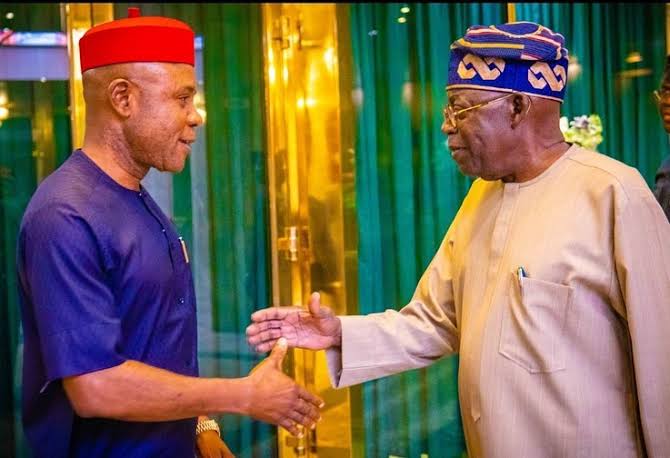
He has effectively invited Enugu voters to judge him not only as Peter Mbah, Governor of Enugu State, but also as Peter Mbah, a political ally and defender of Bola Tinubu. That is an extraordinary electoral gamble. And it is a gamble whose consequences may extend far beyond the quality of the roads Mbah has built or the number of schools his administration has commissioned.
The just-concluded American midterm elections offer a useful political analogy, though the circumstances are not identical. American voters often use congressional and state elections to express approval or disapproval of the president, even when the president’s name does not appear on the ballot. This phenomenon, often described as the nationalization of elections, allows national political sentiments to overshadow the individual merits of local candidates.
A voter may appreciate a Republican governor’s competence yet still vote against that governor’s party because they are dissatisfied with the Republican president. The reverse is equally possible for Democrats. Local elections become instruments through which voters express national grievances. The lesson is not that every American election produces the same result, nor that racial and regional voting patterns can be mechanically transplanted into Nigerian politics. Rather, political parties and national leaders can become powerful electoral liabilities for candidates whose individual records might otherwise be competitive. This is precisely the danger confronting Peter Mbah.
In the United States, Donald Trump repeatedly urged Republican voters to treat the recent midterm election, in which he was not a candidate, as a referendum on his leadership and political movement. In Enugu State, Bola Tinubu may not need to make a similar appeal. Peter Mbah is already doing much of the political identification work himself. Consequently, when Enugu voters go to the polls on February 6, 2027, they may find themselves confronting two competing versions of the same governor.
There is Peter Mbah, the administrator with an ambitious infrastructure agenda whose achievements and shortcomings warrant independent evaluation. And there is Peter Mbah, the APC governor whose political future has become intertwined with Bola Tinubu’s fortunes. The first may be electorally formidable. The second may be considerably more vulnerable. This is why I believe Mbah’s defection may have transformed what could have been a relatively straightforward re-election contest into a genuinely competitive political struggle.
That is also why I have argued that the opposition should not assume that attacking Mbah’s record on physical infrastructure will be enough to defeat him. His administration has invested heavily in projects that voters can see. A serious examination of those projects may reveal legitimate concerns about costs, contracts, engineering standards, debt exposure, or public-private partnership obligations. Such questions are essential to democratic accountability, but they require evidence, explanation, and sustained public engagement. They cannot be resolved through slogans or casually circulated videos.
An opposition that dismisses every completed project as worthless risks appearing unserious. Equally, an incumbent who treats every visible project as conclusive proof of good governance misunderstands the scope of democratic accountability. Governance is not a competition in concrete alone. It is also about political judgment, institutional integrity, public trust, economic welfare, and the relationship between elected officials and the citizens who entrusted them with power. A governor may build an impressive road and still make a disastrous political decision. He may commission a beautiful building and still misunderstand the electorate’s deepest concerns. He may win the argument about physical infrastructure and lose the broader argument about political representation. Mbah’s defection raises precisely that possibility.
The opposition, however, should not mistake a potential opportunity for an assured victory. Dissatisfaction with Tinubu does not automatically translate into support for every candidate who opposes Mbah. Opposition parties must still present credible candidates, coherent development programs, organizational discipline, and convincing alternatives. They must demonstrate that they can govern Enugu better, not merely that they dislike Bola Tinubu and, by association, Peter Mbah.
The upcoming election will also test the strength of Nigeria’s democratic institutions. Allegations of intimidation, restrictions on opposition activities, or misuse of state resources must be independently investigated and addressed. Every political party must be able to campaign lawfully, and every eligible citizen must be able to vote freely. The legitimacy of the result will depend not only on who wins but also on whether the votes are cast, counted, and reported transparently.
In this context, another lesson from American politics is worth considering. Attempts to suppress or marginalize an electorate can sometimes backfire, strengthening its resolve to participate. But this is not automatic, and intimidation can also discourage turnout. The democratic response must therefore be organized, peaceful, lawful, and sustained: voter registration, civic education, election observation, documenting irregularities, and insisting on institutional accountability. The Southeast has experienced enough political violence. Its grievances must be expressed through democratic participation, not through another cycle of confrontation. If 2027 becomes a grievance election in Igboland, it should be conducted with ballots, not bullets, bullies, and bandits.
For Peter Mbah, the most painful aspect of the emerging political equation is that much of the risk may have been avoidable. He did not need to become an enthusiastic political symbol of the Tinubu administration to demonstrate his commitment to Enugu’s development. Federal-state cooperation is a constitutional duty, not a partisan favor. An Enugu governor can work constructively with Abuja without surrendering his independent political identity. Mbah could have cooperated with Abuja on infrastructure, security, investment, and economic development while maintaining a distinct political relationship with his electorate. Instead, he chose a highly visible partisan realignment.
Perhaps he calculated that the benefits of joining the ruling party would outweigh the resentment his defection would provoke. Perhaps he believed the APC’s federal machinery would make his re-election easier. Perhaps he assumed that visible development projects would neutralize any political backlash. These are plausible explanations. The Enugu electorate will decide whether they prove correct. But one thing is already clear: by embracing Tinubu so publicly, Mbah has made Tinubu’s political fortunes relevant to his own.
That is the fundamental difference between the political situations of Alex Otti and Peter Mbah. Otti, at least in his reported declaration, invites voters to judge him primarily on his record. Mbah has made it much harder for voters to judge him without also considering the character of the national political establishment he has joined. One governor is trying to make performance the central question. The other risks allowing political association to become the central question. And in Igboland, where the APC carries considerable historical baggage, that distinction could be decisive.
There is a profound irony here. Peter Mbah may have done enough in physical infrastructure to make a credible case for another term. Yet he may have weakened that case by tying his political identity and fortune to a man many Nigerians blame for their economic hardship. If Mbah loses, it may not be because voters failed to notice his roads, schools, or transportation projects. It may be because those projects were not enough to overcome the political resentment stemming from his pact and partnership with Bola Tinubu.
Mbah may discover that an electorate can appreciate a governor’s accomplishments without endorsing his political judgment. He may also discover that loyalty is a two-way street in politics. A governor is free to leave the party that elected him, just as voters are free to reconsider the mandate they entrusted to him.
This is why the 2027 Enugu governorship election could become one of Nigeria’s most fascinating political contests to watch. It will test whether visible infrastructure can overcome partisan resentment, whether federal political alignment is an electoral advantage or a liability, and whether an incumbent governor can persuade voters to separate his personal performance from the misery-inducing national administration he has embraced. It will also test the proposition that political legitimacy cannot be permanently transferred from one party to another merely because an incumbent defects. The people must have their say.
Alex Otti’s no-reelection campaign stance suggests a governor confident enough to submit his record to his electorate’s judgment without making an elaborate spectacle of his re-election. Peter Mbah faces a more complicated test, partly because of a political complication he created.
And that brings me to the central paradox of Enugu politics in 2027. Peter Mbah may be popular. His infrastructure record may be formidable. His administration may have achievements that even his opponents cannot credibly dismiss. But the governor seeking re-election in February is no longer politically identical to the one who won in 2023. The Peter Mbah of 2023 asked Enugu voters to entrust him with their future. The Peter Mbah of 2027 is asking them, whether explicitly or implicitly, to accept his embrace of Bola Tinubu as part of that future. These are not necessarily the same propositions. If enough voters reject the second while acknowledging the merits of the first, Mbah could face an electoral verdict his infrastructure record alone cannot reverse. That is the extraordinary irony of his political predicament. Peter Mbah may have made himself electorally vulnerable not because he failed to govern, but because he misjudged the political meaning and the consequences of the company he chose to keep.
Peter Mbah may believe he is campaigning for his second term. But by making himself so inseparable from Bola Tinubu, he risks turning the election into a referendum on Tinubu – more than it already is. That is why Peter Mbah may not be the only candidate Enugu voters see on the ballot in February 2027. They may see Peter Ndubisi Tinubu. And Peter Ndubisi Tinubu may prove much harder to elect than Peter Mbah.
Dr. Vitus Ozoke is a lawyer, human rights activist, and public affairs analyst based in the United States. He writes on politics, governance, and the moral costs of leadership failure in Africa.