EXPLAINER
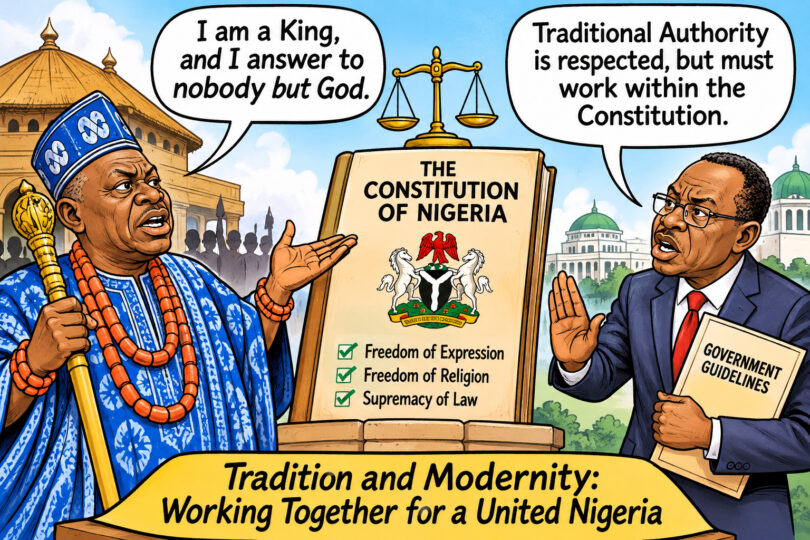
In response to a letter written to him by the Osun State Government, the Oluwo of Iwoland reportedly declared: “I am not a Traditional Ruler; I am a king, and I answer to nobody but God. The God that the Governor, President, Senators and the richest man in Nigeria, Dangote, answer to.”
Beyond the controversy surrounding this statement lies a fundamental misunderstanding that has persisted for more than a century: the place, authority and limitations of traditional institutions in the modern democratic state. Across Africa, the transition from indigenous political systems to colonial administration and, subsequently, constitutional democracy has generated recurring tensions over the relationship between traditional authority and state power.
Ghana offers a notable example. Osagyefo Kwame Nkrumah’s administration experienced significant tensions with the powerful Ashanti traditional institution. In Uganda, the position of the Kabaka of Buganda became a major source of political friction, culminating in the 1966 constitutional crisis. Nigeria, too, has its history. The confrontation between the government of Chief Obafemi Awolowo in the old Western Region and the Alaafin of Oyo, Oba Adeniran Adeyemi II, in the 1950s eventually resulted in the monarch’s deposition and exile. These historical experiences demonstrate that the question of traditional authority in a modern state is neither new nor peculiar to Osun.
It is against this historical background that the current disagreement between the Oluwo and the Osun State Government should be understood.
In a letter with reference number CD.17/1/VOL.VIII/377, dated November 2026 and signed by Wale Alliyu on behalf of the Permanent Secretary, the state government expressed concern over what it described as inflammatory remarks capable of triggering religious and inter-town conflicts. It cautioned the monarch against attacking people of other faiths and fellow traditional rulers, warning that such conduct could heighten communal tensions, sow religious discord and undermine the cultural values of the Yoruba people. The government further reminded him that the preservation of cultural heritage and communal harmony remains central to the responsibilities of traditional institutions.
While the government has a legitimate responsibility to maintain public order and prevent the escalation of communal or religious tensions, its intervention must not be interpreted as an attempt to dictate personal beliefs. Equally, freedom of expression does not confer immunity from accountability. Traditional rulers, like other public figures, must exercise their influence with restraint, particularly on matters capable of provoking religious hostility or intercommunal conflict.
The custodianship of traditional culture must therefore complement, rather than contradict, constitutional guarantees of individual liberty. Even in constitutional monarchies such as the United Kingdom, Spain and Denmark, the authority of monarchs operates within established constitutional limits. History, particularly the French Revolution, demonstrates the consequences of failing to accommodate changing political realities.
Similarly, Britain’s Stonehenge attracts millions of visitors and contributes to its tourism economy. Its monarchy demonstrates how historical institutions can coexist with constitutional democracy. Cultural preservation is not an obstacle to progress; properly harnessed, it is an economic and national asset.
Osun State, with its rich Yoruba heritage, has enormous opportunities in this regard. Its traditional institutions can serve as powerful instruments of cultural preservation, tourism development, conflict resolution and community mobilisation.
The Oluwo and the state government must therefore look beyond the immediate controversy. Neither traditional authority nor governmental power should become an instrument of intimidation. Kings must recognise the constitutional realities of the modern state, while governments must respect the historical significance and legitimate cultural roles of traditional institutions.
Ultimately, kingship derives its enduring renown not merely from the authority a monarch claims, but from the wisdom, dignity, tolerance and service with which that authority is exercised. That is the tradition worth preserving.