EXPLAINERS
– Incumbency is not an electoral entitlement. The real power belongs to the people.
– Performance must determine political continuity, and not who can buy votes with billions of public commonwealth.
– Poverty should not buy votes, capacity and track record should.
In Nigeria, there is a peculiar tendency to celebrate and cheer the advantages conferred by the power of incumbency, often without examining its implications for democratic accountability, good governance and the welfare of the electorate. As the country approaches another electoral cycle, it is imperative to interrogate the incumbency factor in all its ramifications and ask whether it has produced tangible benefits for the people or merely entrenched political privilege.
Of course, one good term deserves another. But the fundamental question is whether those seeking another term have genuinely earned it or are merely being rewarded for occupying public office. Available evidence and the lived experiences of citizens across the country raise serious doubts about whether many incumbents deserve the electoral endorsement they so desperately seek.
In the past, political leaders such as Chief Obafemi Awolowo, Michael Okpara, Lateef Jakande and Sam Mbakwe demonstrated that a second term could be justified by measurable achievements in education, healthcare, infrastructure, housing and other critical sectors. They were not without flaws, and some of their policies attracted considerable controversy. Nevertheless, their legacies remain enduring examples of leaders whose performance provided compelling arguments for continuity.
The same cannot be said of many contemporary political officeholders. Much of what is presented as achievement is increasingly rooted in propaganda, political theatrics and the construction of a make-believe reality rather than meaningful progress towards sustainable development and shared prosperity. Nigeria continues to grapple with widespread poverty, a shrinking productive base, the erosion of the middle class and deepening socioeconomic inequalities. Against this backdrop, the celebration of incumbency without rigorous scrutiny is not only misplaced but potentially dangerous.
In examining Nigeria’s peculiar glorification of incumbency, it may be instructive to consider India’s democratic experience. India, now the world’s fifth-largest economy, has recorded remarkable economic expansion and made significant strides in poverty reduction, although considerable socioeconomic challenges remain. Its electoral politics also offers an interesting contrast to Nigeria’s entrenched culture of political continuity.
In India, electoral outcomes at different levels of government have frequently demonstrated that incumbency is no guarantee of victory. Governments and political parties are routinely subjected to the verdict of the electorate, with voters willing to reject sitting administrations despite the advantages of state power. This phenomenon is often described as the ‘incumbency disadvantage’ or the ‘anti-incumbency factor’.
The significance of this electoral culture lies in the pressure it places on political officeholders to remain responsive to the demands of citizens. Where re-election is not guaranteed by the possession of state power, political leaders must work harder to demonstrate competence, deliver public services and justify their continued occupation of office. The electorate becomes an active participant in determining political relevance rather than a passive audience for government propaganda.
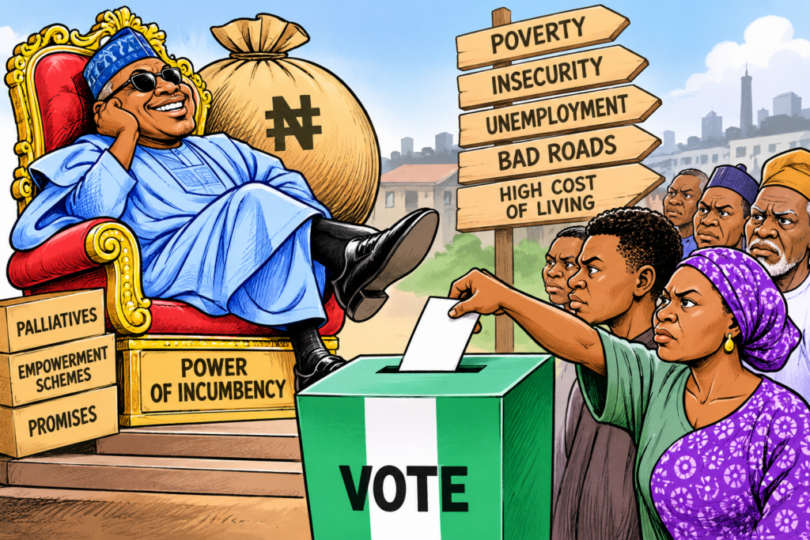
In Nigeria, however, the power of incumbency is increasingly deployed to weaken the electorate’s capacity to demand accountability. The weaponisation of poverty, the manipulation of public resources, the distribution of palliatives and the proliferation of questionable empowerment schemes have become instruments of political mobilisation. Rather than empowering citizens to make informed electoral choices, these practices often reduce political participation to a transactional exercise in which immediate survival takes precedence over the long-term wellbeing of society.
The odious expression ‘Dibo ko sebe’ has become a disturbing reflection of this political culture. It captures a mindset in which voters are encouraged to accept their circumstances, collect whatever is offered and return the same political actors to power, irrespective of their performance. Such an approach reinforces poverty, diminishes civic consciousness and undermines the very essence of democracy.
The political establishment may regard the systematic impoverishment of the electorate as an ingenious strategy for securing electoral victories. But history offers cautionary lessons. In his reflections on revolutionary movements, Vladimir Lenin argued that political upheavals were not necessarily triggered by the deepest levels of deprivation but could emerge when expectations rose and existing conditions failed to meet them. The broader lesson is that poverty does not invariably translate into political submission.
Indeed, a population enduring hardship may eventually become more politically conscious, more demanding and less willing to accept the status quo. Nigeria’s political class would be unwise to assume that the desperation of today will indefinitely translate into electoral docility. The world has changed, information is increasingly accessible, and the younger generation is becoming more conscious of its political and economic rights.
As the January 16 election approaches, voters must resist the myth that incumbency is an irresistible force. Holding public office is not an achievement in itself, nor is the possession of political power a substitute for performance. The real power belongs to the electorate, whose votes should reflect an honest assessment of governance, accountability and the quality of life.
The power of incumbency is, ultimately, a fallacy when it is divorced from performance. A government that has failed its people should not expect the automatic reward of another term. The ballot must remain an instrument of accountability, not a mechanism for perpetuating privilege.