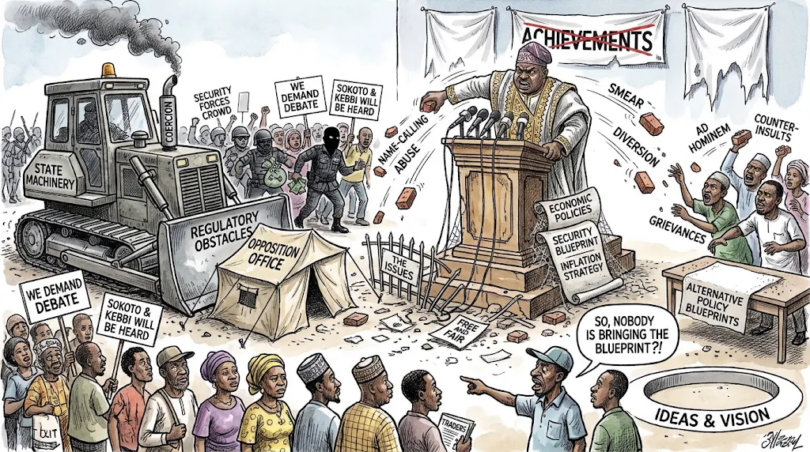
As Nigeria edges closer to the 2027 general elections, the political atmosphere presents a troubling paradox that threatens the very foundations of competitive democracy. On one hand, the operating space for opposition politics appears increasingly constrained by a combination of legal controversies, administrative obstacles, intimidation and the growing perception that the machinery of the state is being deployed, or tolerated, to frustrate alternative political platforms.
On the other, the political class, particularly those entrusted with governing the country, appears to be suffering from an alarming deficit of ideas, preferring the convenience of insults and political theatrics to the difficult business of defending records and presenting credible alternatives.
The unfolding controversy surrounding the African Democratic Congress (ADC) deserves particular attention. What should ordinarily be an internal political disagreement, subject to established party procedures and judicial determination, has become a matter of national democratic concern. The courts have an indispensable responsibility to interpret the law, and their independence must be protected.
However, the frequency with which political disagreements become entangled in protracted legal battles, especially where the consequences threaten the ability of opposition parties to organise and participate effectively, raises legitimate questions about the health of the democratic environment.
Democracy is not merely about holding elections every four years. It is equally about preserving the conditions that make those elections meaningful. An opposition party should not have to spend more time defending its right to exist and organise than explaining its political vision to the electorate. Neither should access to public spaces, security protection and the ordinary privileges of political participation become privileges that depend on one’s proximity to the corridors of power.
The reported difficulties surrounding opposition rallies, including alleged intimidation and attempts to frustrate mobilisation in Sokoto and Kebbi, further expose the fragility of this environment. That the gatherings proceeded despite these concerns is a reminder that political participation remains a constitutional right, not a favour dispensed by those in government. Allegations of inducement of security personnel or the mobilisation of non-state actors to disrupt lawful political activities are particularly serious and deserve impartial investigation. No democracy can thrive where political competition is conducted under the shadow of threats and fear.
The security agencies must understand that their uniforms are not party colours, and their statutory responsibilities cannot be subordinated to the political calculations of any administration. Their duty is to protect all Nigerians and guarantee lawful political activities, irrespective of the political affiliations of those involved. The same obligation applies to public institutions, whose credibility depends on their ability to resist partisan pressure and discharge their responsibilities without discrimination.
Unfortunately, the problems confronting the democratic process are not limited to the treatment of opposition parties. There is also a disturbing intellectual poverty in the country’s political conversation. Rather than presenting compelling arguments on the economy, insecurity, unemployment, education, healthcare and the worsening cost of living, political leaders increasingly find refuge in personal attacks, name-calling and the endless examination of their opponents’ backgrounds and political associations.
It is particularly curious that those occupying the highest political offices, who have the enormous advantage of incumbency and access to the instruments of public communication, should appear more interested in trading insults with their critics than explaining their stewardship. A government with a convincing record should have little difficulty allowing its achievements to speak. Where the response to questions about governance is an attack on the questioner, the electorate is left wondering why the substance of the argument has become so difficult to defend.
Yet, the opposition cannot claim complete innocence in this intellectual decline. Its responsibility is not merely to identify the failures of the incumbent but to demonstrate how it intends to address them. Nigerians deserve costed economic proposals, credible security strategies, measurable commitments and evidence of administrative capacity. A campaign built entirely around the shortcomings of another administration is not necessarily a programme for national renewal. The opposition must offer more than a different set of voices shouting across the same political marketplace.
The tragedy is that the Nigerian electorate is being presented with too much political noise and too little policy substance. The national conversation has become a contest of personalities when it should be a contest of possibilities. Those seeking public office must understand that the people are not looking for the most entertaining insult merchant but for leaders capable of providing answers to the difficult questions confronting their daily lives.
More importantly, Nigerians must recognise that democracy cannot be left entirely in the hands of politicians. Citizens must resist the temptation to become spectators in the gradual narrowing of their democratic choices. They must demand transparency, question the conduct of public institutions and insist that political differences are settled through lawful processes rather than intimidation or institutional manipulation.
The 2027 elections must not become a coronation disguised as a contest. The electoral umpire must demonstrate independence, the judiciary must inspire confidence, and security institutions must protect every lawful political activity. The governing establishment must understand that incumbency carries greater responsibility, not greater ownership of the political space.
Ultimately, the ballot belongs to the Nigerian people. It is neither the property of the ruling party nor an inheritance of the political establishment. Those in power have a duty to defend the conditions under which they can be challenged, just as those seeking power have a duty to present credible alternatives.
A democracy in which the referee is suspected of favouring one contestant will inevitably lose the confidence of the spectators. And an election in which the contestants are more interested in destroying one another than presenting their ideas leaves the people with little to choose from.
Nigeria must not allow its next electoral contest to become a battle over who can silence whom. The country needs fewer political brawls, stronger institutions, better arguments and a genuine commitment to the sovereign right of citizens to make their choices freely.