The Independent National Electoral Commission (INEC) has warned that the popular slogan “rig and die” could trigger bloodshed during the upcoming general election.
The commission said the slogan, which has gained attention amid growing political tensions ahead of the elections, could encourage mob attacks against electoral officials, voters, party agents and observers.
INEC National Commissioner and Chairman of its Information and Voter Education Committee (IVEC), Mohammed Haruna, gave the warning on Monday in Abuja during a zonal forum with media stakeholders.
Haruna, who was represented by the commission’s Deputy Director of Information and Publicity, Wilfred Ifogah, spoke on the theme, “Ethical and Professional Standards in Election Reporting Ahead of the 2027 General Election.”
The forum was attended by representatives of the Nigeria Union of Journalists (NUJ), Nigerian Institute of Social Media Analysts (NISMA), Newspaper Proprietors Association of Nigeria (NPAN) and other media executives.
Expressing concern over the growing use of the slogan, Haruna said its association of electoral offences with death could have dangerous consequences, regardless of the intentions of those promoting it.
“Consider the phrase ‘rig and die’, now widely repeated. Whatever its originators intend, though some people insist it is aimed only at those who rig, a slogan that links an electoral offence to death is dangerous,” he said.
He explained that ordinary Nigerians working at polling units would be more exposed to the consequences of such rhetoric than powerful politicians who make political statements.
According to him, presiding officers, assistant presiding officers, collation officers, other ad hoc electoral workers, voters, party agents and observers could become targets if political tensions escalate into violence.
Haruna warned that an angry crowd could easily misinterpret a delay in announcing results, technical difficulties or unverified information as evidence of electoral manipulation, potentially leading to attacks that could cost lives.
“A charged crowd can easily mistake a delayed result, a technical difficulty or a rumour for rigging, and a mistake of that kind can never be undone,” he said.
The national commissioner stressed that electoral malpractice was a criminal offence that should be addressed through established legal channels rather than threats or violence.
He pointed to the Electoral Act 2026, which prescribes penalties for electoral offences, including result manipulation and other forms of malpractice.
Haruna urged political actors and their supporters to use lawful means to challenge suspected irregularities, including monitoring elections, reporting complaints to INEC and security agencies, and approaching the courts where necessary.
“The remedy lies in the law: vigilant observation, transparent results on IReV, formal complaints to the commission and the security agencies, and where necessary, the courts,” he said.
He also cited Section 33 of the Nigerian Constitution, which guarantees the right to life, warning that nobody should be attacked or killed based on suspicions of electoral wrongdoing.
The commission appealed to political leaders to abandon violent expressions and urged journalists to avoid promoting threats through sensational headlines, social media posts and trending hashtags.
Haruna maintained that threats of violence should not be treated as ordinary political disagreements, stressing that security agencies had a responsibility to respond to such conduct.
He also condemned attempts to intimidate journalists carrying out their professional responsibilities, saying a safe electoral environment depended partly on the freedom of the press.
“No journalists also should be intimidated for doing their work. A free press and a safe election go together,” he said.
INEC further assured Nigerians that it would not shield any of its officials or temporary electoral workers found guilty of compromising the electoral process.
Haruna said the law provided sanctions for result manipulation, vote buying and attempts to prevent the electronic transmission of polling unit results to the INEC Result Viewing Portal, known as IReV.
He disclosed that the commission was working towards ensuring that electoral officials and voting materials arrived at polling units by approximately 7:30 a.m. on election day to prevent unnecessary delays that could create suspicion among voters.
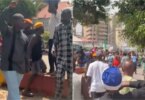
On Monday, a fresh protest broke out at INEC’s headquarters in Abuja as youths and opposition supporters demanded electoral accountability and expressed opposition to President Bola Tinubu’s administration.
The protesters had gathered at Unity Fountain before marching towards the commission’s headquarters, where they chanted slogans including “Tinubu Must Go” and “Rig and Die.”
Among those who joined the demonstration was the presidential candidate of the African Action Congress (AAC), Omoyele Sowore, who addressed the protesters and participated in the chants against Tinubu.