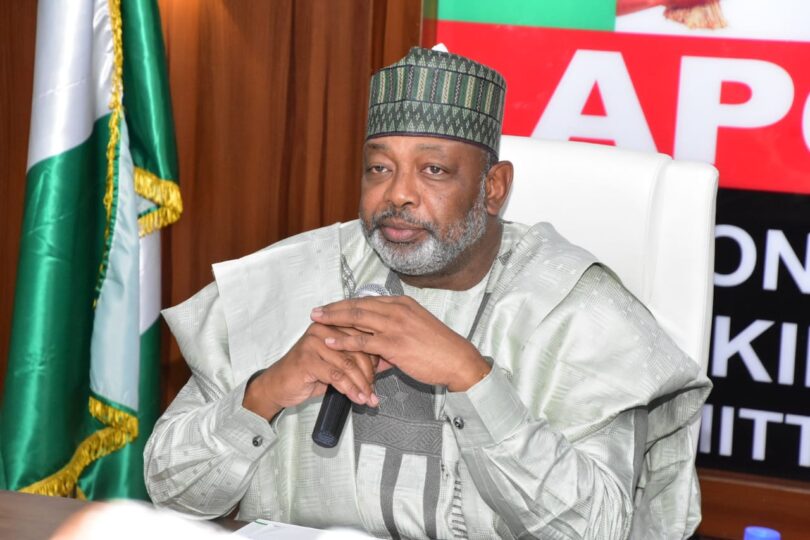
The Minister of Agriculture and Food Security, Senator Abubakar Kyari, has dismissed claims linking the projection that 33.5 million Nigerians could face severe food insecurity in 2027 to President Bola Tinubu’s possible re-election. Kyari described the interpretation of the October 2026 Cadre Harmonisé food security assessment by some opposition figures……
The Minister of Agriculture and Food Security, Senator Abubakar Kyari, has dismissed claims linking the projection that 33.5 million Nigerians could face severe food insecurity in 2027 to President Bola Tinubu’s possible re-election.
Kyari described the interpretation of the October 2026 Cadre Harmonisé food security assessment by some opposition figures as political propaganda, insisting that the report was a technical assessment and not an election forecast.
In a press statement on Monday, November 2, 2026, the minister said the assessment did not attribute the projected food insecurity figure to the continuation of the Tinubu administration.
He said, “The assessment does not say that 33.5 million Nigerians will face food insecurity because President Bola Ahmed Tinubu, GCFR, is re-elected in 2027. That interpretation was added for political purposes.”
Kyari explained that the projected figure relates to the June-August 2027 period, noting that the assessment actually indicated a decline in the number of Nigerians expected to experience severe food and nutrition insecurity compared with the corresponding projection for 2026.
According to him, the figure dropped from 34.8 million in the 2026 projection to 33.5 million in 2027.
He also clarified that the Cadre Harmonisé assessment was developed by the Permanent Inter-State Committee for Drought Control in the Sahel (CILSS), alongside regional and technical partners, including the Food and Agriculture Organisation (FAO), World Food Programme (WFP), FEWS NET, UNICEF and the Integrated Food Security Phase Classification (IPC).
The minister said the framework was designed to identify food and nutrition security risks and provide early warnings to governments and development partners, rather than assess the political performance of administrations.
Kyari identified climate change, inconsistent rainfall, prolonged dry spells and the Super El Niño phenomenon among the factors affecting food production and worsening food insecurity in different parts of the country.
He said these challenges had disrupted planting seasons and made it increasingly difficult for farmers who depend on rain-fed agriculture to sustain production.
The minister added that the assessment did not establish any connection between the identified challenges and the continuation of a particular political administration.
On the Federal Government’s response, Kyari listed increased access to fertiliser and other agricultural inputs, mechanisation, irrigation, dry-season farming, agricultural financing, improved access to farmland and investments in storage and processing among ongoing interventions.
He also attributed improved access to some previously inaccessible farming communities to better security, saying farmers in those areas were gradually returning to their farmlands.
According to him, communities such as Marte and Guzamala in Borno State, which were previously inaccessible to data collectors, have experienced improved stability, allowing the latest Cadre Harmonisé assessment to cover the areas.
The minister further highlighted progress in fertiliser distribution and local blending, support for smallholder farmers, mechanisation partnerships and agricultural financing through the Bank of Agriculture.
While acknowledging that the interventions would not immediately resolve the country’s food security challenges, Kyari maintained that the government was taking steps to address what he described as a longstanding structural problem.
“These interventions will not solve every problem overnight. Food insecurity is a longstanding and structural challenge that has developed over many years and predates this administration,” he said.
He, however, insisted that agriculture had recorded significant progress since Tinubu assumed office.
Kyari urged political actors to exercise caution in interpreting food security data, warning against using the struggles of Nigerians as political campaign material.
He said, “Millions of Nigerians are affected by these challenges. Their food, livelihoods and wellbeing should never be reduced to political talking points.”
The minister added that the government welcomed scrutiny and constructive criticism but would not support what he described as the deliberate misrepresentation of technical assessments for electoral purposes.
He assured that the government would continue to use the findings of the Cadre Harmonisé assessment to strengthen agricultural interventions, support farmers and improve access to safe, nutritious and affordable food.