
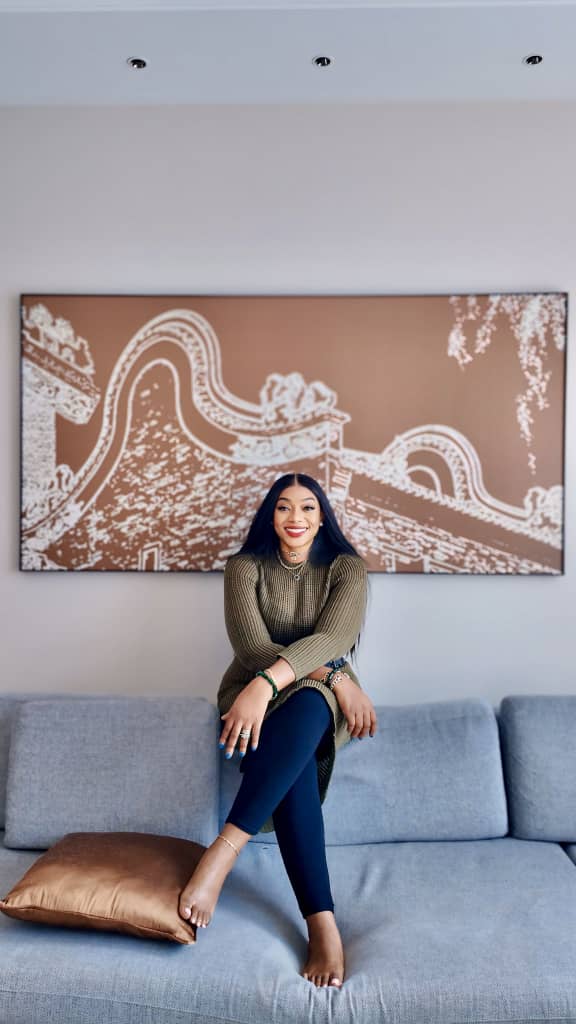
*Asks if your ₦2.5b home doesn’t improve your life, what exactly did you pay for
Tayo Adejumo, the amazon founder and CEO of Kimberly Group, a construction and architectural company in Nigeria, has called for a radical shift in the nation’s luxury housing market from expensive finishes and impressive features to homes intentionally designed around the people who live in them.
She questioned the model being operated in the country, where expensive houses are deemed to be luxury pieces by property market operators.
Adejumo, an environment and architectural strategist with wide expertise in infrastructure and housing development, said in an interview that Kimberly Group has grown into a dominant force in the industries in which it operates, with her vision continuing to drive the purpose of each entity. She said the group’s ambition is not only to change the taste of luxury homes in Nigeria, but also how homeowners feel about the spaces they inhabit.
“We talk about luxury homes in Nigeria largely through price: ₦500 million, ₦1 billion, ₦2.5 billion, ₦5 billion. Then we describe the inventory — six bedrooms, cinema, swimming pool, elevator, imported kitchen, marble floors, chandeliers, walk-in wardrobes and smart-home systems. All beautiful things. But if someone can afford a ₦2.5 billion home, money is clearly not the limitation. The more important question is: what has all of that got to do with the person who is actually going to live there? At KÏMBERLŸS GROUP, I believe luxury residential design should begin with intention. A truly exceptional home should not merely announce wealth; it should improve the quality of the owner’s everyday life,” she said.
According to Tayo Adejumo, who is charting a new frontier in luxury housing, homeowners investing hundreds of millions or billions of naira in private residences should expect architecture to respond to their actual lifestyles rather than simply replicate conventional luxury-house templates.
“A person investing hundreds of millions or billions of naira in a private residence should be able to demand more than expensive finishes. The home should understand how they wake up, dress, work, entertain and rest; how much noise they tolerate; how they experience light; whether nature calms them; whether they prefer intimacy or openness; whether they work from home; whether their children are young, grown or constantly returning; whether parents may eventually live with them; and how domestic staff and household services should operate,” she said.
She added that “Even the less glamorous realities of residential life — laundry, waste, water, solar systems, maintenance, storage and heavy rainfall — deserve intelligent planning. That is design. Not merely the allocation of rooms or the application of marble, but the creation of an environment that understands the life taking place inside it,” she stated.
The Kimberly Founder CEO further explained that a home continuously influences the experiences and routines of its occupants, making factors such as sound, light, temperature, movement, privacy, nature and clutter important elements of luxury design.
“A home is an environment acting on you every day. Sound acts on you. Light acts on you. Temperature, clutter, movement, privacy and nature all influence how a space is experienced. A home can quietly create friction, or it can remove it,” Adejumo stressed.
“This is why I am increasingly interested in designing around the human being rather than beginning with a conventional room schedule. For me, real luxury lies in the layering of functionality, aesthetics, acoustics, lighting, temperature, flow, privacy, nature, storage, service circulation, maintenance and wellbeing.” She said designers should consider “how a space feels at 6 a.m., how it feels at midnight, how it sounds when 20 people are visiting and how peaceful it becomes when everyone leaves,” stressing that “The home should not simply look beautiful in photographs; it should feel beautiful to live in.”
Adejumo also pointed to the need for architects to design around actual household routines rather than allocating large areas to spaces that may only occasionally be used. “We often design rooms instead of designing lives,” she said. Citing one of her residential concepts, she said she designed an owner’s suite as a sequence — “bedroom → walk-in wardrobe → beauty studio.”
According to her, “The beauty studio is not simply a dressing table. It is a dedicated environment for makeup, hair, skincare, product storage, manicures, pedicures, fittings and preparation. If those activities are genuinely part of someone’s life, why should the architecture pretend they do not exist?” She said the same principle should apply to work, exercise, entertaining, relaxation, family life and transitions between public and private spaces, adding: “Intentional design starts by understanding what people actually do, not what a generic luxury-house template says they should do.”
On integrating nature into residential architecture, the enterprising business woman said it should not be treated as decoration added after the building has been designed.
“Nature, too, should not be decoration added after the architecture is finished,” she said, describing another residential concept in which a mature tree sits at the centre of the house, with the building wrapping around it. She said the upper floor incorporates “a covered internal veranda around an open-to-sky courtyard, allowing the owner to remain connected to the tree even when it rains.”
According to Tayo Adejumo ,“The tree becomes part of the architecture rather than an afterthought in the landscape plan.” She said such an approach changes the questions designers ask, including “Where does morning light enter? Where does afternoon heat fall? Where should shade be created? How does rain move? What should the owner hear — and what should they not hear? Where does fresh air travel? Which spaces should feel social, and which should feel deeply private? Where does the eye rest? Where does the body relax? Where does the nervous system settle?” She added: “These are not decorative questions. They are questions about living.”
She said her understanding of luxury has consequently evolved from simply having more to being deliberately considered in the design process.
“My definition of luxury has therefore changed. I no longer think luxury is simply having more. I think luxury is being considered”.
The Kimberly Group boss identified features such as task-appropriate lighting, calming acoustics, practical storage, efficient morning routes, discreet service circulation and properly designed staff spaces as elements of genuine luxury. She also highlighted the importance of integrating solar, water, pumps, waste systems and maintenance requirements into the overall design, while considering how kitchens are used, where pets can stay, how entertaining can be separated from private areas, and how ageing, children, returning adult children and parents can be accommodated.
“It is the ability to evolve within your home without the house immediately becoming inconvenient. That is luxury: not simply visual excess, but the reduction of friction,” she said.
“This is why I believe the conversation around luxury housing should move beyond the assumption that a more expensive home is automatically a better home,” Adejumo said.
“A thoughtfully planned ₦500 million residence can sometimes serve its owner more effectively than a ₦2.5 billion house conceived primarily around scale, resale expectations, generic luxury features and expensive finishes. And a ₦2.5 billion residence can be extraordinary when the thinking behind it is equally extraordinary.”
She said the issue was not whether a home costs “₦500 million, ₦2.5 billion or more,” but “intention,” adding that high-net-worth Nigerians and members of the diaspora investing in private homes have an opportunity to create residences that are “not simply purchased, but deeply conceived around the people who will inhabit them.”
Looking ahead, Adejumo said the next evolution of African luxury housing should prioritise personalisation, intelligence and human experience.
“I believe the next evolution of African luxury housing should be more personal, intelligent and human. Not necessarily smaller. Not necessarily larger. Not minimalist for the sake of minimalism, or extravagant for the sake of spectacle. Intentional,” she said.
According to her, “At KÏMBERLŸS GROUP, that means approaching private residential projects as integrated experiences in which architecture, interiors, lighting, landscape, procurement, utilities, acoustics, technology and human behaviour are considered together — from the first idea through to the finished home.”
Tayo Adejumo added that,: “A truly luxurious residence should not require its owner to constantly adapt to it. It should have been designed around the owner. So perhaps the question for anyone with the means to live exceptionally well is not simply, ‘How much house can I afford?’ It is: ‘How intentionally can my home be designed around the life I actually want to live?’ That, for me, is where the future of luxury residential design begins.”
Speaking further, Adejumo said, “At KÏMBERLŸS GROUP, we believe a home should know you before it is asked to hold you.
“That is why our process begins with your life, not your floor plan. We want to see how you live now, whether the home is yours or rented. We want to understand what you love enough to carry forward, what you have tolerated for too long, what calms you, what irritates you, how you sleep, how you work, how you entertain, how your family moves through a space, and even what your children dream of becoming.
“Then we study the land. Its light, wind, orientation, views, trees, privacy, access, rain, sound and surrounding environment. But we do not allow the land to dictate the limits of the life that can be created there. We work with its realities and unlock its possibilities”, Tayo Adejumo added.
Continuing, she said, “Because we are only here in this world for a little while. And if you have worked hard enough to spend significant money creating a permanent place for yourself and your family, make it count.
“Your home should not simply be expensive. It should be deeply yours. It should grow with you, play with you, restore you, protect your peace, support your productivity, accommodate the different seasons of your life and quietly make everyday living better.
“That philosophy runs through everything we do. Even at Kimberly’s Electric, from the mattress you sleep on and the pillow beneath your head, to the lighting that shapes a room and the décor you live among, our intention is the same: what surrounds you should contribute something meaningful to the life you are living.
“So if you are thinking about building, redesigning, or you already have drawings and something still does not feel quite right, talk to us before you build. KÏMBERLŸS GROUP is only a Google search away. And you can walk into our office at No. 7b, Centigrade Mall, Fola Osi, Lekki Phase 1. Let us begin with the life you actually want to live, and design from there’, said the CEO of Kimberly’s Group.