More than three years after President Bola Tinubu assumed office on a platform of “Renewed Hope”, Nigerians are increasingly measuring the administration against the promises made during the 2023 election campaign, with questions mounting over jobs, food prices, electricity, security, transportation and the broader cost of living.
With the 2027 general election only months away, the gap between some of the administration’s promises and the realities confronting households has become a major subject of public debate.
Tinubu came into office promising to transform the economy, create jobs, improve electricity supply, make food more affordable, strengthen national security and expand opportunities for young Nigerians.
In his May 29, 2023 inaugural address, the President said his administration would pursue higher economic growth and significantly reduce unemployment.
He promised that electricity would become “more accessible and affordable” to businesses and households, while power generation should “nearly double”.
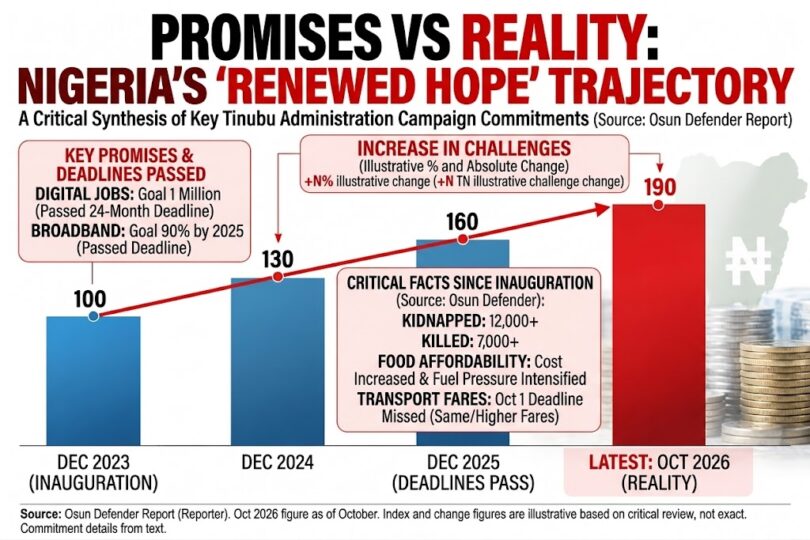
He also pledged to honour his campaign commitment to create one million new jobs in the digital economy.
More than three years later, the administration points to reforms and programmes in several of these areas, but the extent to which the original promises have translated into measurable improvements in the lives of Nigerians remains contested.
The latest example is the promise to reduce transportation costs.
On September 19, Tinubu announced that, following a meeting with the 36 state governors, Nigerians should begin to see “measurable reductions in transportation costs” from October 1.
He directed states to work with transport unions and commercial operators to ensure that savings from cheaper energy, particularly Compressed Natural Gas (CNG), were passed on to commuters through lower fares.
The President cited examples of what he described as the potential of cheaper energy to reduce transport costs.
He said CNG-powered and electric public transport services in Borno were carrying passengers for between N50 and N100 on routes where commercial operators charged between N300 and N600.
He also cited CNG deployments in Edo, Kano, Delta, Kwara and Lagos, while encouraging states to accelerate the process before October 1.
But October 1 came without the nationwide fare reduction promised by the President.
Findings published by major media outlets showed that commuters in several states continued to pay the same fares, while some reported paying even higher fares.
Newspapers also reported that the presidential directive had not translated into widespread fare reductions, with transport operators in several states saying they had not received CNG buses and that inadequate refuelling and conversion infrastructure remained a problem.
They similarly reported that commuters in Kaduna, Oyo, Enugu, Abuja and Lagos said they were still paying the same fares after October 1, with no noticeable reduction in the cost of public transportation.
The situation was particularly significant in Osun, where commuters continued to face existing fares.
The reports therefore exposed a clear gap between the President’s September 19 deadline and what commuters actually experienced when October arrived.
While the Federal Government can point to CNG buses and subsidised transport schemes in some locations, the promise was for more Nigerians to begin seeing measurable reductions from October 1.
That outcome was not achieved on a nationwide scale.
As the nation heads into the elections, social media platforms have become a major arena for Nigerians to compare the promises of 2023 with their current experiences.
Former Vice President Atiku Abubakar, speaking on Independence Day, challenged Tinubu’s description of the country as entering an “age of prosperity”, arguing that many Nigerians were still struggling to afford food, transportation, healthcare and other basic necessities.
The African Action Congress (AAC) similarly criticised the government on October 1, accusing the administration of failing to translate its economic reforms into affordable living conditions for millions of Nigerians.
A development expert, Mr. Kazeem Raji, said the worsening economic situation had significantly affected the cost of living and the overall wellbeing of Nigerians, arguing that government policies should ultimately be judged by their impact on ordinary citizens.