
By Henry Akubuiro
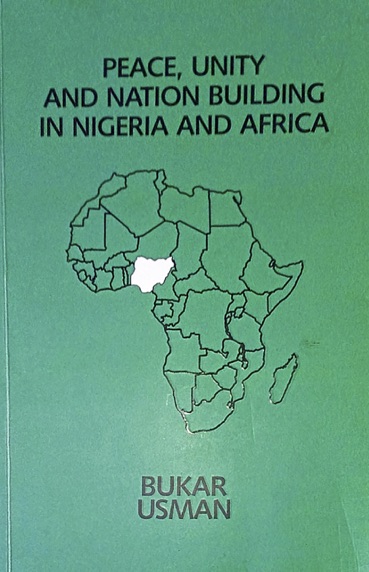
Peace, Unity and Nation Building in Nigeria and Africa, Bukar Usman, Klamidas Communications Ltd, Abuja, 2025, pp. 355
Since the dawn of independence in Africa, the task of nation building has been a laborious undertaking, demanding sweats, reaching new highs at one point and fractured at different junctures in other instances. Nation building in Africa has been hampered by the difficulty in unifying diverse ethnic and religious divides in artificial borders arbitrarily created by colonial powers, who did little to reflect preexisting organic, historical structures. This has resulted in different groups within African nations who prioritise ethnic, linguistic and religious identities above national identities. Internal and external conflicts haven’t helped matters, either. But nation building prevails mostly under a peaceful, united atmosphere.
Dr. Bukar Usman has spoken and written extensively on governance in Nigeria. It didn’t come as a surprise, having served as a civil servant in different Nigerian governments, including parliamentary, presidential and military governments. The book, Peace, Unity and Nation Building in Nigeria and Africa, stems from a keynote address on Peace, Unity and Nation Building organised by StandTall Africa Initiative (STAI), presented not too long ago by the author. In this book, the author has expanded the pagination to 354 with additional information on the publications of the author and his numerous book donations that were not in the original public presentation. The book also has translations in three major Nigerian languages – Hausa, Igbo and Yoruba. Thus, we have four books in one.
The initial public presentation of this topic by Usman was greeted with rave reviews by the Nigerian media, but the author has opted to publish it as a book for a longer documentation and preservation. He desires to reach many people who speak not only the English language but also Nigeria’s major language, which also have long established orthographies.
The English version of Peace, Unity and Nation Building in Nigeria and Africa is written by the author himself while the Hausa part is translated by Bashir Yahuza Malumfashi. The Igbo and Yoruba translations are handled by Henry Akubuiro and Ben Tomoloju. By having a single book containing translations in three indigenous languages, the author has pointed to a new direction for African writers to explore in order to encourage reading culture in diverse African languages, particularly as the audience in indigenous languages in Nigeria has continued to shrink.
The book enlightens us on the constitutional provisions for individuals and stakeholders to follow, contained in Section 24 (a)-(j) of the Nigerian Constitution 1999, including to protect and preserve public property, and fight against misappropriation and squandering of public funds; to make useful and positive contributions to the advancement, progress and well-being of the community where he resides; to render assistance to appropriate and lawful agencies in the maintenance of law and order, etcetera.
On the other hand, the government is responsible for the provision of security and welfare as its primary functions, ensuring the participation of the people in their governance, conduct of the affairs of governance in a manner that reflects the federal character, and the need to promote national unity and command loyalty. The states are expected to recognise the diversity of the people and the need to promote a sense of belonging and loyalty among all the people of the federation. However, much is also expected from the leadership at all levels to work towards the implementation of the enshrined national goals by remaining above board.
“All things being equal, it is expected that the interests of individuals subsumed in the group interests would be pursued and projected peacefully. However, an individual’s conduct, and also that of a group, is influenced by their immediate environment…. Nation building, therefore, requires aggregation of those interests and the working out of suitable programmes, in the short and long term, towards the attainment of the common good as set out by a nation,” writes Usman (p. 6).
The author argues that individual capacity to stand alone or contribute to the group interests could be enhanced by the acquisition of necessary skills to excel in any setting – traditional or modern. He also submits that the government has a responsibility to provide the required environment for individuals to realise their full potentials and contribute maximally to nation building. In emphasising the role of individuals and other stakeholders, the author recommends that “Nigeria, being a country of great diversity, should have pillars of stability that should be consciously nurtured to insulate them from political partisanship, especially in the face of increasingly unbridled quest for power in our polity.”
Another valid point advocated by Bukar Usman here is the empowerment of youths and women to enhance their role in nation building. He, therefore, calls for a resetting of our development focus to take care of the needs of this big chunk of our population. Citing Nigeria’s constitutional trajectory over the years, the author informs us that efforts at nation building in Nigeria arguably started since 1914 following the amalgamation of the Northern and Southern Protectorates by the British colonial government. Since then, we have had the Clifford Constitution (1922), the Richards Constitution (1947), the MacPherson Constitution (1952), the Lyttleton Constitution (1954), the Independence Constitution (1960), the Republican Constitution (1963), the 1979 Constitution, and the 1999 Constitution.
It is important to note that the land area of Nigeria since her creation has remained virtually the same after the 1962 plebiscite which exercised Southern Cameroon and the recent ceding of Bakassi Peninsula to the Republic of Cameroon. “However, administration is becoming more and more complex,” says Usman (p.8), who also uses tables tobl explain the internal restructuring of Nigeria by different military and civilian administrations, starting with General Yakubu Gowon in May 27, 1967, and ending with Gen. Sani Abacha’s creation of six additional states in October 1, 1996 and Gen Abdusalam Abubakar ‘s creation of six area councils for the Federal Capital Territory in 1999.
Nation building in Nigeria is still ongoing, says the author, despite the atrocities of extremists and discondant voices making different demands. He is, however, worried that the spread of fake news, which is going out of hand with the introduction of the social media, is capable of causing upheavels capable of jeopardising national stability and nation building. Hence, “disinformation, insinuations, innuendoes, misrepresentations and so-called conspiracy theories being spread in social media, whether deliberately or unwittingly, must be guarded against as they have become the tools of modern warfare and social destablisation. They are now more frequently used than tanks, missiles and battalions” (p.11).
Usman echoes that what applies to Nigeria largely applies to other countries in Africa, though they may not be identical. The bottom line is that “every country requires peace and security for individuals and groups to contribute their quota to the goal of achieving the common good” (p.11). Also, “to stablise democracy as a primary condition for security and national development in a country of great diversity…, decision makers in positions of leadership at all levels should strive for a workable formula … that ensures an inclusive system of governance” (p.11), which, ultimately, requires great individual and group sacrifice. In addition, Usman advocates that security situations in African countries must not be allowed to deteriorate to a stage of despair and helplessness whereby people would resign their fate to divine intervention for their salvation.
The book teems with historical photos and maps, which include pre-independence Nigeria regional structure, administrative map of Nigeria (1996 to date), map of Africa showing every country on the continent, colonial leaders of Nigeria from 1914-1966, etcetera. Professor Ademola Dasylva, in his take on the treatise, describes it as a “deep, incisive, thought-provoking well researched and concise,” while Professor Damian Opata sees it as “detailed and interesting analysis”. In the estimation of Magaji Danbatta, it an “articulated submission and, above all, thought-provoking.”