
By Maduka Nweke
[email protected]
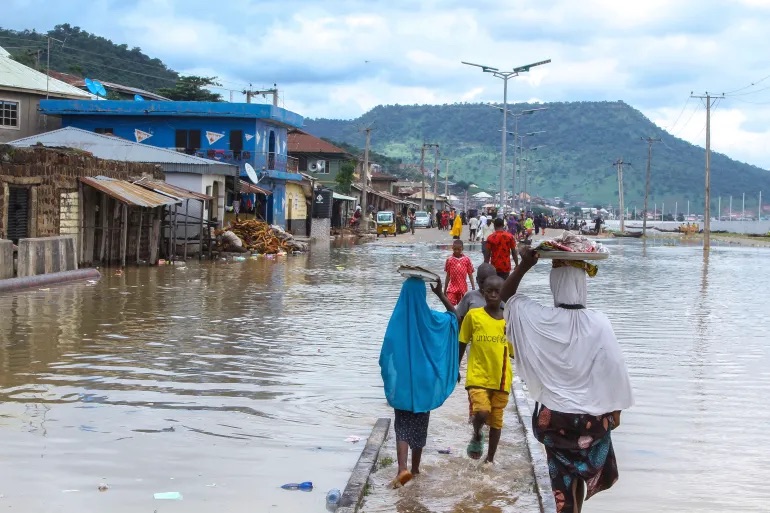
As the 2026 rainy season peaks, Nigerians, especially those living along flood plains or flood-prone zones, are already drowning in fear.
They are picturing how they will be trapped or devastated by floods since they have been repeatedly betrayed by the government’s broken promises.
Many of them are complaining they lack good roads and drainage systems, so that when it rains, it drains.
The National Emergency Management Agency (NEMA) reported that more than 200 people died in floods in 2025, just as tens of thousands have been displaced in 17 states.
It further explained that more than 600 lives were lost and 1.4 million displaced during 2022 flooding.
Despite the tortuous stats, residents across the country are wondering what preventive actions have been taken by stakeholders to address the horror.
Real estate players are also scared of their investments being washed off by rains if drainage systems are not in place.
Wale Akinwumi, a resident of Igando area of Lagos has repeatedly called on the state government to fix the bad roads and drainage systems in his area.
Naomi Charles, a teacher in ajah has complained of the same horror and is already picturing how she will scoop water out of her flat for days.
Experts have said that flooding can be somewhat controlled by strategic actions, such that during flooding, excess water is channeled through canals to non-risk areas further downstream or to other areas with high demand for water, such as arid and semi-arid areas.
They also say that canals can be used to lock excess flood waters in its linear reservoirs to prevent flooding and store water for future use.
They have also warned against indiscriminate refuse dumping into gutters and canals that impede water movement.
Each year, before the rains begin, weather forecasters issue familiar warnings about the looming threat of flooding. What often follows are a series of government assurances and promises to reduce the risks. But experts say those pledges repeatedly amount to little, as when the floods eventually arrive, communities are left exposed and the disasters unfold with little or no preventive action in place.
Weather agencies and experts have earlier warned that heavy rainfall is expected in many parts of Nigeria this 2026 season thereby increasing the risk of flooding. They warn residents to clear drainages around their homes and avoid dumping refuse in waterways, and stay informed through official weather alerts. They always warn that early preparedness can save lives and property.
Experts argue that these measures are often announced without clear timelines or accountability, while government officials tend to remain passive until the rains begin causing widespread damage, after which responsibility is frequently shifted to the public.
Earlier this year, the National Emergency Management Agency (NEMA) announced that it will embark on a massive sensitisation campaign in some council areas in Anambra, Ebonyi and Enugu States regarding the 2026 Flood Prediction. The Information Officer of NEMA Enugu Operations Office, Mr Ezeani Nnanyelugo, disclosed this in Enugu recently. Nnanyelugo stated that the agency, its partners and stakeholders would carry out a robust sensitization campaign in the three states.
The sensitisation followed the 2026 Nigerian Meteorological Agency (NiMet) Seasonal Climate Prediction and the Nigeria Hydrological Services Agency (NIHSA) Annual Flood Outlook.
Nnanyelugo said that the two agencies, in their predictions, noted that there would be high rainfall and a high risk of flooding in the three states under the NEMA Enugu Operations.
According to him, “we have flyers on flood-risk reduction activities and actions, in both English and the Igbo indigenous language, to distribute to flood-prone communities identified in the prediction. He added; “We have started and would sustain public enlightenment on the prediction through television, radio and online news platforms. The sensitization in Anambra State will mostly be for the areas close to major rivers like the Niger and Omambala rivers.
Mr. Ambrose Nwose, a Meteorologist living in Onitsha, Anambra State said, the government should use the experience of past events to take precautionary measures to avoid the havoc of the past years otherwise the event of the later years did not teach any lesson. “If after experiencing flood havoc all these years, nothing is done to stop or mitigate the menace of flooding in those areas, then questions should be asked of the use of the budgets allotted to that all those years. It seems that government officials like the fire brigade approach to tackling life threatening disasters. The implication is that governments do not value lives and properties, otherwise as they say, prevention is better than cure,” he said.
The NEMA South-East Zonal Director and Information Officer Mr. Ezeani Nnanyelugo earlier shared information on NEMA preparedness plan for the public to get ready. NEMA is also partnering with NiMet and NIHSA officials to ensure that their predictions are discussed among stakeholders in various meetings, training and workshops for the purpose of reducing flood risks in the states.
He also said that the Agency would conduct flood sensitisation programmes, including drills and simulation exercises with other stakeholders in major flood-prone council areas across the states. He said that NEMA had begun downscaling flood early warnings to identified hotspot council areas and would soon commence direct writing to the authorities of the councils and communities involved.
Nnanyelugo said, “We have started sharing weekly alerts forecast from NiMet/NIHSA to all relevant stakeholders via WhatsApp forum/meetings, notwithstanding numerous stakeholders’ meetings. The public is advised to stay informed”.
The Director-General of NEMA, Mrs Zubaida Umar recently reaffirmed the Agency’s commitment to strengthening partnerships with international humanitarian organisations – KSRElief, UNOCHA, World Food Programme (WFP) and International Office for Migration (IOM).
These partnerships are meant to enhance service delivery and support vulnerable populations across Nigeria. We will partner with various state SEMAs and community leaders soon to identify higher grounds and update on the existing Internally Displaced People (IDP) camps’ condition, as well as update the equipment holdings of stakeholders.
Recently, the National Environmental Standards and Regulations Enforcement Agency (NESREA) sealed about 30 construction sites in the FCT for violating provisions of the National Environmental (Construction Sector) Regulations, 2011.
The affected facilities according to them included Primate Reality in Wuye, XTadok Nigeria Limited in Wuye, and Samdus Limited in Asokoro District, among others.
Speaking with newsmen after the exercise, the Director-General of NESREA, Prof. Innocent Barikor, expressed concern over poor compliance with environmental regulations by operators in the construction sector. Officials of the National Environmental Standards and Regulations Enforcement Agency (NESREA) during an enforcement operation Barikor, who was represented by Mr. Elijah Udofia, Director of Environmental Quality Control, said the violations were uncovered during routine inspections and compliance monitoring across the FCT.
According to him, the affected facilities failed to meet regulatory requirements, especially in environmental documentation and responsiveness to compliance directives. “These facilities owners demonstrated unwillingness to fully comply with regulatory requirements relating to environmental documentation and engagement,” he said. He explained that the enforcement action was taken to halt environmentally non-compliant activities, compel adherence to regulations and ensure corrective measures are implemented within stipulated timelines.
Barikor noted that while the construction sector remains vital to national development, it must be effectively regulated to mitigate risks such as poor waste management, construction on floodplains and environmentally sensitive areas, as well as uncontrolled dust emissions. “Where regulatory communication is clear, time-bound and evidence-based, failure to respond constitutes a serious breach of compliance obligations and poses risks to both the environment and public health,” he said. He stressed that the regulations were designed to prevent environmental harm and ensure responsible construction practices from the outset. “Environmental compliance is not optional,” Barikor warned.
But reacting to the actions above, Mr. Nnamdi Ezenwosu, an environmental expert, stated that government officials use regulation and enforcement of the law to target government enemies. He said that government officials whose job it was to monitor government environment should stop any construction from the beginning so that the developer will not encore wastages before the work is stopped. “If someone is building on waterways, he should be stopped at an earlier stage. If you allow the builder to continue the project and when it has reached a stage when a maximum amount of money is spent on it before you come for demolition, in an ideal society, he can sue you to court and demand compensation for damages. But because we are in a society where the court is cash and carry, the government can do anything and go scot-free,” he said.
The NESREA boss, despite delayed actions, assured that the agency would continue to enforce environmental laws fairly and consistently nationwide. He said, “Let this enforcement serve as a clear directive. NESREA will continue to enforce environmental regulations rigorously, particularly where non-compliance poses risks to the environment and public health,” he added. He called on stakeholders to cooperate with the agency to improve environmental performance in the construction sector.
In the same way NEMA led by Mrs. Mmandu Aisueni, visited the State Coordinator of AKISEMSAS, Dr. Etimana Jacob and his management team at their operational facility in Uyo, Akwa Ibom State. The visit was in continuation of the sensitisation programme. Aisueni conveyed the goodwill of the Director General of NEMA, Mrs. Zubaida Umar, and reaffirmed the Agency’s commitment to fostering stronger partnerships with critical stakeholders involved in disaster preparedness, mitigation, response, and recovery.
Aisueni emphasised that disaster management requires collective responsibility and synergy among stakeholders, particularly agencies with mandates relating to medical emergencies, ambulance services, and humanitarian response. She further highlighted the need for regular information sharing, joint preparedness planning, and collaborative strategies to improve response capacity before, during, and after disasters.
Responding, the State Coordinator of AKISEMSAS, Dr. Etimana Jacob, appreciated NEMA for the visit and commended the Agency’s leadership in coordinating disaster management interventions. He stated that preparedness must remain a priority for emergency responders and reaffirmed AKISEMSAS’ readiness to collaborate with NEMA and other stakeholders in delivering swift and effective emergency response services across the state.
Dr. Jacob also proposed the conduct of a multi-stakeholder flood simulation drill to strengthen preparedness and build capacity on rescue operations, protection of lives and property, and environmental management during flood emergencies.
As part of the visit, the NEMA delegation was taken on a guided tour of key operational units within AKISEMSAS, including the call centre and emergency data management unit, where they observed emergency communication and response coordination systems.
The visit concluded with renewed commitments by both agencies to sustain collaboration, promote joint preparedness activities, and strengthen emergency response mechanisms for improved disaster risk management in Akwa Ibom State.