From Okwe Obi, Abuja
The National Chairman of the Labour Party, Benani Usman, has identified financial constraints as a barrier to women’s political participation in elective positions.
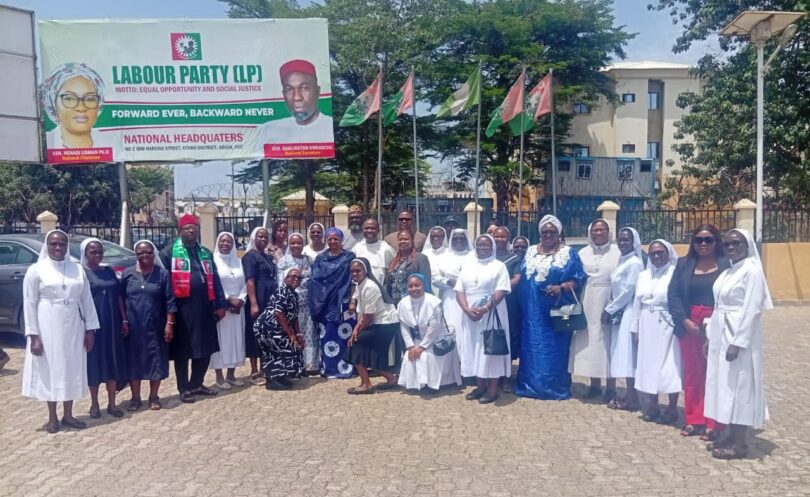
Usman stated this when a religious delegation led by the Dominicans for Justice and Peace Permanent Delegate to the United Nations, Fr. Aniedi Okure, and the Coordinator of Africa Faith and Justice Network Women Empowerment Programme, Sr. Eucharia Madueke, paid her a courtesy visit in Abuja.
She also argued that the lack of support from fellow women plays a role in weakening the strength of female politicians, despite their population advantage.
Beyond that, the former lawmaker said men influence their spouses and children on whom to vote for.
“So, the issues are many. I was discussing with somebody the other day.
“I said, what do you think are the issues? Why are women not occupying positions of leadership in Nigeria?
“He said there is a book he read; we were just talking at the airport. He said there is a book that he read, and the book asked the question: as far as women’s problems in politics and occupying positions are concerned, what is responsible for those problems?
“He said, is it society? Is it men? Is it God? Then he added, he showed me the title of the book, and he wrote to tell the person that he should have added one more thing: women themselves.
“I know for certain that most women don’t have the financial muscle to come out and contest elections.
“That is very certain. But I also know that most voters are women. But do you know, having contested elections twice and won, I have realised that when you keep a man here, you keep a woman here, when women come to vote, they mostly will vote for the man.”
She said for women to occupy their pride of place in politics, they should push for direct primaries.
“Some political parties did not like that. But I felt it was a good thing for me because if you say indirect primaries, where delegates are put together in a room, very few women can buy, can pay those delegates and win that primary election.
“But when you say direct primaries, consensus, there are many women who have contributed so much in their communities that if you tell the community, come and queue up behind this woman to win the primary election, they will queue up, she will win,” she added.
Also, Coordinator of Africa Faith and Justice Network Women Empowerment Programme, Sr. Eucharia Madueke, argued that the clamour for more women in politics was not for showmanship but to strengthen and solidify good governance.
Madueke contended that with more women in politics, governance would trickle down to the grassroots and good policies would be implemented.
“It is not a show, it is a reality that when enough women are represented in governance, the policy changes, the situation changes. It’s a given fact.
“Because when you have women underrepresented in governance, the policy is kind of skewed because you do not have enough women bringing their perspective, bringing their own experience, lived experience.
“So why we are doing this is because we know that it is a fact that when you bring enough women into politics and decision-making, they will bring their own experience.
“You may have one or two women that may not have represented well, maybe because there were not enough supports from the women.”
As part of his recommendations, the Dominicans for Justice and Peace Permanent Delegate to the United Nations, Fr. Aniedi Okure, suggested that women should be allotted 40% representation in politics.
The cleric said: “At least start with the policy Nigeria adopted in 2006. That is 20 years ago, that 35% at least should be women.
“Now it’s 4%. What a disgrace. So that should be the starting point. Ideally it should be 50-50, but at least make it 40%.
“And one last thing is that it is not enough to say we have made policy. Have law to enforce it. And say if we are having 5 congress people from this district there has to be 2 women at least.”