From Juliana Taiwo-Obalonye, Abuja
The Secretary to the Government of the Federation (SGF), George Akume, yesterday, urged religious and traditional leaders across Nigeria to intensify tolerance, grassroots mobilisation and peaceful coexistence ahead of the 2027 general elections.
Akume said faith-based and traditional institutions must take the lead in fostering understanding among citizens and preventing manipulation that could trigger violence before, during and after the polls.
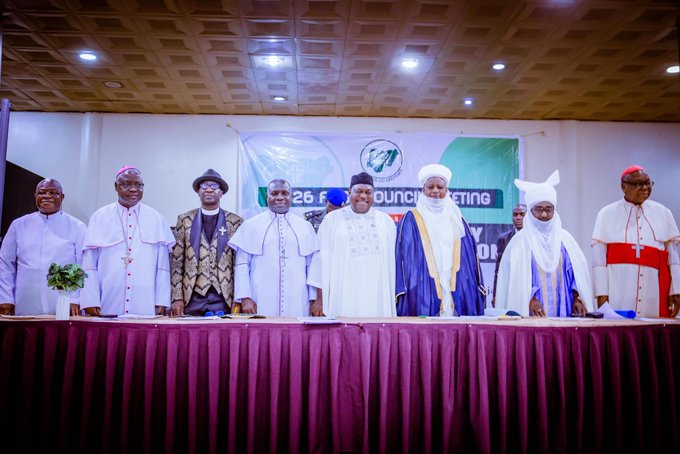
He made the call in Abuja while speaking at the first tri-annual meeting of the Nigerian Inter-Religious Council (NIREC), under the theme, “Religious Literacy for National Cohesion.”
He said religious and traditional leaders have a moral duty to deepen collaboration, youth education, and peace-building efforts as the country approaches the end of the current political and electoral cycle.
“The 2027 general elections are fast approaching and NIREC, through our traditional and religious leaders, faith-based organisations, and youth associations, has the moral responsibility for strengthening the network of collaboration, grassroots mobilisation, youth education, peaceful co-existence, tolerance, security, and protection of lives and property in our communities,” he said.
He stressed that peaceful elections begin with responsible leadership at the grassroots and warned against all forms of manipulation capable of creating divisions within communities.
He noted that Nigeria’s religious and cultural diversity makes tolerance and religious literacy essential for national cohesion, adding that understanding one another’s beliefs and practices remains key to building trust and sustaining peace.
He said the role of NIREC has become increasingly important in promoting dialogue, mutual understanding and peaceful coexistence among the country’s diverse religious communities.
He warned that Nigeria, like many parts of the world, continues to face serious challenges driven by stereotypes, misinformation, insecurity, and identity-based divisions.
“The world, today, continues to encounter formidable challenges that are capable of generating conflicts. These challenges are fuelled by lack of understanding, existence of stereotypes, ineffective communication, and the weaponisation of identity,” he said.
He said the government’s responsibility is not to politicise religion or encourage intolerance, but to strengthen citizenship, understanding, and responsibility among Nigerians.
The SGF said religious studies already form part of the school curriculum, but argued that the greater priority should be improving the quality of teaching through better teacher preparation, learning materials and classroom values that encourage empathy, respect, and responsible citizenship. He also expressed concern over insecurity in the education sector, warning that attacks on schools and prolonged closures in unsafe areas were worsening Nigeria’s education crisis.
“A child cannot learn fraternity in fear; a nation cannot preach literacy while schools are under threat,” he said.
He further said religious literacy must go hand in hand with media and information literacy, especially in an era of misinformation and hate speech.
He referenced the recent launch of the International Media and Information Literacy Institute by Nigeria and UNESCO, saying citizens must be equipped to verify information and reject falsehoods designed to divide society.
“Religious literacy must, therefore, be accompanied by media and information literacy; the discipline to verify before sharing, to question before reacting, and to reject falsehood, hate speech, and incendiary narratives,” he said.
He called on schools, faith communities, universities, media organisations, and traditional institutions to work together to raise a generation of Nigerians who embrace faith, patriotism, humility, and peaceful coexistence.
Akume described religious leaders as the conscience of society, saying they must use their influence to resolve conflicts, reduce hatred, and promote truth. He warned against the misuse of religion to justify falsehood, discrimination, violence, and bloodshed, insisting that such acts undermine both faith and national unity.
The SGF said the Federal Government had already put machinery in place to support religious and traditional institutions in ensuring peace and security across communities ahead of the elections. He added that his office would further engage stakeholders after receiving recommendations from the NIREC meeting.
He urged participants to prioritise literacy in all forms, describing it as central to peace-building, institutional trust, stability, and national unity.
He expressed optimism that the council’s deliberations would produce practical solutions for strengthening tolerance and national cohesion as the country moves towards the 2027 elections.