
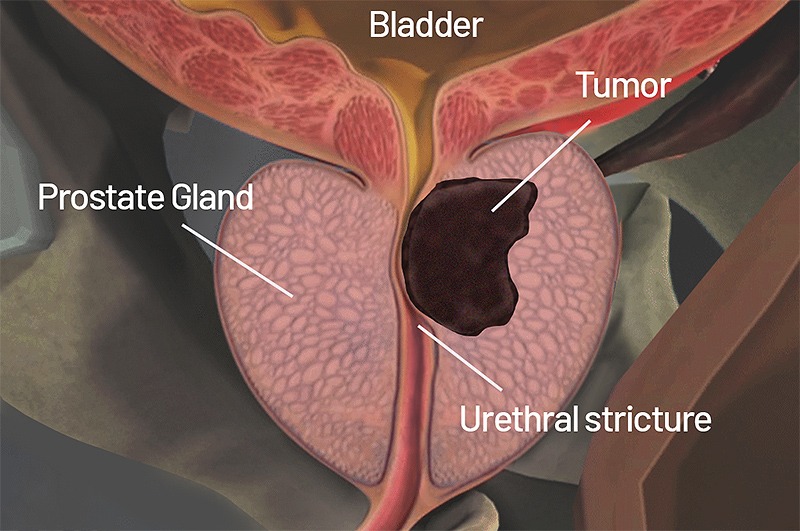
Medical expert, Dr Rasheed Abbasi, has asserted that men who are not sexually active or ejaculate fewer than four times a month may have a 33 per cent higher risk of prostate cancer. In a Video seen by TVC News on Wednesday, Abbasi disclosed this while appearing on The Morayo……
Medical expert, Dr Rasheed Abbasi, has asserted that men who are not sexually active or ejaculate fewer than four times a month may have a 33 per cent higher risk of prostate cancer.
In a Video seen by TVC News on Wednesday, Abbasi disclosed this while appearing on The Morayo Show.
Dr Abbasi further explained that men who marry more than one wives are at lower risk of prostate cancer, provided they engage in sexual intercourse regularly.
The medical expert defended his position, citing data from the Health Professionals, including a landmark piece of research conducted by experts at the Harvard T.H. Chan School of Public Health.
The expert argued that the study led by a female researcher, Dr Jennifer Rider, followed almost 32,000 men for over 18 years, comparing men who reported at least 21 ejaculations per month to those who reported only four to seven.
According to him, the researchers concluded that hitting the 21-mark had a 20% lower risk of prostate cancer.
He said, “I am not just giving you my opinion; I am giving you the data from the Health Professionals Follow-up Study. This is a landmark piece of research conducted by experts at the Harvard T.H. Chan School of Public Health.
“They didn’t just look at a few people for a few weeks. They followed almost 32,000 men for over 18 years. And what they found was definitive. They compared men who reported at least 21 ejaculations per month to those who reported only four to seven. The group hitting that 21-mark had a 20% lower risk of prostate cancer.
“The researchers, led by people like Dr Jennifer Rider, concluded that this ‘prostate stagnation hypothesis’ is real. If you are not clearing that pipe, you are inviting trouble. This is why I tell men: your biological health is tied to your activity levels.”
The expert emphasised that marrying more than one wife helps men live longer, stressing that lack of biological maintenance and isolation shorten men’s lifespan.
Dr Abbasi cited the telomere science, a study which won a Nobel Prize for Elizabeth Blackburn and her team, noting that a well-managed home with multiple partners helps improve men’s general well-being.
He said, “Even if you look at the Sheffield University studies on marriage and longevity, or the work done on telomere biology—which won a Nobel Prize for Elizabeth Blackburn and her team—it all points to the same thing. Stress, lack of biological ‘maintenance,’ and isolation shorten your life.
“A vibrant, well-managed home with multiple partners, if you can afford it, provides the social cushion and the biological ‘flush’ that protects your DNA. We have the Harvard data, we have the telomere science; we just need to start applying it to our lives here in Nigeria.”
Dr Abbasi explained that it’s about the social and emotional ecosystem, adding that “in a monogamous relationship that is highly stressful—where there is constant friction, nagging, or what we call ‘marital toxicity’—the man’s cortisol levels are perpetually high. High cortisol is a telomere killer.”
“However, in a well-managed polygamous setting, there is a different dynamic. There is a sense of variety, yes, but there is also a biological “competitive” drive that keeps the man’s testosterone levels higher for longer. Higher testosterone is linked to better cardiovascular health and cognitive function in ageing men,” he noted.
“If the home is peaceful and well-structured, the man often has a larger support system. Research in certain Mediterranean and Middle Eastern cultures has shown that men in these structures, provided they are wealthy enough to avoid the stress of poverty, often outlive their monogamous counterparts,” he concluded.