For seven decades, Israel has functioned not within fixed borders, but through the calculated deployment of “fluid lines.” From the 1947 Partition Plan to modern military doctrines, its geography remains a moving target—a series of unilateral impositions designed to facilitate expansion while evading international law. Effectively, Israel recognizes no definitive borders for itself, nor does it respect the sovereign boundaries of its neighbors. From Iran to Egypt, international borders are treated as mere sketches on a map rather than inviolable markers. This refusal to define its own limits maintains a permanent “frontier status,” where expansion is the only constant and international law is merely an optional suggestion.
We must not lose sight of the factual reality: immediately upon its creation on stolen Palestinian land, Israel was ostensibly bound by UN Resolution 181. This 1947 Partition Plan was presented by the international community as a definitive blueprint for borders—borders that the Zionist leadership, in truth, never intended to inhabit.
History records that while the Jewish Agency publicly accepted the plan to gain international legitimacy, its leaders privately viewed it as a mere “first step.” As David Ben-Gurion told the Zionist Executive at the time, statehood was a tool to “abolish partition and expand to the whole of Palestine.”
Following the 1948 war and the catastrophic displacement of the Palestinian people, the 1949 Armistice Agreements established the “Green Line.” It is a crucial distinction that this was never a “border” in the legal sense; at the insistence of both sides at the time, it was defined strictly as a military demarcation line “without prejudice to future political settlements.” However, while the UN’s intention was for this line to serve as the baseline for a future two-state reality, the Israeli leadership envisioned it only as a temporary pause.
By refusing to formalize these lines into permanent, recognized borders, Israel ensured its strategic flexibility—allowing it to treat the map as a work in progress, to be redrawn by force whenever the political winds allowed.
Today, the Green Line remains a strategic phantom. In the Zionist calculus, it is an optical illusion maintained for the consumption of the international community, while on the ground, it has been systematically erased by relentless settlement expansion. This “orthographic minimalism” applied to geography ensures the state remains in a permanent state of flux; it facilitates a “creeping annexation” that renders the logic of a two-state solution not only obsolete but self-defeating.
As the physical Green Line faded into geopolitical irrelevance, a new vocabulary emerged: the “Yellow Line.” This is no longer a fixed geographic marker, but a calibrated political-military tool used to project power across the region.
Unlike a border, the Yellow Line is an elastic boundary of “permissible” presence—a shifting gray zone that Israel expands or contracts to justify incursions, surveillance, and the gradual absorption of neighboring space under the guise of security necessity.
In Gaza and Lebanon, this strategy of fluid boundaries has transitioned into a violent re-mapping of the Levant. In Gaza, Israel has seized a significant portion of the devastated Strip under the perennial pretext of “security,” creating deep buffer zones that effectively shrink the territory. This occurs even as diplomatic overtures—such as Trump’s “Deal of the Century” and various “ceasefire” frameworks—theoretically dictate a full withdrawal. The reality on the ground mocks the paper promises; the “line” in Gaza is currently defined by the tread of a tank, not the ink of a treaty.
READ: Former US official: Iran war is direct extension of ‘Greater Israel’ project
In Lebanon, the encroachment is even more brazen. Despite the technical existence of a ceasefire, the Yellow Line—now functioning as an aggressive “Security Line”—has pushed far beyond the UN-recognized Blue Line. It appears to have reached northward to the Litani River, effectively encompassing the entirety of South Lebanon. This is a profound historical regression; this very land was only liberated from Israeli occupation in 2000 through the sustained efforts of the Lebanese Islamic Resistance and its allies.
By unilaterally redrawing this line at the Litani, Israel is attempting to undo decades of Lebanese sovereignty, treating the South once again as a “frontier” to be managed by force rather than a border to be respected.
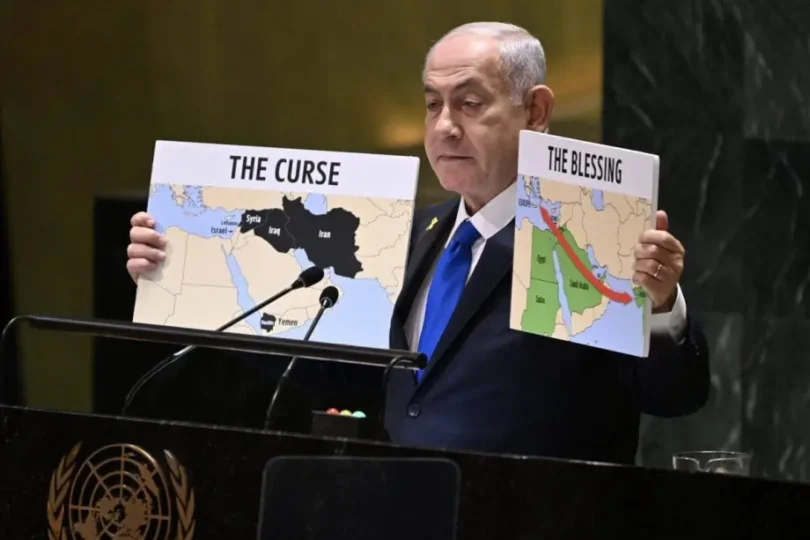
In the case of Iran, the discourse surrounding its nuclear program serves as the ultimate expression of the “Red Line” doctrine. Here, the term is weaponized to claim a total monopoly on regional security and to safeguard Israel’s Qualitative Military Edge—a mandated policy ensuring that no regional rival can achieve military or technological parity. These lines are not fixed by international law, nor are they rooted in objective security requirements; rather, they are unilaterally redefined according to Israeli strategic desires and bolstered by unconditional American financial, diplomatic, and military support.The ultimate goal remains the realization of the “Greater Israel” project. While historically this was pursued through conventional warfare and territorial seizure, we are witnessing a new phase of this expansion. Today, the project is being advanced through normalization.
The ultimate realization of the “Greater Israel” project is no longer being pursued solely through conventional warfare; it is now being finalized through normalization. By bypassing the Palestinian issue and establishing diplomatic and economic “lines” across the Arab world, Israel seeks to validate its territorial gains without ever committing to a definitive map. This strategy has enabled it to cultivate a network of both open and secret allies, even among Arab nations, effectively turning regional neighbors into partners in its “frontier” logic.
This is the shift from physical conquest to systemic hegemony.
The symbolic and the religious are frequently invoked here; historical narratives and biblical references are weaponized to frame these strategic choices as a “divine right” rather than a flagrant violation of modern international norms.
By refusing to settle within fixed borders, Israel maintains a permanent “frontier mentality” that thrives on perpetual conflict and the constant outward push of its influence.
Today, “Greater Israel” is a fact on the ground—a strategic reality that stretches its shadow from the borders of Iran to the gates of Egypt. This is a state defined not by geography, but by the “Red Lines” it imposes on others and the “Yellow Lines” it erases for itself. The inherent danger of this strategy is that such boundaries are unstable by design. When a state’s security is predicated on the constant movement of its political and physical boundaries, peace becomes a secondary concern.
In this framework, the primary goal is not coexistence, but a regional hegemony that ensures no border in the Middle East is ever truly inviolable.
OPINION: After the ceasefire illusion: Why Gaza’s “Day After” still has no buyer?
The views expressed in this article belong to the author and do not necessarily reflect the editorial policy of Middle East Monitor.