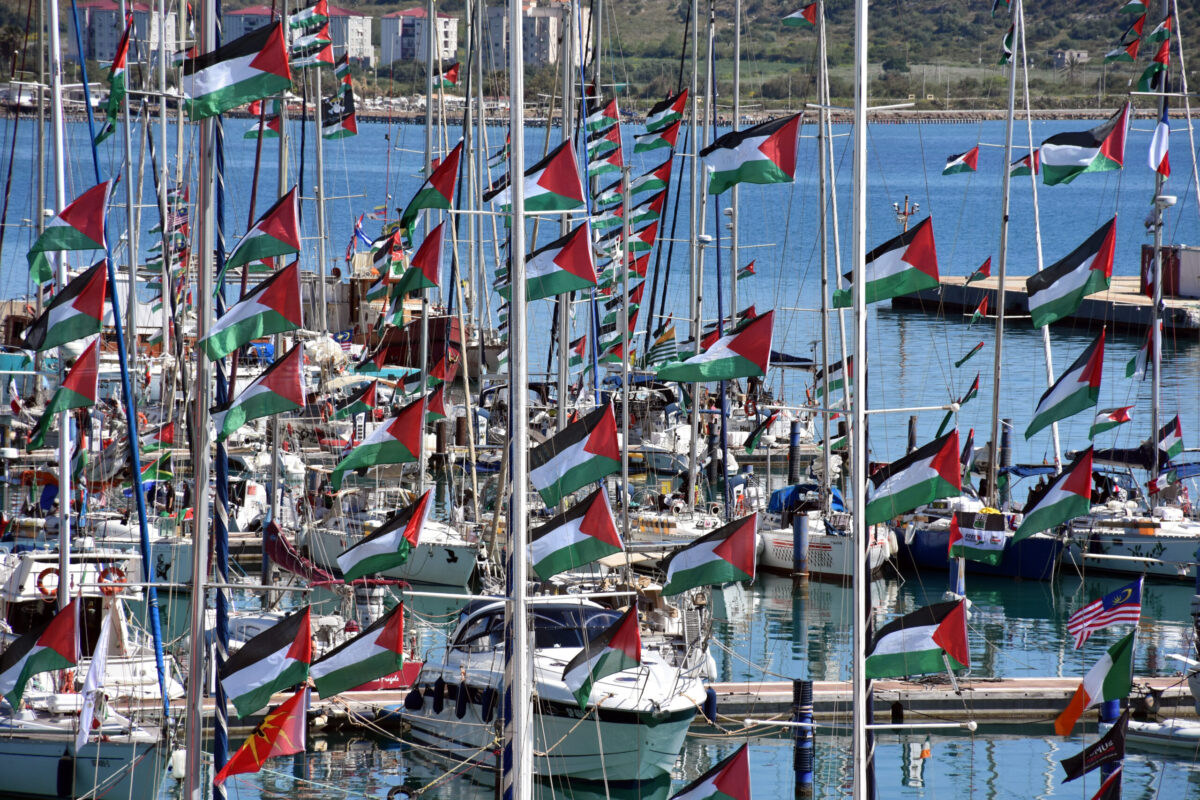
There are moments when power stops pretending to be lawful and simply performs its obscenity in public. Israel’s assault on the Gaza-bound flotilla is one such moment: a state so accustomed to impunity that it now treats the Mediterranean as its private checkpoint, international waters as occupied territory, and unarmed civilians as contraband.
The flotilla’s “crime” was not military. It carried no army, no missiles, no threat to Israel’s heavily armed paranoia. Its cargo was aid, witness, and moral embarrassment. That is precisely why it had to be attacked.
Flour is dangerous when starvation is policy. Medicine is subversive when siege is strategy. A civilian boat becomes a menace when it exposes an empire of barbed wire, bombardment, and bureaucratic cruelty.
Among those aboard, Senator Mushtaq Ahmad Khan’s presence is more than symbolic. It is an indictment of every palace, presidency, and general headquarters that has spent nearly two years reciting Palestine into microphones while doing nothing of consequence for Palestinians.
When a civilian flotilla must do what states refuse to do, the moral order has not merely collapsed; it has been reversed. The governed have become braver than their governors.
Israel, of course, will mumble the usual incantation: security. The most overworked word in the vocabulary of colonial violence. Security, apparently, requires bombing neighborhoods, starving children, sealing borders, humiliating doctors, killing journalists, and now abducting humanitarian activists at sea. One waits for the next press release explaining that bread posed an existential threat and bandages were intercepted in self-defense.
But the flotilla has already succeeded. It has torn the mask off. Israel’s problem was never that aid could reach Gaza. Its problem was that the world might see, again, that Gaza is not dying by accident. It is being made to suffer by design. The siege is not a tragic complication of war; it is war by other means — slower, quieter, and dressed in paperwork.
And still Gaza does not submit. This is the miracle that terrifies its tormentors. After rubble, famine, displacement, mass graves, orphaned children, shattered hospitals, and the industrial production of grief, Palestinians continue to live with a defiance that makes every empire look temporary.
They bury their dead, rescue their neighbors, document their wounds, teach their children, raise their flags, and refuse the one thing Israel most desperately demands: surrender. Gaza’s survival is not passive endurance. It is resistance in its most elemental form.
The flotilla activists understood this. They did not sail because they were naïve enough to believe Israel would suddenly discover mercy. They sailed because symbolic action is not empty when the world has normalized paralysis. They sailed because silence has become collaboration. They sailed because history does not remember those who calculated wisely while children starved; it remembers those who moved.
Which brings us to the Muslim regimes, those grand custodians of conferences, communiqués, and choreographed outrage. Their performance has been immaculate: condemnations without consequences, summits without strategy, tears without teeth. The Gulf monarchs, the military republics, the professional sermonizers of sovereignty — all have mastered the art of appearing wounded while ensuring nothing vital is disturbed. Palestine is invoked as poetry and abandoned as policy.
Pakistan’s rulers deserve a special place in this gallery of strategic cowardice. They speak of mediation, boast of access to Washington, flirt with Trumpian “peace” architecture, and then behave as though leverage is a decorative object best admired from a distance. If they truly possess influence, let them use it. If they do not, let them stop insulting the public with the fiction that proximity to power is the same as power.
The test is now simple. Protect the detained. Demand their release. Defend humanitarian corridors. Facilitate global civil-society efforts. Stop treating Palestine solidarity as a slogan to be harvested and start treating it as an obligation to be honored. Even cowardice has gradations; they might at least aspire to the less disgraceful variety.
The flotilla may be seized, its passengers detained, its cargo stolen by the guardians of starvation. But its moral victory is already secured.
It has shown us who acts and who performs, who risks and who rehearses, who sails and who issues statements from upholstered rooms.
History will not need footnotes for this. It will know. Some enforced the siege. Some laundered it. Some watched. And some — unarmed, outnumbered, magnificent — sailed into the machinery of cruelty carrying bread.
The views expressed in this article belong to the author and do not necessarily reflect the editorial policy of Middle East Monitor.